Dispositivo optofluidico NIR para análisis de líquidos

NIRFLOW es un proyecto I+D+i para la realización de una Prueba de Concepto en el que se plantea desarrollar un prototipo precomercial para análisis óptico en el infrarojo cercano de fluidos en condiciones de flujo en entornos industriales relevantes. El proyecto se basa en varias innovaciones no contempladas en equipos comerciales basados en análisis NIR…

Recent Advances in Alkaline Exchange Membrane Water Electrolysis and Electrode Manufacturing

Water electrolysis to obtain hydrogen in combination with intermittent renewable energy resources is an emerging sustainable alternative to fossil fuels. Among the available electrolyzer technologies, anion exchange membrane water electrolysis (AEMWE) has been paid much attention because of its advantageous behavior compared to other more traditional approaches such as solid oxide electrolyzer cells, and alkaline…

Mechanically Switchable Wetting Petal Effect in Self-Patterned Nanocolumnar Films on Poly(dimethylsiloxane)

Switchable mechanically induced changes in the wetting behavior of surfaces are of paramount importance for advanced microfluidic, self-cleaning and biomedical applications. In this work we show that the well-known polydimethylsiloxane (PDMS) elastomer develops self-patterning when it is coated with nanostructured TiO2 films prepared by physical vapor deposition at glancing angles and subsequently subjected to a…

Photonic sensor systems for the identification of hydrocarbons and crude oils in static and flow conditions

Identification of hydrocarbons and crude oils is typically carried out with samples that, taken from natural sources or refineries, must be brought to the laboratory for their analysis with rather sophisticated instruments. Alternatively, «in situ» procedures have been also developed for this purpose. In this work, we propose the use of a series of several…

Plasma-Assisted Deposition of TiO2 3D Nanomembranes: Selective Wetting, Superomniphobicity, and Self-Cleaning

Fabrication of tunable wetting surfaces is sought for the last years given its importance on energy, biomaterials and antimicrobials, water purification, microfluidics, and smart surfaces. Liquid management on surfaces mainly depends on the control at the micro- and nanoscale of both roughness and chemical composition. Herein, the combination of a soft-template method and plasma-enhanced chemical…

Nanorecubrimientos dieléctricos para dispositivos electrónicos Flexibles por tecnología de plasma (FLEXDIELEC)

Dadas sus características físicas y mecánicas de la tecnología de dispositivos electrónicos flexibles emergente combina estructuras multicapas de láminas delgadas flexibles, nanomateriales 2D, o nanoconductores 1D, como son los nanotubos de carbono y los nanohilos. Sin embargo, estos presentan diferentes limitaciones relacionadas con su degradación frente a agentes ambientales e incompatibilidad con las técnicas de…

Procesos de Nucleación y Crecimiento en Superficies Piezoeléctricas Excitadas Acústicamente en Atmósferas de Plasma/Vacío

Este proyecto aborda el estudio de los fenómenos de nucleación atómica y crecimiento de películas delgadas sobre materiales piezoeléctricos sometidos a excitación acústica en atmósferas de plasma y vacío. Los materiales piezoeléctricos se caracterizan por la aparición de una polarización eléctrica no nula al someterlos a una deformación mecánica, y por el efecto contrario, la…

One-reactor vacuum and plasma synthesis of transparent conducting oxide nanotubes and nanotrees: from single wire conductivity to ultra-broadband perfect absorbers in the NIR

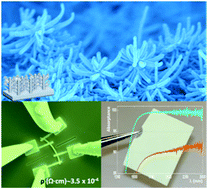
The eventual exploitation of one-dimensional nanomaterials needs the development of scalable, high yield, homogeneous and environmentally friendly methods capable of meeting the requirements for fabrication of functional nanomaterials with properties on demand. In this article, we demonstrate a vacuum and plasma one-reactor approach for the synthesis of fundamental common elements in solar energy and optoelectronics,…