Nitrogen plasma functionalization of low density polyethylene

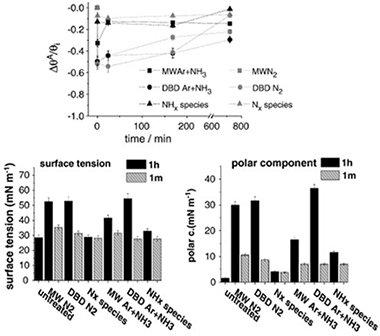
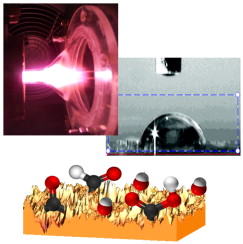
Low density polyethylene (LDPE) films have been treated with different nitrogen containing plasmas with the purpose of incorporating nitrogen functional groups on its surface and analyzing the changes experienced in their surface tension. Effects of a dielectric barrier discharge (DBD) at atmospheric pressure and a microwave discharge (MW) at reduced pressure are compared with those…

Transparent Nanometric Organic Luminescent Films as UV-Active Components in Photonic Structures

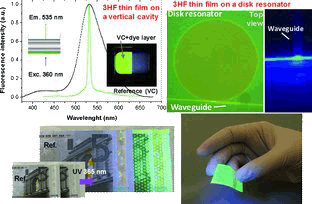
A new kind of visible-blind organic thin-film material, consisting of a polymeric matrix with a high concentration of embedded 3-hydroxyflavone (3HF) dye molecules, that absorbs UV light and emits green light is presented. The thin films can be grown on sensitive substrates, including flexible polymers and paper. Their suitability as photonic active components photonic devices…

Láminas delgadas porosas funcionales y nanoestructuras 1D soportadas de óxidos para el desarrollo de microfluídica en lámina delgada, válvulas fotónicas y micro plasmas (POROUSFILMS)

En este proyecto se prepararán láminas delgadas de TiO2, ZnO, SiO2 y SnO2 dopado, así como nanostructruras de fibras soportadas de estos óxidos mediante deposition por plasma y por evaporación a ángulo rasante (GLAD). Se controlará la nano- y micro-estructura de las capas y fibras mediante la selección de las condiciones adecuadas de deposición usando…

Síntesis mediante plasma CVD de nuevos materiales orgánicos nanoestructurados integrado en dispositivos planares para aplicaciones como sensores fotónicos y de marcaje de seguridad NANOPLASMA

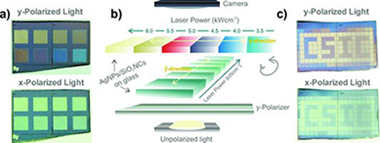
En NANOPLASMA se propone el desarrollo de nuevas técnicas basadas en plasmas para la síntesis y procesado de nuevos materiales funcionales orgánicos. La tecnología de plasma para síntesis de materiales actualmente en uso, como el CVD activado por plasma (PECVD) o los procesos de polimerización por plasma, implica siempre la fragmentación completa de un precursor…

Enhanced photoactivity in bilayer films with buried rutile-anatase heterojunctions

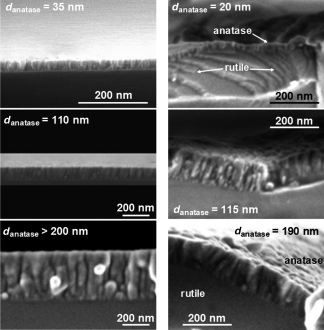
Herein, we study the photoactivity of anatase–rutile bilayer thin films consisting of an anatase overlayer of variable thickness from some tenths to some hundred nanometers deposited onto a rutile thin film. As references single anatase layers of equivalent thickness were deposited onto silicon. All the films were characterized by X-ray diffraction (XRD), scanning electron microscopy…

Enhanced photoactivity in bilayer films with buried rutile-anatase heterojunctions

Herein, we study the photoactivity of anatase–rutile bilayer thin films consisting of an anatase overlayer of variable thickness from some tenths to some hundred nanometers deposited onto a rutile thin film. As references single anatase layers of equivalent thickness were deposited onto silicon. All the films were characterized by X-ray diffraction (XRD), scanning electron microscopy…

Band Gap Narrowing versus Formation of Electronic States in the Gap in N-TiO2 Thin Films

N-containing TiO2 thin films with different amounts of nitrogen have been prepared by plasma enhanced chemical vapor deposition (PECVD) by using different titanium precursors without (titanium isopropoxide, TTIP) and with (tetrakis diethylamino titanium, TDEAT and tetrakis dimethylamino titanium, TDMAT) nitrogen in their structures and different N-2/O-2 ratios as plasma gas. For low/high content of nitrogen,…