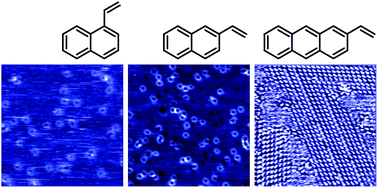
Self-assembly at room temperature of thermally stable discrete and extended oligomers of polycyclic aromatics on Ag(100): induced dipoles and cooperative effects

Thermally stable nanoarchitectures are realized on the Ag(100) surface by self-assembly of asymmetrically substituted arenes. The process is instigated by adsorption-induced molecule → surface charge transfer that gives rise to in-plane dipole moments. Observation and calculation indicate that cooperative interactions further enhance the stability of these polarizable systems.

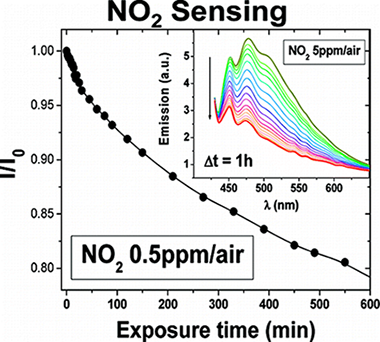
Plasma deposition of perylene-adamantane nanocomposite thin films for NO 2 room-temperature optical sensing

This work reports the preparation, by a new remote assisted plasma deposition process, of luminescent nanocomposite thin films consisting of an insoluble organic matrix where photonically active perylene molecules are embedded. The films are obtained by the remote plasma deposition of adamantane and perylene precursor molecules. The results show that the adamantane precursor is very…

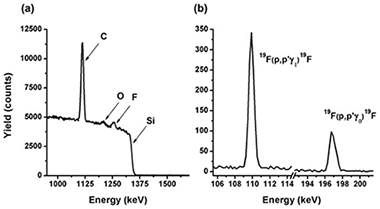
Quantification of low levels of fluorine content in thin films

Fluorine quantification in thin film samples containing different amounts of fluorine atoms was accomplished by combining proton-Rutherford Backscattering Spectrometry (p-RBS) and proton induced gamma-ray emission (PIGE) using proton beams of 1550 and 2330 keV for p-RBS and PIGE measurements, respectively. The capabilities of the proposed quantification method are illustrated with examples of the analysis of…

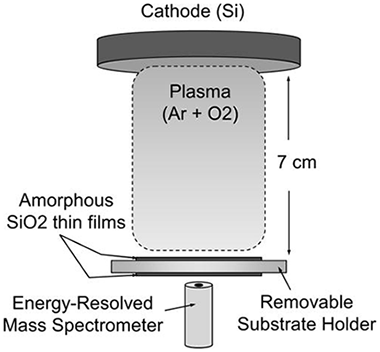
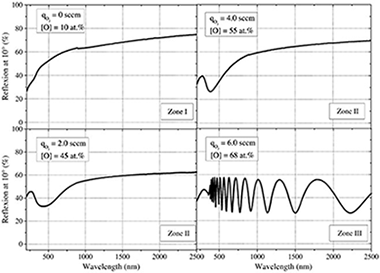
Influence of plasma-generated negative oxygen ion impingement on magnetron sputtered amorphous SiO2 thin films during growth at low temperatures

Growth of amorphous SiO2 thin films deposited by reactive magnetron sputtering at low temperatures has been studied under different oxygen partial pressure conditions. Film microstructures varied from coalescent vertical column-like to homogeneous compact microstructures, possessing all similar refractive indexes. A discussion on the process responsible for the different microstructures is carried out focusing on the…

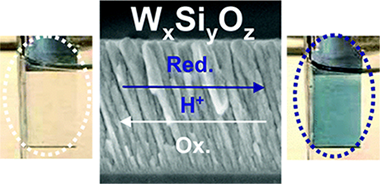
Electrochromic Behavior of WxSiyOz Thin Films Prepared by Reactive Magnetron Sputtering at Normal and Glancing Angles

This work reports the synthesis at room temperature of transparent and colored WxSiyOz thin films by magnetron sputtering (MS) from a single cathode. The films were characterized by a large set of techniques including X-ray photoelectron spectroscopy (XPS), Rutherford backscattering spectrometry (RBS), Fourier transform infrared (FT-IR), and Raman spectroscopies. Their optical properties were determined by…

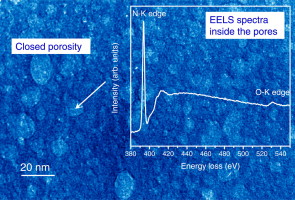
Magnetron sputtered a-SiO xN y thin films: A closed porous nanostructure with controlled optical and mechanical properties

Amorphous silicon oxynitride coatings with similar composition and different closed porosity were prepared by magnetron sputtering. Pores size, shape and distribution were evaluated by scanning electron microscopy and transmission electron microscopy. Raman and EELS analysis proved that the pores are filled with molecular nitrogen trapped during deposition. The mechanical properties evaluated by nanoindentation shows that…

Analysis of multifunctional titanium oxycarbide films as a function of oxygen addition

Reactive magnetron sputtering was used to deposit titanium oxycarbide thin films. The overall set of results showed that the oxygen flow rate, and thus the composition of the atmosphere in the deposition chamber, controls the composition of the titanium oxycarbide thin films obtained by reactive sputtering. Rutherford Backscattering Spectroscopy analysis revealed the existence of three…

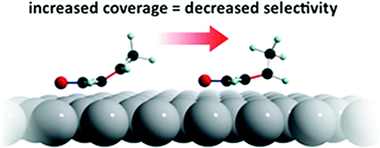
Adsorption Geometry Determines Catalytic Selectivity in Highly Chemoselective Hydrogenation of Crotonaldehyde on Ag(111)

The chemoselective hydrogenation of crotonaldehyde to crotyl alcohol was studied by temperature-programmed desorption/reaction, high-resolution XPS, and NEXAFS. The organic molecule adsorbed without decomposition, all three possible hydrogenation products were formed and desorbed, and the clean overall reaction led to no carbon deposition. Selectivities up to 95% were found under TPR conditions. The observed behavior corresponded…

Soft plasma processing of organic nanowires: a route for the fabrication of 1D organic heterostructures and the template synthesis of inorganic 1D nanostructures

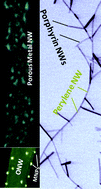
Hierarchical (branched) and hybrid metal-NPs/organic supported NWs are fabricated through controlled plasma processing of metalloporphyrin, metallophthalocyanine and perylene nanowires. The procedure is also applied for the development of a general template route for the synthesis of supported metal and metal oxide nanowires.