Improved strain engineering of 2D materials by adamantane plasma polymer encapsulation

Two-dimensional materials present exceptional crystal elasticity and provide an ideal platform to tune electrical and optical properties through the application of strain. Here we extend recent research on strain engineering in monolayer molybdenum disulfide using an adamantane plasma polymer pinning layer to achieve unprecedented crystal strains of 2.8%. Using micro-reflectance spectroscopy, we report maximum strain…

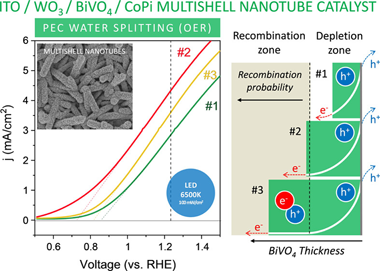
Photoelectrochemical Water Splitting with ITO/WO3/BiVO4/CoPi Multishell Nanotubes Enabled by a Vacuum and Plasma Soft- Template Synthesis

A common approach for the photoelectrochemical (PEC) splitting of water relies on the application of WO3 porous electrodes sensitized with BiVO4 acting as a visible photoanode semiconductor. In this work, we propose a new architecture of photoelectrodes consisting of supported multishell nanotubes (NTs) fabricated by a soft-template approach. These NTs are formed by a concentric…

A Holistic Solution to Icing by Acoustic Waves: De-Icing, Active Anti-Icing, Sensing with Piezoelectric Crystals, and Synergy with Thin Film Passive Anti-Icing Solutions

Icing has become a hot topic both in academia and in the industry given its implications in transport, wind turbines, photovoltaics, and telecommunications. Recently proposed de-icing solutions involving the propagation of acoustic waves (AWs) at suitable substrates may open the path for a sustainable alternative to standard de-icing or anti-icing procedures. Herein, the fundamental interactions…

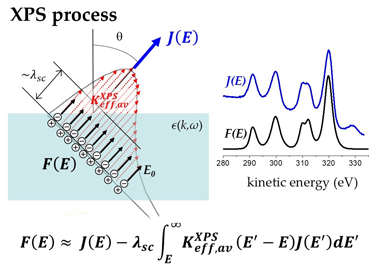
Determination of the Primary Excitation Spectra in XPS and AES

This paper reviews a procedure that allows for extracting primary photoelectron or Auger electron emissions from homogeneous isotropic samples. It is based on a quantitative dielectric description of the energy losses of swift electrons travelling nearby surfaces in presence of stationary positive charges. The theory behind the modeling of the electron energy losses, implemented in…

Desarrollo de plasmas intermitentes operados con electricidad renovable para la eliminación y revalorización de CO2

La emisión de CO2 representa actualmente un 77% de las emisiones totales de gases de efecto invernadero con origen antropogénico, propiciando un aumento paulatino del calentamiento global del planeta con las consecuentes y nefastas repercusiones medioambientales que ello supone. Por tanto, es indudable la necesidad de propiciar una transición hacia una economía donde el uso…

Nanogeneradores triboeléctricos para la recolección de energía renovable de gotas de lluvia

DropEner tiene como objetivo el desarrollo de paneles de lluvia, es decir, recolectores de energía proveniente de gotas que, basados en el principio del nanogenerador triboeléctrico (TENG), funcionan en condiciones exteriores y pueden fabricarse a través de tecnologías escalables y de alto rendimiento. El proyecto demostrará la aplicación de un concepto innovador patentado recientemente por…

Design and Characterization of ITO-Covered Resonant Nanopillars for Dual Optical and Electrochemical Sensing

In this work we present a dual optical and electrochemical sensor based on SiO2/Si3N4 resonant nanopillars covered with an indium tin oxide (ITO) thin film. A 25-30 nm thick ITO layer deposited by magnetron sputtering acts as an electrode when incorporated onto the nanostructured array, without compromising the optical sensing capability of the nanopillars. Bulk…

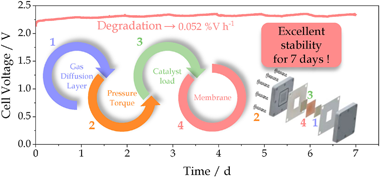
Optimization of anion exchange membrane water electrolyzers using ionomer-free electrodes

This work is carried out in the context of the anion exchange membrane water electrolysis (AEMWE) and pursuits to determine the influence of different cell components on the global electrochemical performance. Ionomer-free electrodes consisting of anodic Ni-Fe and cathodic Ni electrocatalysts deposited by magnetron sputtering in an oblique angle deposition configuration were utilized for this study. In addition to the characteristics and equivalent thickness of the electrocatalysts, other factors affecting the…

One-Dimensional Photonic Crystal for Surface Mode Polarization Control

Bloch surface waves sustained by truncated 1D photonic crystals (1DPCs) are well known tools for surface-enhanced spectroscopy. They provide strongly confined fields with uniform distribution over a large surface area, a characteristic exploited in standard refractometric sensing. However, their application to polarization-sensitive investigations is not straightforward because the transverse electric (TE) and magnetic (TM) surface…