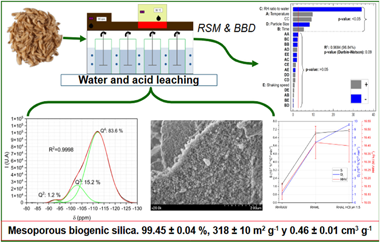
Comprehensive understanding of the experimental factors determining the leaching of rice husk, and their effect on the thermochemical properties and characteristics of bio-silica

Leaching is a pretreatment that removes ionic species responsible for undesired reactions during biomass thermochemical transformation. Despite numerous reported leaching conditions, the impact of specific factors on ionic species removal remains insufficiently understood for widespread application. This study investigates the relationship between experimental factors and their optimal levels in aqueous medium, focusing on the effects…

An efficient strategy for simultaneous gold deposition and obtention of hierarchical Au/TS-1 applied to liquid-phase propylene epoxidation

A novel and straightforward one-step method has been developed for the controlled deposition of gold nanoparticles (AuNPs) with uniform diameters onto the titanosilicate (TS-1) zeolitic surface via a direct anionic exchange (DAE) approach. This innovative process simultaneously introduces auxiliary mesoporosity into the zeolite framework, overcoming critical limitations associated with traditional microporous catalysts, including diffusion constraints…

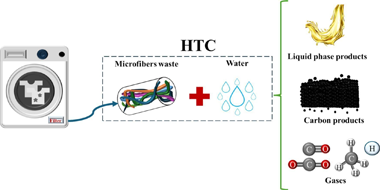
Upcycling textile derived microplastics waste collected from washer and dryers to carbonaceous products using hydrothermal carbonization

Microplastics are an emerging pollutant of concern. Many microplastics in the waters arise from washing synthetic textiles in residential and commercial washing machines. The present research evaluated the upcycling of this waste to carbon materials by hydrothermal carbonization. Real microfiber waste was collected using clothes washer and dryer microfilters. Via temperature and residence time screening…

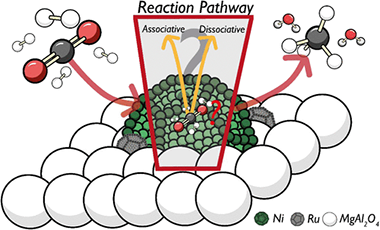
Exploring the Synergistic Interaction between Nickel- and Ruthenium-Based Catalysts for Carbon Dioxide Methanation Reaction

The utilization of nickel-ruthenium as bimetallic catalysts is widely recognized for its efficacy in enhancing the catalytic performance in the carbon dioxide methanation reaction. The present study focuses on the synergistic interplay between both active sites and their respective roles in the reaction mechanism through operando DRIFT-MS analysis. Findings reveal that the bimetallic catalyst is…

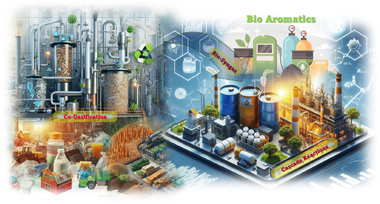
Bio-aromatics: Revolutionizing the integrated biomass and plastic waste valorization for high-value aromatic hydrocarbons via bifunctional catalytic pathways of bio-syngas conversion

Aromatic hydrocarbons play a pivotal role in various industrial applications, serving as essential building blocks to produce polymers, resins, and specialty chemicals. Traditionally, their synthesis has been reliant on fossil fuels, raising concerns about environmental sustainability and resource depletion. However, recent advancements in the field have paved the way for a paradigm shift, with a…

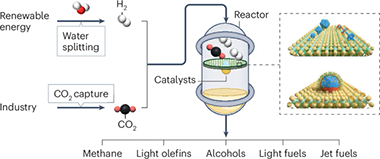
Design of catalysts for selective CO2 hydrogenation

CO2 hydrogenation with green hydrogen is a practical approach for the reduction of CO2 emissions and the generation of high-value-added chemicals. Generally, product selectivity is affected by the associated reaction mechanisms, internal catalyst identity and structure, and external reaction conditions. Here we examine typical CO2 hydrogenation reaction pathways, which can provide insight useful for the atomic-level design of…

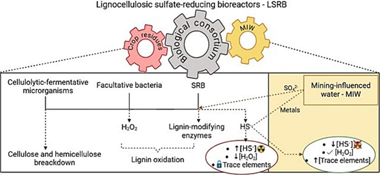
Unlocking the anaerobic conversion of crop residues: Biological pretreatments and the role of sulfide pathway in lignin degradation

Research on the reutilization of crop residues has gained significant attention as a strategy for generating energy and high-value chemicals from renewable sources, while simultaneously reducing feedstock costs and mitigating environmental pollution. Crop residues have been effectively applied in lignocellulosic sulfate-reducing bioreactors (LSRBs) for the treatment of mining-influenced water. A comprehensive evaluation of the state-of-the-art…

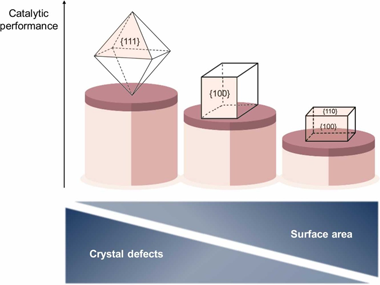
Exploring the impact of nanoshaped ceria in the methanol decomposition reaction pathway for clean energy production

The effect of facet exposure in ceria nanostructures on the catalytic properties of Pd/CeO2 during methanol decomposition was investigated. The results showed the structure sensitive nature of this reaction, with the catalytic activity depending on the facet exposed in the ceria nanostructures. Operando DRIFTS-MS and DFT calculations demonstrated that methanol decomposition proceeds mainly via two…

Síntesis de biocombustibles avanzados mediante estrategias CCU (Carbon Capture Utilization), combinando nuevos sistemas catalíticos con microrreactores fabricados por impresión 3D (BioCASs-CCU)

BioCAs-CCU es un proyecto de colaboración público-privada cuyo objetivo general es diseñar, desarrollar e implementar una tecnología circular de síntesis de biocombustibles avanzados (SAF y e-Diesel), a partir de CO2 capturado y biomasa residual, basada en la combinación de un sistema de gasificación con un sistema catalítico de un solo paso, empleando para la síntesis,…