Elucidation of Water Promoter Effect of Proton Conductor in WGS Reaction over Pt-Based Catalyst: An Operando DRIFTS Study

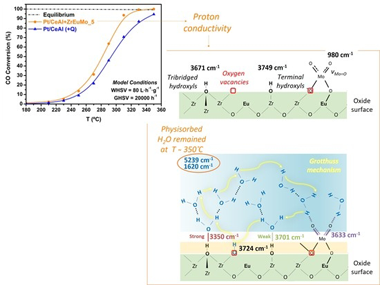
A conventional Pt/CeO2/Al(2)O(3)catalyst physically mixed with an ionic conductor (Mo- or Eu-doped ZrO2) was tested at high space velocity (20,000 h(-1)and 80 L h(-1)g(cat)(-1)) under model conditions (only with CO and H2O) and industrial conditions, with a realistic feed. The promoted system with the ionic conductor physically mixed showed better catalytic activity associated with better…

Evaluation of the Oxygen Mobility in CePO4-Supported Catalysts: Mechanistic Implications on the Water-Gas Shift Reaction

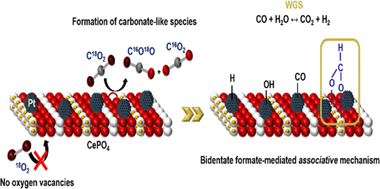
The hexagonal and monoclinic phases of CePO4 have been demonstrated to be excellent catalytic supports for Pt-based water-gas shift (WGS) catalysts. Consequently, the elucidation of the WGS reaction mechanism in these materials constitutes a fundamental aspect in order to explain their catalytic behavior. Because the observed WGS reaction path is closely related to the absence…

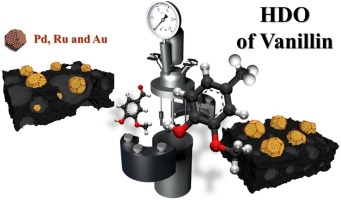
Hydrodeoxygenation of vanillin over noble metal catalyst supported on biochars: Part II: Catalytic behaviour

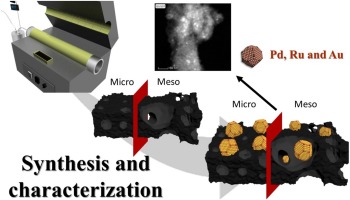
Vanillin hydrodeoxygenation was investigated using noble metal (Pd, Au, Ru) supported on active carbon prepared from waste derived biochars, which were produced via pyrolysis in CO2 atmosphere. Chemical activation with ZnCl2 and HNO3 was also used in the preparation of active carbon to enhance the specific surface area and demineralize material, respectively. Both fresh and…

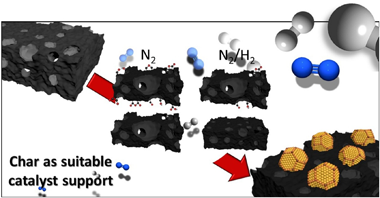
Reductant atmospheres during slow pyrolysis of cellulose: First approach to obtaining efficient char -based catalysts in one pot

Char based metallic (Pd-Au-Ru-Pt/C) catalysts have drawn increasing research interest due to their versatility in biomass related industrial reactions. Recent studies dealing with the synthesis of char-based catalysts in one single step (one-pot) use reductant atmospheres for biomass pyrolysis. In this work, the influence of the use of a reductant N2/H2 atmosphere on the physicochemical…

Cost-effective routes for catalytic biomass upgrading

Catalytic hydrodeoxygenation (HDO) is a fundamental and promising route for bio-oil upgrading to produce petroleum-like hydrocarbon fuels or chemical building blocks. One of the main challenges of this technology is the demand of high-pressure H-2, which poses high costs and safety concerns. Accordingly, developing cost-effective routes for biomass or bio-oil upgrading without the supply of…

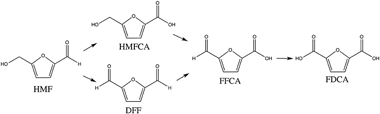
5-Hydroxymethyl-2-Furfural Oxidation Over Au/Ce(x)Zr(1-x)O(2)Catalysts

A series of gold catalysts supported on pure CeO2, ZrO2, and two different Ce-Zr mixed oxides have been prepared and tested in the 5-hydroxymethyl-2-furfural oxidation reaction. All catalysts show high catalytic activity (100% conversion) and important selectivity (27-41%) to the desired product i.e., 2,5-furandicarboxylic acid at low base concentration. Products selectivity changes with the support…

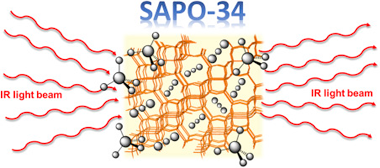
Time-resolved operando DRIFTS-MS study of the moisture tolerance of small-pore SAPO-34 molecular sieves during CH4/CO2 separation

This study pretends to evaluate and understand the effect of moisture presence during CO2/CH4 separation on small-pore SAPO-34 molecular sieves. Two SAPO-34 samples with different physicochemical properties (composition, crystal size and texture) were prepared by hydrothermal synthesis using either one or a mixture of two templates. Transient operando DRIFTS-MS measurements revealed that the sample’s hydrophobic…

Potentialization of bentonite properties as support in acid catalysts

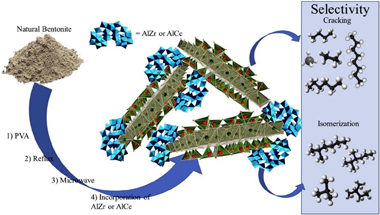
Enhancement of the main physicochemical properties of a natural bentonite was carried out by means of modifications using surfactant, reflux, microwave treatment and, subsequently, the incorporation of AlZr and AlCe species. The evolution of the main changes in each modification stage was evaluated by means of X-ray diffraction, N-2 sortometry, scanning microscopy (SEM), NH3-TPD, NH3-DRIFTS…