


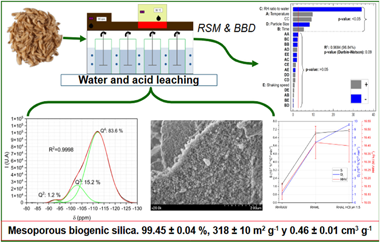
Leaching is a pretreatment that removes ionic species responsible for undesired reactions during biomass thermochemical transformation. Despite numerous reported leaching conditions, the impact of specific factors on ionic species removal remains insufficiently understood for widespread application. This study investigates the relationship between experimental factors and their optimal levels in aqueous medium, focusing on the effects of pH and acid type on rice husk and bio-silica’s physicochemical and thermochemical properties. Optimal leaching conditions were identified as HCl at pH 1.5, 70 degrees C, 150 min, 1 g rice husk per 80 g H2O, and 30 rpm, yielding biosilica with 99.45 +/- 0.04 % purity, a surface area of 318 +/- 10 m2 g-1, and a pore volume of 0.46 +/- 0.01 cm3 g-1. Leaching enhances devolatilization during thermal decomposition but inhibits biochar oxidation. 29Si NMR analysis revealed 16.4 % Q3 and Q2 silanol groups in the bio-silica, while SEM-EDX confirmed its high purity and porosity. These results offer key insights into improving leaching methods, helping to produce better-quality biosilica, and supporting its use in eco-friendly industrial applications.