


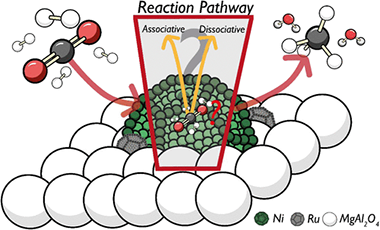
The utilization of nickel-ruthenium as bimetallic catalysts is widely recognized for its efficacy in enhancing the catalytic performance in the carbon dioxide methanation reaction. The present study focuses on the synergistic interplay between both active sites and their respective roles in the reaction mechanism through operando DRIFT-MS analysis. Findings reveal that the bimetallic catalyst is constituted by NiRu nanocrystallites with Ru atoms segregated at defect edge/corner sites, promoting the dissociation of carbon dioxide and the formation of CH x species. Furthermore, Ni atoms predominantly occupy facets or terrace sites, characterized by higher electron density conducive to carbon monoxide hydrogenation to methane. This research offers a comprehensive elucidation of the carbon dioxide methanation mechanism within a bimetallic system and underscores the efficacy of the operando methodology in advancing our fundamental understanding of heterogeneous catalysis.