Zr and Fe on Pt/CeO2-MOx/Al2O3 catalysts for WGS reaction

By evaluating the functional modifications induced by Zr and Fe as dopants in Pt/CeO2‐MOx/Al2O3 catalysts (M = Fe and Zr), the key features for improving water gas shift (WGS) performance for these systems have been addressed. Pt/ceria intrinsic WGS activity is often related to improved H2 surface dynamics, H2O absorption, retentions and dissociation capacities which are influenced…

Functionalized biochars as supports for Pd/C catalysts for efficient hydrogen production from formic acid

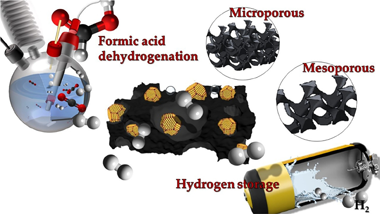
Biomass waste product was used to generate biochars as catalytic supports for selective hydrogen production from formic acid. The supports were obtained after pyrolysis in CO2 atmosphere of non-pretreated and che-mically ZnCl2 activated raw materials (vine shoot and crystalline cellulose). The support series includes materials with different textural properties and surface chemistry. The support nature…

Guaiacol hydrodeoxygenation in hydrothermal conditions using N-doped reduced graphene oxide (RGO) supported Pt and Ni catalysts: Seeking for economically viable biomass upgrading alternatives

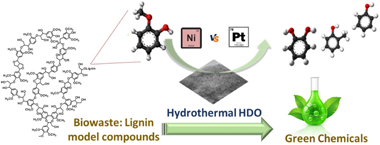
Herein we present an innovative route for model biomass compounds upgrading via “H2-free” hydrodeoxygenation (HDO) reactions. The underlaying idea is to implement a multifunctional catalyst able to activate water and subsequently use in-situ generated hydrogen for the HDO process. In this sense we have developed a series of effective Ni and Pt based catalysts supported on N-promoted…

Ru-Ni/MgAl2O4 structured catalyst for CO2 methanation

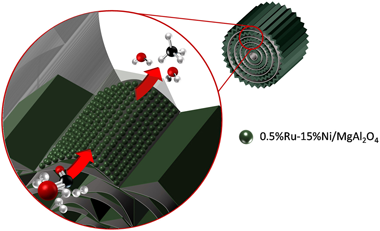
Novel catalytic systems should be tested for the valorization of CO2 through the Sabatier reaction, since this process is gaining great importance within strategic sectors of the chemical industry. Therefore, this work explores the feasibility of structuring a catalyst (0.5%Ru-15%Ni/MgAl2O4) for CO2 methanation using metal micromonoliths. The coating of the catalyst over the surface of…

Flexible syngas production using a La2Zr2-xNixO7-delta pyrochlore-double perovskite catalyst: Towards a direct route for gas phase CO2 recycling

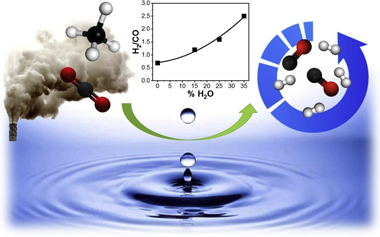
The bi-reforming of methane (BRM) has the advantage of utilising greenhouse gases and producing H2 rich syngas. In this work Ni stabilised in a pyrochlore-double perovskite structure is reported as a viable catalyst for both Dry Reforming of Methane (DRM) and BRM. A 10 wt.% Ni-doped La2Zr2O7 pyrochlore catalyst was synthesised, characterised and tested under both reaction conditions…

Conversión Avanzada de Biogas a Ácido Acético: Soluciones Catalíticas para una Sociedad con Bajas Emisiones de Carbono

En ADVENTURE se presenta un nuevo concepto para convertir biogás, procedente de desechos orgánicos, en productos químicos de alto valor industrial, como es el ácido acético (AA), de una manera tanto amigable con el medio ambiente como viable económicamente. El AA se emplea como precursor de muchos productos procedentes de la química fina, con numerosas…

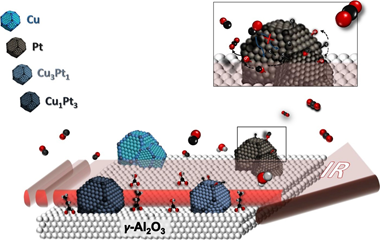
Upgrading the PtCu intermetallic compounds: The role of Pt and Cu in the alloy

This work is devoted to the study of the role of both metals in the intermetallic PtxCuy/ γ Al2O3 catalysts commonly employed in CO-PROX reaction. Therefore, monometallic Pt and Cu based catalysts and PtCu intermetallic compound with different molar ratios (Pt3Cu1 and Pt1Cu3) supported catalysts were carefully synthesized and deeply characterized. Room temperature CO adsorptions by FTIR spectroscopy were…

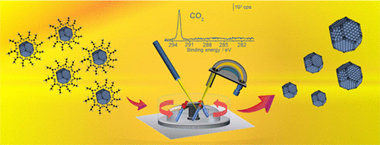
Free-Carbon Surface for PtCu Nanoparticles: An In Situ Near Ambient Pressure X-ray Photoelectron Spectroscopy Study

Usually, nanoparticle synthesis methodologies require the use of organic molecules (capping agent, solvent molecules, etc.), which results in carbon deposits on the nanoparticle surface. These residues modify the surface properties mainly affecting the catalytic behavior. In this work, unsupported poly(vinylpyrrolidone) (PVP)-stabilized PtCu (1:3 molar ratio) bimetallic alloy nanoparticles were synthetized and characterized. An alternative surface…

Bimetallic PdAu catalysts for formic acid dehydrogenation

A series of monometallic and bimetallic palladium gold catalyst were prepared and studied for the formic acid dehydrogenation reaction. Different Pd/Au compositions were employed (PdxAu100-x, where x = 25; 50 and 75) and their impact on alloy structure, particle size and dispersion was evaluated. Active phase composition and reaction parameters such as temperature, formic acid…