Integración de NH3 verde en tecnologías de valorización de CO2 para la producción de amidas

En la actualidad, los procesos industriales para el desarrollo de amidas presentan importantes inconvenientes como la generación de cantidades estequiométricas de residuos costosos y tóxicos, la difícil purificación del producto y escalas de operación relativamente pequeñas. Así, se han dirigido esfuerzos sustanciales hacia la creación de rutas más sostenibles y atómicamente eficientes. Ejemplos exitosos de…

Producción de hidrógeno y gas de síntesis de composición ajustable a partir de corrientes de fermentación etanólica y biocarbones (HySynChar)

El presente proyecto forma parte del proyecto coordinado HySynChar, que pretende desarrollar una estrategia novedosa para la integración de un conjunto de reacciones y procesos basados en tecnologías catalíticas y de gasificación para la producción de vectores de energía o productos de alto valor añadido (hidrógeno y compuestos oxigenados, particularmente acetaldehído, ácido fórmico y ácido…

Oxygen vacancy-dependent low-temperature performance of Ni/CeO2 in CO2 methanation

The transformative power of CO2 methanation can efficiently transform greenhouse gases into high-value products, aligning with the carbon neutrality goals. However, achieving this target at low temperature requires cumbersome efforts in designing catalysts that possess high reactivity and selectivity. Focusing on understanding the pivotal role of alkaline (such as Ca) sites in catalyzing these reactions…

Reactive Surface Explored by NAP-XPS: Why Ionic Conductors Are Promoters for Water Gas Shift Reaction

Near-ambient pressure X-ray photoelectron spectroscopy (NAP-XPS) experiments have been carried out in N-2 and N-2-H2O atmospheres on a Pt-based catalyst physically mixed with an Eu-doped ZrO2 ionic conductor as a function of temperature under realistic conditions of the water gas shift (WGS) reaction. This work aims to demonstrate the significant effect of having active H2O…

FGD-Gypsum Waste to Capture CO2 and to Recycle in Building Materials: Optimal Reaction Yield and Preliminary Mechanical Properties

The use of waste to capture CO2 has been on the rise, to reduce costs and to improve the environmental footprint. Here, a flue gas desulfurization (FGD) gypsum waste is proposed, which allows us to obtain a CaCO3-based solid, which should be recycled. The CO2 capture stage has primarily been carried out via the direct carbonation method…

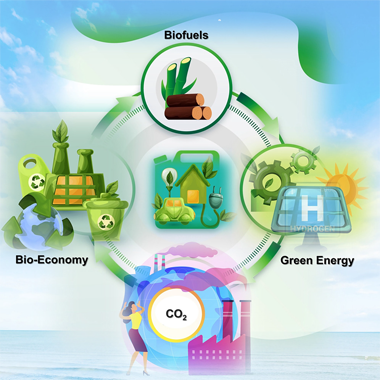
Integrating catalytic tandem reactions for the next of biofuels: A perspective

In this piece, we explore the transformative potential of sustainable biofuel production as a solution to the energy crisis and a pivotal element in realizing the environmental and societal ambitions of Society 5.0. Through a critical examination of «bottom-up»and «topdown»strategies for converting bio-feedstocks sourced from anthropogenic activities into renewable fuels, the work underscores the need…

An efficient pressure sensor based on environmental-friendly CNTs-graphene-PDMS film

Given the rapid advancements in artificial intelligence, there is an escalating demand for wearable sensors. An efficient graphene-based material synthesized from the mesophase pitch of waste slurry oil was integrated into a cost-effective piezoresistive pressure sensor consisting of a conductive film made of carbon nanotubes (CNTs), graphene, and Polydimethylsiloxane (PDMS). A simple fabrication approach has…

Finely Tunable Carbon Nanofiber Catalysts for the Efficient Production of HMF in Biphasic MIBK/H2O Systems

This work proposes catalytic systems for fructose dehydration to 5-hydroxymethylfurfural using a series of functionalized carbon nanofibers. The catalysts were synthesized via finely selected covalent grafting in order to include a variety of functionalities like pure Bronsted acid, tandem Br & oslash;nsted/Lewis acid, and tandem Lewis acid/Lewis base catalysts. After the characterization and evaluation of…

V2O5/TiO2 Catalyst for Catalytic Glucose Oxidation to Formic Acid in Batch Reactor: Vanadium Species Nature and Reaction Conditions Optimization

  This study focused on the development of vanadium-based catalysts for formic acid production from glucose. The influence of different vanadium precursors on the catalytic activity of titania supported catalysts was contemplated and compared to the performance of commercial and synthesized unsupported V2O5. The obtained results reveal a successful deposition of multiple vanadium species on…