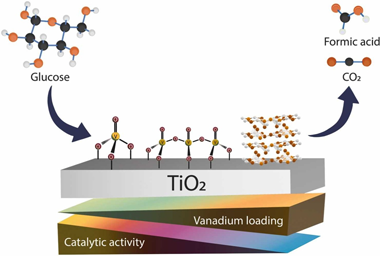
Influence of vanadium species on the catalytic oxidation of glucose for formic acid production

VOx/TiO2 catalysts with various theorical monolayer values have been prepared and used to study, for the first time, the effect of vanadium loading in the selective oxidation of glucose to formic acid. Monomeric or isolated vanadia species dominate at low loadings, evolving into polymeric chains at higher concentrations, while crystalline V2O5 is observed at loadings over the…

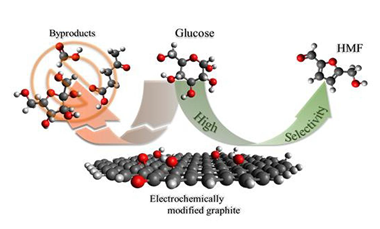
Electrochemical tailoring of graphite properties for tunable catalytic selectivity of glucose conversion to 5-hydroxymethylfurfural

This study presents a novel approach for boosting the selectivity of 5-hydroxymethylfurfural (HMF) production from glucose through electrochemical modification of graphite materials. Three distinct graphitic substrates were subjected to controlled electrochemical treatments utilizing sodium sulfate or phosphoric acid as electrolytes. The process expanded the graphite particles/pieces and introduced oxygenated functional groups to the exposed surfaces…

Effect of Na/Ca Adsorbents on NiRu-DFM Performance for Integrated CO2 Capture and Hydrogenation

  Integrated carbon dioxide capture and utilization (ICCU) technology is being developed to address the challenge of increasing atmospheric CO2 levels. Dual function materials (DFMs) are designed with catalytic and adsorbent components that enable the capture and utilization of CO2 within a single reactor. In this investigation, we systematically evaluated the performance of NiRu-DFMs incorporating…

Impact of the biogas impurities on the quality of the precipitated calcium carbonate in the regenaration stage of a chemical absorption biogas upgrading unit

Combining Carbon Capture and Storage (CCS) with producing competitive secondary raw materials is key to decarbonizing industry and reducing resource extraction. Biogas upgrading to biomethane stand out as an alternative, but a significant gap remains in integrating this process within a circular economy framework. This issue has been recently addressed by a process that integrates…

A Circular Economy Perspective: Recycling Wastes through the CO2 Capture Process in Gypsum Products. Fire Resistance, Mechanical Properties, and Life Cycle Analysis

In recent years, the implementation of CO2 capture systems has increased. To reduce the costs and the footprint of the processes, different industrial wastes are successfully proposed for CO2 capture, such as gypsum from desulfurization units. This gypsum undergoes an aqueous carbonation process for CO2 capture, producing an added-value solid material that can be valorized.…

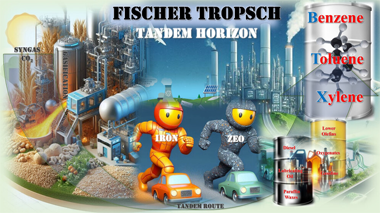
Redefining the Symphony of Light Aromatic Synthesis Beyond Fossil Fuels: A Journey Navigating through a Fe-Based/HZSM-5 Tandem Route for Syngas Conversion

The escalating concerns about traditional reliance on fossil fuels and environmental issues associated with their exploitation have spurred efforts to explore eco-friendly alternative processes. Since then, in an era where the imperative for renewable practices is paramount, the aromatic synthesis industry has embarked on a journey to diversify its feedstock portfolio, offering a transformative pathway…

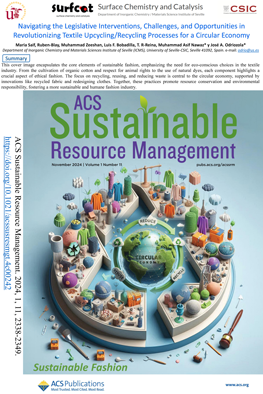
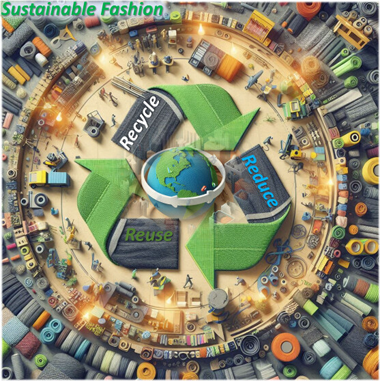
Navigating the Legislative Interventions, Challenges, and Opportunities in Revolutionizing Textile Upcycling/Recycling Processes for a Circular Economy

Embracing a circular economy in the textile industry represents a crucial step toward sustainability, where fashion and textile sectors contribute significantly to CO2 emissions. However, transitioning from a linear “take-make-waste” model to circularity, poses multifaceted challenges, that highlight the staggering volume of annual textile waste surpassing industry predictions, thus emphasizing the urgent need for comprehensive strategies.…