Lanthanide vanadate-based trimodal probes for near-infrared luminescent bioimaging, high-field magnetic resonance imaging, and X-ray computed tomography

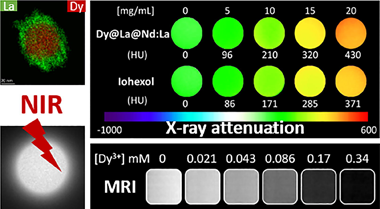
We have developed a trimodal bioimaging probe for near-infrared luminescent imaging, high-field magnetic resonance imaging, and X-ray computed tomography using Dy3+ as the paramagnetic component and Nd3+ as the luminescent cation, both of them incorporated in a vanadate matrix. Among different essayed architectures (single phase and core-shell nanoparticles) the one showing the best luminescent properties is that consisting of uniform DyVO4 nanoparticles coated with a first uniform layer of LaVO4 and a second layer…

Effect of Alkaline Salts on Pyrolyzed Solid Wastes in Used Edible Oils: An Attenuated Total Reflectance Analysis of Surface Compounds as a Function of the Temperature

Biochars obtained via the pyrolysis of biomass are very attractive materials from the point of view of their applications and play key roles in the current energy context. The characterization of these carbonaceous materials is crucial to determine their field of application. In this work, the pyrolysis of a non-conventional biomass (solid wastes in used…

Preparation, characterization and activation of Pd catalysts supported on CNx foam for the liquid phase decomposition of formic acid

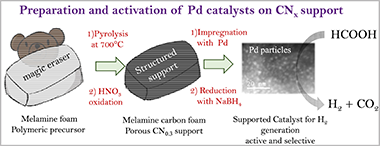
In this work, we have prepared a series of Pd catalysts on a CNx support for the liquid phase decomposition of formic acid. The structured CNx support was obtained through thermal pyrolysis of melamine foam and the pyrolysis conditions were optimized to achieve high surface area. The resulting support contains high amount of nitrogen with…

Cobalt Stabilization through Mesopore Confinement on TiO2 Support for Fischer-Tropsch Reaction

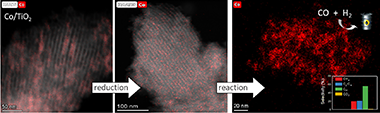
Cobalt supported on mesostructured TiO2 catalysts has been prepared by a wet-impregnation method. The Co/TiO2 catalytic system showed better catalytic performance after support calcination at 380 °C. Co nanoparticles appeared well distributed along the mesopore channels of TiO2. After reduction pretreatment and reaction, a drastic structural change leads to mesopore structure collapse and the dispersion of the…

Germination and First Stages of Growth in Drought, Salinity, and Cold Stress Conditions of Plasma-Treated Barley Seeds

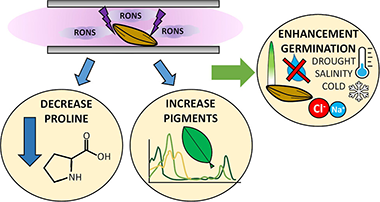
Numerous works have demonstrated that cold plasma treatments constitute an effective procedure to accelerate seed germination under nonstress conditions. Evidence also exists about a positive effect of plasmas for germination under environmental stress conditions. For barley seeds, this work studies the influence of cold plasma treatments on the germination rate and initial stages of plant…

Plasma assisted dry reforming of methane: Syngas and hydrocarbons formation mechanisms

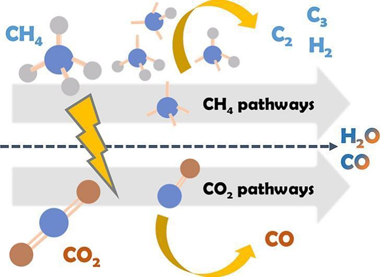
Plasma reactions of CO2 + CH4 mixtures have been proposed as a suitable process for the dry reforming of methane. Without specific catalysts, most studies report the formation of CO and H2 as main reaction products and arise the question whether CHx radicals coming from CH4 may interact with intermediate species formed by electron impact dissociation of CO2, a critical step for the formation of high added value oxygenated compounds.…

Process design and utilisation strategy for CO2 capture in flue gases. Technical assessment and preliminary economic approach for steel mills

The steel industry is the most relevant sector in emerging economies due to its application in numerous fields. However, steel manufacturing involves large energy investment and produces significant greenhouse gas emissions. The current world economic and environmental scenario therefore necessitates that improvements in the footprint of the steel industry be made without affecting its viability.…

Understanding ice and water film formation on soil particles by combining density functional theory and Casimir-Lifshitz forces

Thin films of ice and water on soil particles play crucial roles in environmental and technological processes. Understanding the fundamental physical mechanisms underlying their formation is essential for advancing scientific knowledge and engineering practices. Herein, we focus on the role of the Casimir-Lifshitz force, also referred to as dispersion force, in the formation and behavior…

Paper-based ZnO self-powered sensors and nanogenerators by plasma technology

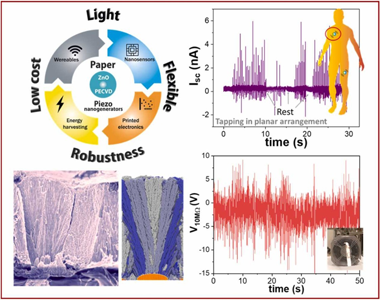
Nanogenerators and self-powered nanosensors have shown the potential to power low-consumption electronics and human-machine interfaces, but their practical implementation requires reliable, environmentally friendly and scalable processes for manufacturing and processing. Furthermore, the emerging flexible and wearable electronics technology demands direct fabrication onto innovative substrates such as paper and plastics typically incompatible with high process temperatures.…