Effect of Mo and W interlayers on microstructure and mechanical properties of Si3N4-nickel-base superalloy joints

Si3N4/nickel-base superalloy (Inconel-625) and Si3N4/Si3N4 joints with refractory metal (W and Mo) interlayers were vacuum brazed using a Ti-active braze Cu-ABA (92.75Cu-3Si-2Al-2.25Ti) at 1317 K for 30 min with the following interlayered arrangements: Si3N4/Mo/W/Inconel and Si3N4/Mo/W/Si3N4. The joints exhibited Ti segregation at the Si3N4/Cu-ABA interface, elemental interdiffusion across the joint interfaces, and sound metallurgical bonding.…

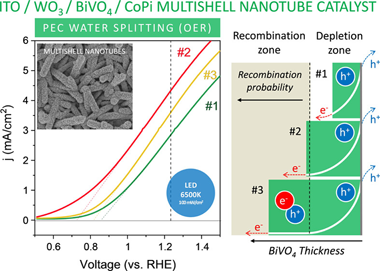
Photoelectrochemical Water Splitting with ITO/WO3/BiVO4/CoPi Multishell Nanotubes Enabled by a Vacuum and Plasma Soft- Template Synthesis

A common approach for the photoelectrochemical (PEC) splitting of water relies on the application of WO3 porous electrodes sensitized with BiVO4 acting as a visible photoanode semiconductor. In this work, we propose a new architecture of photoelectrodes consisting of supported multishell nanotubes (NTs) fabricated by a soft-template approach. These NTs are formed by a concentric…

Non-sticky interactions

Quantum mechanical fluctuations of the electromagnetic field in a vacuum between two close together objects result in an attractive force. Now, it has been experimentally shown that by exploiting a similar repulsive interaction, attraction between objects can be modulated simply by tuning temperature.

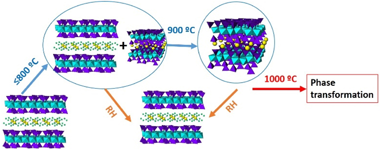
Structural, Vibrational, and Magnetic Characterization of Orthoferrite LaFeO3 Ceramic Prepared by Reaction Flash Sintering

LaFeO3 perovskite ceramics have been prepared via reaction flash technique using Fe2O3 and La2O3 as precursors. The obtained pellets have been investigated using several techniques. The formation of LaFeO3 has been clearly confirmed by X-ray diffraction. The scanning electron microscopy micrographs have shown the microporous character of the obtained pellets due to the low temperature…

Effect of L-Glutamic Acid on the Composition and Morphology of Nanostructured Calcium Phosphate as Biomaterial

Calcium phosphate (CaP) with several chemical compositions and morphologies was prepared by precipitation using aqueous solutions of L-Glutamic acid (H(2)G) and calcium hydroxide, both mixed together with an aqueous solution (0.15 M) of phosphoric acid. Plate-shaped dicalcium phosphate dihydrate (brushite) particles were obtained and identified at a lower concentration of the solution of the reactants.…

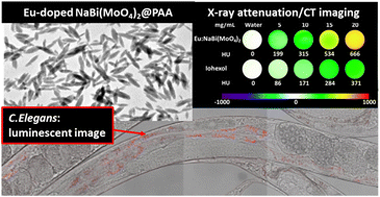
Europium doped-double sodium bismuth molybdate nanoparticles as contrast agents for luminescence bioimaging and X-ray computed tomography

A one-pot method for the synthesis of uniform Eu3+-doped NaBi(MoO4)2 nanoparticles with an ellipsoidal shape and tetragonal crystal structure functionalized with polyacrylic acid is reported for the first time in the literature. The method is based on a homogeneous precipitation reaction from solutions in an ethylene glycol/water medium containing appropriate bismuth, sodium, and molybdate precursors and…