


Synthetic natural gas production using CO2-rich waste stream from hydrothermal carbonization of biomass: Effect of impurities on the catalytic activity

The utilization of biomass and bio-waste, particularly through hydrothermal processes, has shown promise as a technology for converting these materials into valuable products. While most research has traditionally focused on the solid and liquid byproducts of these hydrothermal treatments, the gaseous phase has often been over-looked. This study specifically investigates the conversion of off-gases produced during hydrothermal carbonation (HTC) into synthetic natural gas, offering a readily marketable product with economic potential. Although the methanation of conventional flue gases has been extensively studied, dealing…
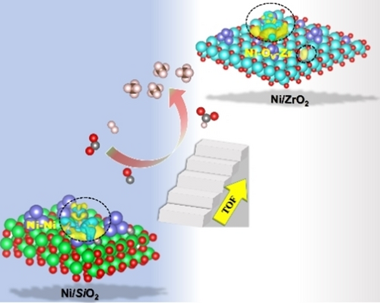
Boosting Low-Temperature CO2 Hydrogenation over Ni-based Catalysts by Tuning Strong Metal-Support Interactions

Rational design of low-cost and efficient transition-metal catalysts for low-temperature CO2 activation is significant and poses great challenges. Herein, a strategy via regulating the local electron density of active sites is developed to boost CO2 methanation that normally requires >350 °C for commercial Ni catalysts. An optimal Ni/ZrO2 catalyst affords an excellent low-temperature performance hitherto, with…

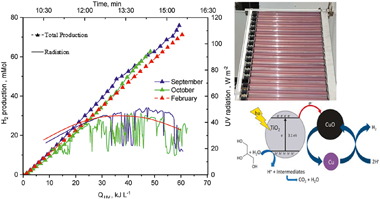
CuO-TiO2 pilot-plant system performance for solar photocatalytic hydrogen production

  The main goal of the present study was to explore photocatalytic performance of the TiO2 -CuO mixture, for solar to hydrogen conversion at pilot plant scale under two different irradiation conditions (sunny and partly cloudy), focusing on high-temperature pretreat-ment of the catalyst mixture to try to improve TiO2 doping with copper. P25-TiO2 and commercial CuO were used with different amounts of Cu (2 wt%…

Switchable catalysis for methanol and synthetic natural gas synthesis from CO2: A techno-economic investigation

The oil and gas sector produces a considerable volume of greenhouse gas emissions, mainly generated from flaring and venting natural gas. Herein, a techno-economic analysis has been performed of a switchable catalytic process to convert the CH4 and CO2 in flared/vented natural gas into syngas or methanol. Specifically, it was shown that depending on greenhouse gas composition, dry methane reforming (DRM), reverse…

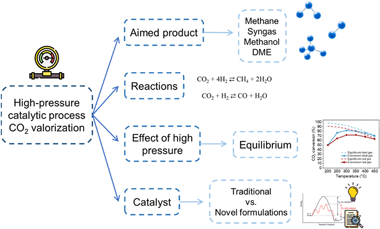
A review on high-pressure heterogeneous catalytic processes for gas-phase CO2 valorization

  This review discusses the importance of mitigating CO2 emissions by valorizing CO2 through high-pressure catalytic processes. It focuses on various key processes, including CO2 methanation, reverse water-gas shift, methane dry reforming, methanol, and dimethyl ether synthesis, emphasizing pros and cons of high-pressure operation. CO2 methanation, methanol synthesis, and dimethyl ether synthesis reactions are thermodynami-cally favored under high-pressure conditions. However, in the case of methane dry reforming and reverse water -gas shift, applying high pressure, results…

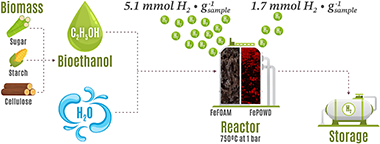
Green hydrogen production using doped Fe2O3 foams

  Hydrogen is the ideal energy vector to reduce our fossil-fuels dependency and diminish the climate change consequence. However, current production is still methane based. It is possible to produce hydrogen using bioethanol from the alcoholic fermentation of organic waste by chemical looping processes, but unfortunately current redox systems generate hydrogen with significant traces of CO. In the case of proton exchange membrane…

Natural hydrogen in the energy transition: Fundamentals, promise, and enigmas

Beyond its role as an energy vector, a growing number of natural hydrogen sources and reservoirs are being discovered all over the globe, which could represent a clean energy source. Although the hydrogen amounts in reservoirs are uncertain, they could be vast, and they could help decarbonize energy-intensive economic sectors and facilitate the energy transition. Natural hydrogen is mainly produced through a geochemical process known as serpentinization, which involves the reaction of water with low-silica, ferrous minerals. In favorable locations, the hydrogen produced…

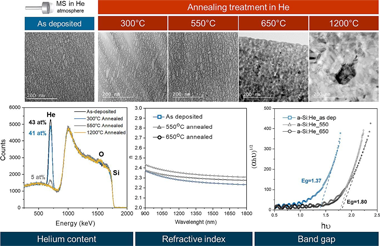
Microstructural evolution and properties of He-charged a-Si coatings prepared by magnetron sputtering

The introduction of porosity in nanomaterials via magnetron sputtering in helium atmospheres is an interesting strategy for the design of functional materials. Amorphous silicon coatings, with high concentration of He incorporated in the form of overpressurized nano-bubbles, present modified optical properties in comparison with dense coatings of similar composition. In this work, annealing process in…

Ba3(PO4)2 Photocatalyst for Efficient Photocatalytic Application

Barium phosphate (Ba-3(PO4)(2)) is a class of material that has attracted significant attention thanks to its chemical stability and versatility. However, the use of Ba-3(PO4)(2) as a photocatalyst is scarcely reported, and its use as a photocatalyst has yet to be reported. Herein, Ba-3(PO4)(2) nanoflakes synthesis is optimized using sol-gel and hydrothermal methods. The as-prepared Ba-3(PO4)(2) powders are investigated…