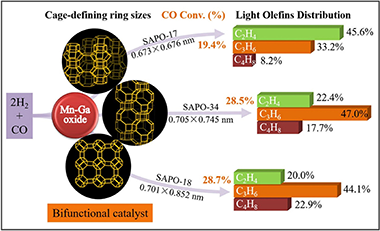
Effect of zeolite topological structure in bifunctional catalyst on direct conversion of syngas to light olefins

Bifunctional catalyst composed of metal oxide and zeolite (OX-ZEO) is a promising strategy for the direct conversion of syngas to light olefins (STO), where the structure of zeolite plays a vital role in determining the selectivity of product. Herein, three kinds of silicoaluminophosphate zeolites with different topological structures, i.e., the ERI(SP17), AEI(SP18) and CHA(SP34), were…

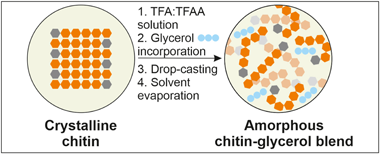
Plasticized, greaseproof chitin bioplastics with high transparency and biodegradability

A mixture of trifluoroacetic acid:trifluoroacetic anhydride (TFA:TFAA) was used to dissolve chitin from shrimp shells. Free-standing films were prepared by blending the chitin solution and glycerol at different percentages, followed by drop-casting, and the complete evaporation of the solvents. After this process, the chitin matrix showed an amorphous molecular structure, as determined by X-ray diffraction. Optical, mechanical, thermal, and antioxidant properties…

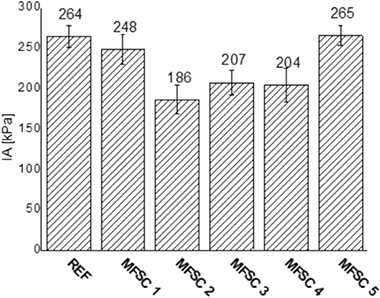
Spherosilicate-modified epoxy coatings with enhanced icephobic properties for wind turbines applications

Industries around the world use active methods, which include thermal, mechanical and chemical approaches, to reduce icing on aerodynamic surfaces such as wind turbines and aircraft. However, they are often inefficient, costly, and pollute the environment. For years, new coatings with anti-icing properties (so-called icephobic coatings) have been developed to either replace or work in…

Efficient SrO-based thermochemical energy storage using a closed-loop pressure swing

The SrCO3/SrO system has recently attracted interest for thermochemical energy storage due to the high energy densities potentially attainable. However, the high temperatures needed to promote calcination involve a sintering-induced deactivation of SrO to carbonation. In this work, SrO-based samples have been tested using a closed-loop pressure swing approach involving calcinations and carbonations at absolute…

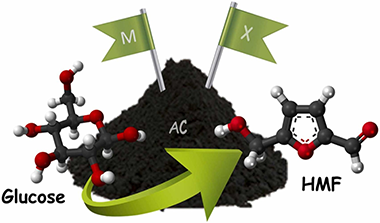
Glucose dehydration reaction over metal halides supported on activated charcoal catalysts

Different metal halide catalysts supported on a commercial active charcoal have been synthesized, activated, characterized and tested in glucose dehydration to 5-hydroxymethylfurfural using a biphasic water/methyl isobutyl ketone media. The influence of the cation nature (K+, Ca2+, Sr2+, Mg2+) and anion nature (F–, Cl–, Br–) on the catalytic performance of the solid is discussed in…

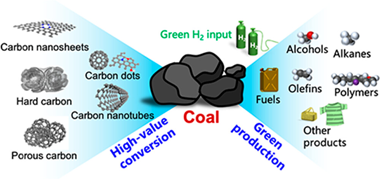
Coal Chemistry Industry: From Production of Liquid Fuels to Fine Chemicals to Carbon Materials

Coal resources are one of the key energy sources and essential for modern economic development. Despite the traditional coal industries having made considerable contributions to chemical production and energy storage, the accompanying environmental pollution and high energy consumption have also arisen that cause significant influence of the ecological balance. Hence, there is an urgent need…

H2 Production from NH3 in a BaTiO3 Moderated Ferroelectric Packed-Bed Plasma Reactor

Plasma decomposition reactions are used for various gas phase chemical processes including the decomposition of ammonia. In this work we show that pure ammonia can be effectively decomposed at atmospheric pressure and ambient temperature using a packed-bed plasma reactor moderated with BaTiO3 ferroelectric pellets without catalyst. The decomposition rate and energy efficiency of this ferroelectric barrier…

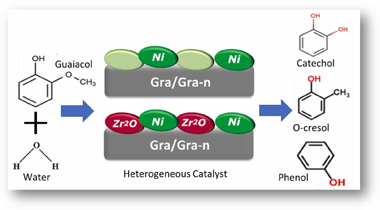
Multicomponent graphene based catalysts for guaiacol upgrading in hydrothermal conditions: Exploring «H2-free» alternatives for bio-compounds hydrodeoxygenation

  Catalytic hydrodeoxygenation (HDO) is a critical technique for upgrading biomass derivatives to deoxygenated fuels or other high-value compounds. Phenol, guaiacol, anisole, p-cresol, m-cresol and vanillin are all monomeric phenolics produced from lignin. Guaiacol is often utilised as a model lignin compound to deduce mechanistic information about the bio-oil upgrading process. Typically, a source of H2 is supplied as reactant for the HDO reaction. However, the H2…

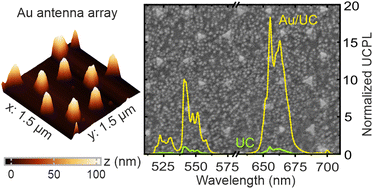
Enhancement of upconversion photoluminescence in phosphor nanoparticle thin films using metallic nanoantennas fabricated by colloidal lithography

Lanthanide-doped upconversion nanoparticles (UCNPs), as multifunctional light sources, are finding utility in diverse applications ranging from biotechnology to light harvesting. However, the main challenge in realizing their full potential lies in achieving bright and efficient photon upconversion (UC). In this study, we present a novel approach to fabricate an array of gold nanoantennas arranged in…