MIL-100(Fe)-derived catalysts for CO2 conversion via low- and high-temperature reverse water-gas shift reaction

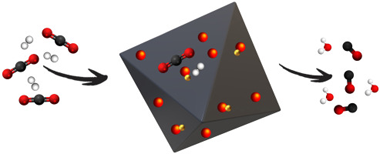
Fe-derived catalysts were synthesized by the pyrolysis of MIL-100 (Fe) metal-organic framework (MOF) and evaluated in the reverse water-gas shift (RWGS) reaction. The addition of Rh as a dopant by in-situ incorporation during the synthesis and wet impregnation was also considered. Our characterization data showed that the main active phase was a mixture of &…

Unravelling the CO2 capture and conversion mechanism of a NiRu-Na2O switchable dual-function material in various CO2 utilisation reactions

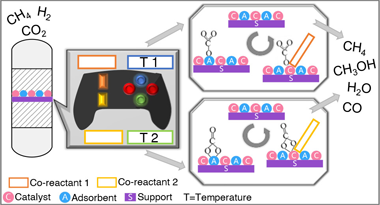
Time-resolved operando DRIFTS-MS was performed to elucidate the CO2 capture and conversion mechanisms of a NiRuNa/CeAl DFM in CO2 methanation, reverse water-gas shift, and dry reforming of methane. CO2 was captured mainly in the form of carbonyls and bidentate carbonates, and a spillover mechanism occurred to obtain the desired products.

Modeling Weakly Scattering Random Media: A Tool to Resolve the Internal Structure of Nanoporous Materials

Nanoporous media scatter a small fraction of the light propagating through them, even if pore sizes are significantly smaller than the characteristic visible wavelengths. The disordered spatial modulation of the refractive index at the few or few tens of nanometers length scale, resulting from the presence of randomly distributed air bubbles or solid aggregates within…

Optical monitoring of detergent pollutants in greywater

Large amount of wastewater is produced by washing machines and dishwashers, which are used in a daily basis. This domestic wastewater generated in households or office buildings (also called greywater) is drained directly to the drainpipes without differentiation from that with fecal contamination from toilets. Detergents are arguably the pollutants most frequently found in greywater…

The Need for Flexible Chemical Synthesis and How Dual-Function Materials Can Pave the Way

Since climate change keeps escalating, it is imperativethat theincreasing CO2 emissions be combated. Over recent years,research efforts have been aiming for the design and optimizationof materials for CO2 capture and conversion to enable acircular economy. The uncertainties in the energy sector and the variationsin supply and demand place an additional burden on the commercializationand implementation…

Surface Acoustic Waves Equip Materials with Active De-Icing Functionality: Unraveled Glaze Ice De-Icing Mechanisms and Application to Centimeter-Scale Transparent Surfaces

Enabling active de-icing functionality on low heat conductive and transparent materials is a requirement for several seminal industries in critical economic sectors. However, developing efficient and environmentally friendly de-icing methods still fails because of compatibility problems with large-scale devices and real-world conditions. In this paper, de-icing several square centimeters covered with thick layers of glaze…

Tribological Response of delta-Bi2O3 Coatings Deposited by RF Magnetron Sputtering

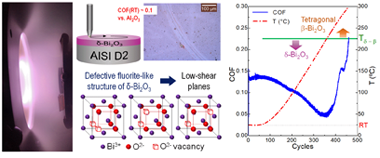
Bismuth oxide (Bi2O3) coatings and composite coatings containing this oxide have been studied due to their potential applications in gas sensing, optoelectronics, photocatalysis, and even tribology. Two parametric models based on chemical features have been proposed with the aim of predicting the lubricity response of oxides. However, such models predict contradictory values of the coefficient…

Strontium/zinc phytate-based self-assembled monolayers on titanium surfaces enhance osteogenesis and antibacterial performance in vitro

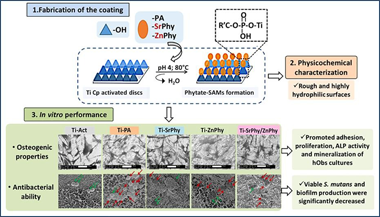
The accumulation of bacteria over implant surfaces is still the first cause of failure, and the development of antimicrobial surfaces constitutes a first line in implant research. Besides, the durability and mechanical performance of implants, in special in the dental area, are mainly determined by their osseointegration capacity into the maxillofacial bone and the appearance…