Nanofibrous Gelatin-Based Biomaterial with Improved Biomimicry Using D-Periodic Self-Assembled Atelocollagen

Design of bioinspired materials that mimic the extracellular matrix (ECM) at the nanoscale is a challenge in tissue engineering. While nanofibrillar gelatin materials mimic chemical composition and nano-architecture of natural ECM collagen components, it lacks the characteristic D-staggered array (D-periodicity) of 67 nm, which is an important cue in terms of cell recognition and adhesion…

Electrical and reaction performances of packed-bed plasma reactors moderated with ferroelectric or dielectric materials

The operational behavior of packed-bed plasma reactors depends on the dimension, shape, and chemical properties of the pellets used as moderators, but little information exists about the influence of their specific dielectric properties. Herein, we comparatively study the electrical behavior of a packed-bed reactor filled with pellets of either dielectric (Al2O3 and glass) or ferroelectric…

Synergizing carbon capture and utilization in a biogas upgrading plant based on calcium chloride: Scaling-up and profitability analysis

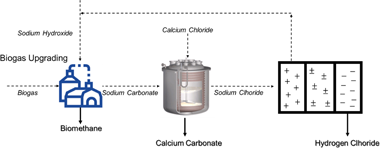
Herein we analyze the profitability of a novel regenerative process to synergize biogas upgrading and carbon dioxide utilization. Our proposal is a promising alternative which allows to obtain calcium carbonate as added value product while going beyond traditional biogas upgrading methods with high thermal energy consumption. Recently we have demonstrated the experimental viability of this…

Facile synthesis and characterization of a novel 1,2,4,5-benzene tetracarboxylic acid doped polyaniline@zinc phosphate nanocomposite for highly efficient removal of hazardous hexavalent chromium ions from water

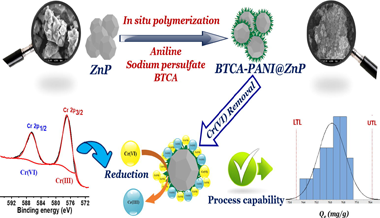
The present study describes the preparation of a novel 1,2,4,5-benzene tetracarboxylic acid doped polyaniline@zinc phosphate (BTCA-PANI@ZnP) nanocomposite via a facile two-step procedure. Thereafter, the as-prepared composite material adsorption characteristics for Cr(VI) ions removal were evaluated under batch adsorption. Kinetic approach studies for Cr(VI) removal, clearly demonstrated that the results of the adsorption process followed the…

Overcoming Pd-TiO2 Deactivation during H-2 Production from Photoreforming Using Cu@Pd Nanoparticles Supported on TiO2

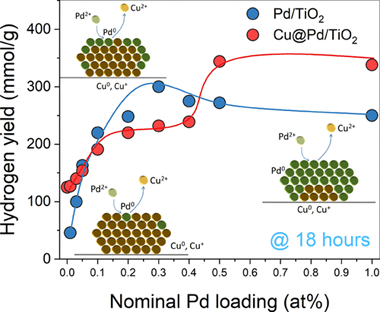
Different Cu@Pd-TiO2 systems have been prepared by a two-step synthesis to obtain a bimetallic co-catalyst for the H-2 photoreforming reaction. We find that the tailored deposition of Pd covering the Cu nanoclusters by a galvanic replacement process results in the formation of a core@shell structure. The photocatalytic H-2 production after 18 h is 350 mmol/g…

Zr and Fe on Pt/CeO2-MOx/Al2O3 catalysts for WGS reaction

By evaluating the functional modifications induced by Zr and Fe as dopants in Pt/CeO2‐MOx/Al2O3 catalysts (M = Fe and Zr), the key features for improving water gas shift (WGS) performance for these systems have been addressed. Pt/ceria intrinsic WGS activity is often related to improved H2 surface dynamics, H2O absorption, retentions and dissociation capacities which are influenced…

The Complex Interplay of Lead Halide Perovskites with Their Surroundings

Photoexcitation of lead halide perovskites induces a restructuration of the material that simultaneously enhances its emission properties and triggers its degradation. These concomitant processes are strongly dependent on the surroundings of the perovskite, both while and after being processed, underlining the relevance the environment and the interfacial design have in the stability and performance of…