Archeometric characterization (physical-chemical and microstructural) of tiles in the Mudejar Palace of the Royal Alcazar of Seville using non-invasive quantitative chemical methods

The Palaces in the Alcazar of Seville, Spain, are famous for their ceramic decoration. The technique of tessellation was used extensively in all rooms in the Mudejar Palace, dated in the fourteenth century. These glazed ceramics have been analysed in situ using noninvasive quantitative chemical methods of X-ray fluorescence and diffraction (XRF and XRD). Micro-samples…

Bimetallic Ni-Ru and Ni-Re Catalysts for Dry Reforming of Methane: Understanding the Synergies of the Selected Promoters

Designing an economically viable catalyst that maintains high catalytic activity and stability is the key to unlock dry reforming of methane (DRM) as a primary strategy for biogas valorization. Ni/Al2O3 catalysts have been widely used for this purpose; however, several modifications have been reported in the last years in order to prevent coke deposition and deactivation…

Ligand-Free MAPbI(3) Quantum Dot Solar Cells Based on Nanostructured Insulating Matrices

The stability, either chemical or thermal, and performance of colloidal quantum dot (CQD) devices are typically limited by the presence of surface-bonded organic ligands required to stabilize the nanocrystals. In addition, optimization of charge transport implies lengthy ligand exchange processing. Herein, evidence of efficient charge transport through a network of ligand-free perovskite quantum dots (PQDs)…

Characterizing the physicochemical and mechanical properties of ZrN thin films deposited on Zr substrates by pulsed laser technique

Due to their outstanding physical and mechanical features, ZrN thin films are increasingly used as coatings to protect materials intended for nuclear applications such as Zirconium. To our knowledge, there is no report of pulsed laser deposition (PLD) of ZrN thin films on a Zr substrate. In this work, we have successfully prepared ZrN thin…

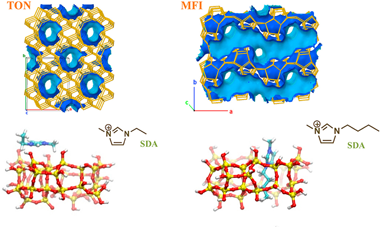
How a small modification in the imidazolium-based SDA can determine the zeolite structure? MFI vs. TON

The present study proposes an important contribution to the understanding of ionic liquid role as structure directing agent for zeolite synthesis. A series of imidazolium based ionic liquids are used for this purpose. While the anionic counterpart influences the micellar organization during the synthesis, the imidazolium cation clearly directs the structure to one or another…

Tuning the excitation wavelength of luminescent Mn2+-doped ZnSxSe1-x obtained by mechanically induced self-sustaining reaction

Mn2+-doped ZnSxSe1-x solid solution samples (Mn:ZnSxSe1-x) were synthesized by the mechanochemical process denoted as mechanically-induced self-sustaining reaction from Mn/Zn/S/Se powder elemental mixtures. The samples were characterized by X-ray diffraction, scanning electron microscopy, diffuse reflectance UV-Vis spectroscopy and emission and excitation photoluminescence measurements. The band-gap energy of samples was controlled by changing the stoichiometry, x, of…

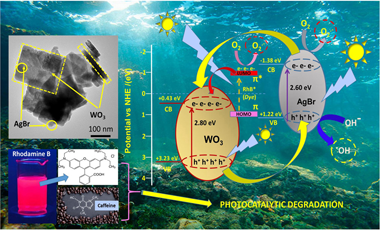
Features of coupled AgBr/WO3 materials as potential photocatalysts

AgBr/WO3 composite photocatalysts with different selected molar AgBr/WO3 ratios were prepared and widely characterized by XRD, N2-adsorption, SEM, TEM, UV–visible/DRS and XPS techniques. The samples were tested using rhodamine B (RhB) or caffeine, under two illumination conditions (UV and visible light). Although AgBr and WO3 pristine materials have relatively low band gap values (2.6 eV and 2.8 eV, respectively), they…

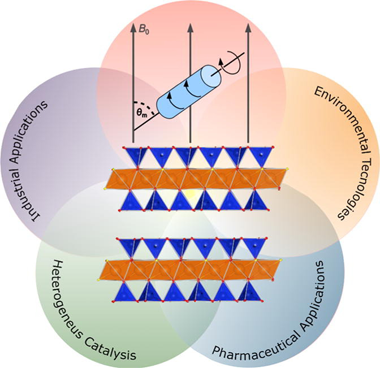
Swelling layered minerals applications: A solid state NMR overview

Swelling layered clay minerals form an important sub-group of the phyllosilicate family. They are characterized by their ability to expand or contract in the presence or absence of water. This property makes them useful for a variety of applications, ranging from environmental technologies to heteroge-neous catalysis, and including pharmaceutical and industrial applications. Solid State Nuclear…

The Role of the Atmosphere on the Photophysics of Ligand-Free Lead-Halide Perovskite Nanocrystals

Lead halide perovskite (LHP) nanocrystals (NCs) have gained attention over the past decade due to their outstanding optoelectronic properties, making them a suitable material for efficient photovoltaic and light emitting devices. Due to its soft nature, these nanostructures undergo strong structural changes upon irradiation, where these light-induced processes are strongly influenced by the environment. Since…

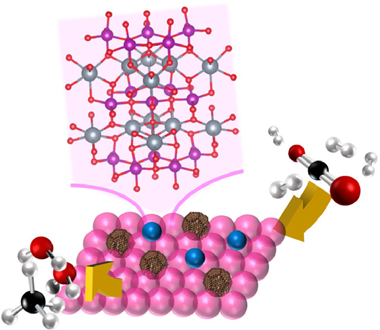
Ni/YMnO3 perovskite catalyst for CO2 methanation

This work proposes an innovative Ni catalyst supported over YMnO3 perovskite as a promising catalytic system for CO2 methanation reaction. Under reductive conditions, the attendance of Mn redox couples within the layered perovskite structure promotes the constitution of sub-stoichiometric YMnO3-x units which, by means of the flexible YMnO3-x reorganization capacity, results in boosted anionic mobility’s.…