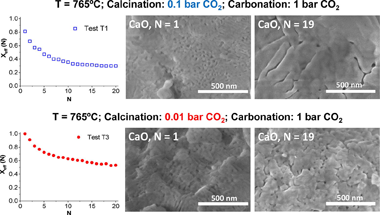
Calcination under low CO2 pressure enhances the calcium Looping performance of limestone for thermochemical energy storage

The Calcium Looping performance of limestone for thermochemical energy storage has been investigated under novel favorable conditions, which involve calcination at moderate temperatures under CO2 at low pressure (0.01 and 0.1 bar) and carbonation at high temperature under CO2 at atmospheric pressure. Calcining at low CO2 pressures allows to substantially reduce the temperature to achieve…

Factors triggering germination in plasma-activated cotton seeds: water imbibition vs. reactive species’ formation

Plasma technology has emerged as an efficient, simple, and eco-friendly method for activating seed germination processes. Most studies on this subject have focused on the morphological and wetting effects on the surface state of seeds and attributed the improvement in germination occasionally found to the induced hydrophilicity and a higher water imbibition rate. Recently, the…

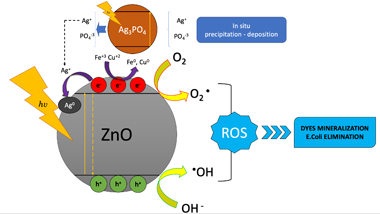
ZnO/Ag3PO4 and ZnO–Malachite as Effective Photocatalysts for the Removal of Enteropathogenic Bacteria, Dyestuffs, and Heavy Metals from Municipal and Industrial Wastewater

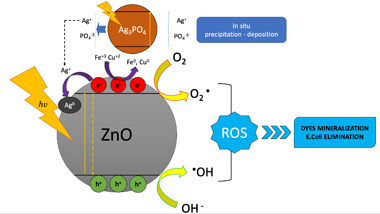
Different composites based on ZnO/Ag3PO4 and ZnO–malachite (Cu2(OH)2CO3) were synthesized in order to determine their effectiveness in the treatment of municipal and industrial wastewaters (mainly polluted by enteropathogenic bacteria, dyes, and heavy metals). The addition of Ag3PO4 and malachite did not significantly modify the physicochemical properties of ZnO; however, the optical properties of this oxide were modified…

Mechanochemical synthesis of ternary chalcogenide chalcostibite CuSbS2 and its characterization

In this work, the very rapid one-step mechanochemical synthesis of nanocrystalline ternary chalcogenide chalcostibite CuSbS2 prepared from copper, antimony, and sulfur precursors by high-energy milling for only 30 min in a planetary mill is reported. XRD confirmed the orthorhombic crystal structure of CuSbS2. The crystallite size of CuSbS2 calculated by LeBail refinement of the X-ray…

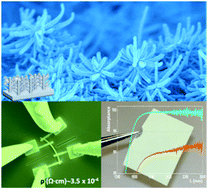
One-reactor vacuum and plasma synthesis of transparent conducting oxide nanotubes and nanotrees: from single wire conductivity to ultra-broadband perfect absorbers in the NIR

The eventual exploitation of one-dimensional nanomaterials needs the development of scalable, high yield, homogeneous and environmentally friendly methods capable of meeting the requirements for fabrication of functional nanomaterials with properties on demand. In this article, we demonstrate a vacuum and plasma one-reactor approach for the synthesis of fundamental common elements in solar energy and optoelectronics,…

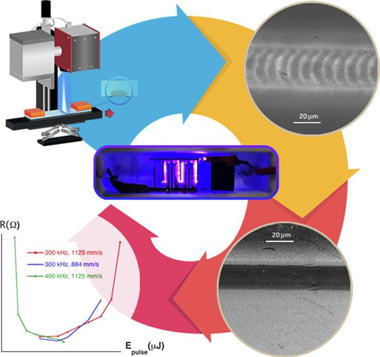
Laser-induced scanning transfer deposition of silver electrodes on glass surfaces: A green and scalable technology

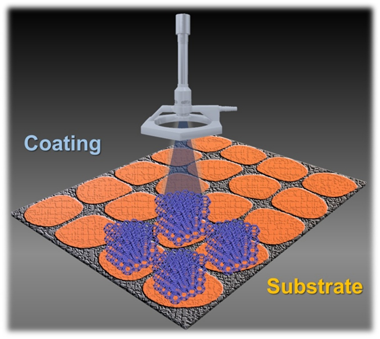
A pulsed laser ablation backwriting technique with high repetitive rates is implemented for the fabrication of silver coatings on glass surfaces. This method enables geometrical constraint-free deposition of metallic coatings. These exhibit sufficiently low electrical resistance to be used as electrodes in dielectric barrier discharge (DBD) plasma elements. Ambient air deposition of metallic silver electrodes…

ZnO/Ag3PO4 and ZnO–Malachite as Effective Photocatalysts for the Removal of Enteropathogenic Bacteria, Dyestuffs, and Heavy Metals from Municipal and Industrial Wastewater

Different composites based on ZnO/Ag3PO4 and ZnO–malachite (Cu2(OH)2CO3) were synthesized in order to determine their effectiveness in the treatment of municipal and industrial wastewaters (mainly polluted by enteropathogenic bacteria, dyes, and heavy metals). The addition of Ag3PO4 and malachite did not significantly modify the physicochemical properties of ZnO; however, the optical properties of this oxide were modified…

Light-Harvesting Properties of a Subphthalocyanine Solar Absorber Coupled to an Optical Cavity

Herein, both from the experimental and theoretical point of view, the optical absorption properties of a subphthalocyanine (SubPc), an organic macrocycle commonly used as a sunlight harvester, coupled to metallic optical cavities are analyzed. How different electronic transitions characteristic of this compound and specifically those that give rise to excitonic (Q band) and charge transfer…

Mechanistic Considerations on the H-2 Production by Methanol Thermal-assisted Photocatalytic Reforming over Cu/TiO2 Catalyst

We have studied the gas phase H-2 production by methanol thermo-photoreforming using Cu-modified TiO2. Metal co-catalyst has been deposited by means of photodeposition method. The concentration of methanol in the steam was also considered. It appears that H-2 production is notably higher as temperature increases. Moreover, the optimum H-2 yield is achieved using methanol concentration…

Current scenario and prospects in manufacture strategies for glass, quartz, polymers and metallic microreactors: A comprehensive review

One of the most remarkable benefits of the microreactors is the achievement of more efficient processes by enhancing the heat and mass transfer phenomena, which is the key factor for processes intensification in chemical reactions, resulting in higher conversion, selectivity and yield towards desired products. Currently, the entire scenario of microreaction approach is an emergent…