Effect of Al content on the hardness and thermal stability study of AlTiN and AlTiBN coatings deposited by HiPIMS

The microstructure, mechanical properties and thermal stability of AT(x)Ti(1-x)N and Al1Ti1-xBN coatings grown by reactive high-power impulse magnetron sputtering (HiPIMS) have been analyzed as a function of Al/(Al + Ti) ratio (x) between 0.5 and 0.8. The coatings were predominantly formed by a face-centered cubic Ti(Al)N crystalline phase, both with and without B, even for…

Photocatalytic production of hydrogen and methane from glycerol reforming over Pt/TiO2–Nb2O5

In this study, platinized mixed oxides (TiO2–Nb2O5) were tested on photocatalytic hydrogen production from a glycerol solution under UV light. Different samples with different Ti:Nb ratios were prepared by using a simple method that simultaneously combined a physical mixture and a platinum photochemical reduction. This method led to improved physicochemical properties such as low band gap, better Pt nanoparticle distribution on the surface, and…

Nb-C thin films prepared by DC-MS and HiPIMS: Synthesis, structure, and tribomechanical properties

Nanostructured Nb-C thin films were prepared by direct current magnetron sputtering (DC-MS) and high-power impulse magnetron sputtering (HiPIMS). The films were characterized in depth by X-ray diffraction (XRD), grazing incidence X-ray diffraction, scanning electron microscopy, atomic force microscopy, electron probe microanalysis, and Raman spectroscopy. The mechanical properties were measured by nanoindentation, and the tribological properties…

Persistent luminescent nanoparticles: Challenges and opportunities for a shimmering future

Persistent phosphors are luminescent sources based on crystalline materials doped with rare-earth or transition metal cations able to produce light after the excitation source vanishes. Although known for centuries, these materials gained renewed interest after the discovery of Eu2+,RE3+ co-doped aluminates and silicates in the late 1990s due to their unprecedented afterglow properties. In contrast,…

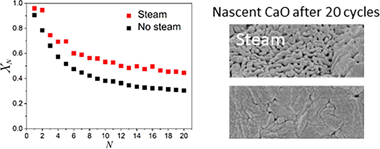
Kinetics and cyclability of limestone (CaCO3) in presence of steam during calcination in the CaL scheme for thermochemical energy storage

In the present work, we explore the use of steam in the CaCO3 calcination step of the Calcium Looping process devised for thermochemical energy storage (CaL-TCES). Steam produces a double benefit: firstly, it fastens calcination, allowing a reduction of the temperature needed to attain full calcination in short residence times, as those required in practice,…

Study of the Influence of Sintering Atmosphere and Mechanical Activation on the Synthesis of Bulk Ti2AlN MAX Phase Obtained by Spark Plasma Sintering

The influence of the mechanical activation process and sintering atmosphere on the microstructure and mechanical properties of bulk Ti2AlN has been investigated. The mixture of Ti and AlN powders was prepared in a 1:2 molar ratio, and a part of this powder mixture was subjected to a mechanical activation process under an argon atmosphere for…