New Insights on the Conversion Reaction Mechanism in Metal Oxide Electrodes for Sodium-Ion Batteries

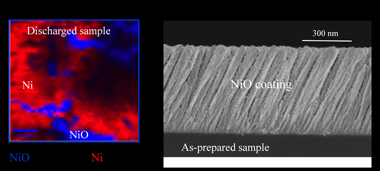
Due to the abundance and low cost of exchanged metal, sodium-ion batteries have attracted increasing research attention for the massive energy storage associated with renewable energy sources. Nickel oxide (NiO) thin films have been prepared by magnetron sputtering (MS) deposition under an oblique angle configuration (OAD) and used as electrodes for Na-ion batteries. A systematic…

Novel procedure for studying laser-surface material interactions during scanning laser ablation cleaning processes on Cu-based alloys

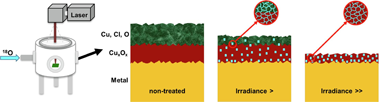
Laser ablation is an effective method to clean Cu-based alloys. A novel procedure of characterisation was developed involving O-18 isotopes evaluated by ToF-SIMS spectroscopy to assess the driving mechanisms of laser-surface interactions. The presence of re-oxidised compounds was detected, discerning between the oxygen from the corrosion layer and the one introduced by the interaction with…

Fluorinated and platinized Titania for Glycerol oxidation

In this research, photocatalysts based on TiO2 modified by fluorination and platinum addition were evaluated in the glycerol oxidation. These materials were characterized by different instrumental analysis techniques to determine the physicochemical properties. It was found that the surface modification lead to improve the materials absorption in the Visible region of the electromagnetic spectra and to…

Holmium phosphate nanoparticles as negative contrast agents for high-field magnetic resonance imaging: Synthesis, magnetic relaxivity study and in vivo evaluation

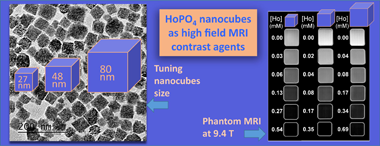
The increasing use of high magnetic fields in magnetic resonance imaging (MRI) scanners demands new contrast agents, since those used in low field instruments are not effective at high fields. In this paper, we report the synthesis of a negative MRI contrast agent consisting of HoPO4 nanoparticles (NPs). Three different sizes (27 nm, 48 nm and 80 nm) of…

LED-driven controlled deposition of Ni onto TiO2 for visible-light expanded conversion of carbon dioxide into C-1-C-2 alkanes

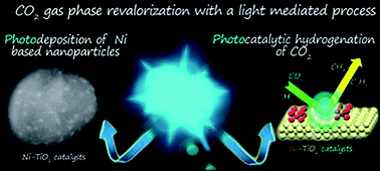
Photocatalytic gas-phase hydrogenation of CO2 into alkanes was achieved over TiO2-supported Ni nanoparticles under LED irradiation at 365 nm, 460 nm and white light. The photocatalysts were prepared using photo-assisted deposition of Ni salts under LED irradiation at 365 nm onto TiO2 P25 nanoparticles in methanol as a hole scavenger. This procedure yielded 2 nm Ni particles…

Electrochromic response and porous structure of WO3 cathode layers

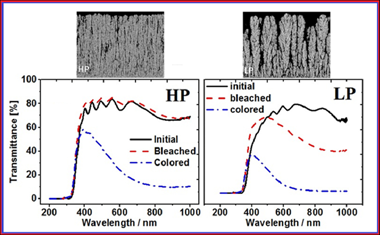
Maximizing the electrochromic response of tungsten oxide-based systems demands highly porous electrode layers that facilitate the incorporation of electrolyte cations during the reduction process. In this work, amorphous and porous WO3 thin films were grown on indium tin dioxide glass substrates by magnetron sputtering at oblique angles at two different plasma gas pressures. Remarkably, the…

Cu supported Fe-SiO2 nanocomposites for reverse water gas shift reaction

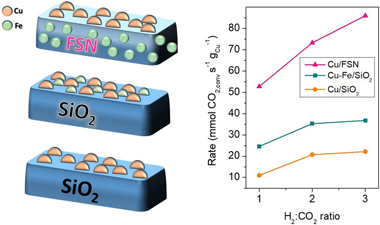
This work analyses the catalytic activity displayed by Cu/SiO2, Cu-Fe/SiO2 and Cu/FSN (Fe-SiO2 nanocomposite) catalysts for the Reverse Water Gas Shift reaction. Compared to Cu/SiO2 catalyst, the presence of Fe resulted on higher CO?s selectivity and boosted resistances against the constitution of the deactivation carbonaceous species. Regarding the catalytic performance however, the extent of improvement…

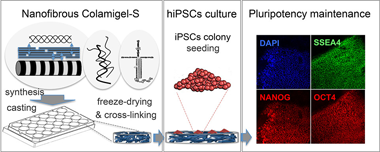
Nanofibrous Matrix of Defined Composition Sustains Human Induced Pluripotent Stem Cell Culture

Human induced pluripotent stem cells (hiPSCs) represent the most promising biological material for regenerative medicine applications. In this work, a 3D solid nanofibrous matrix of defined composition (Colamigel-S) consisting of 97 wt % gelatin, 2.6 wt % atelocollagen, and 0.4 wt % laminin has been reproducibly processed and characterized and exhibits a homogeneous nanofibrillar network…