


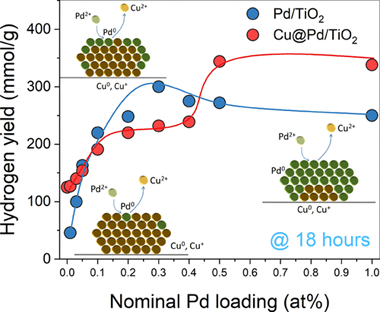
Different Cu@Pd-TiO2 systems have been prepared by a two-step synthesis to obtain a bimetallic co-catalyst for the H-2 photoreforming reaction. We find that the tailored deposition of Pd covering the Cu nanoclusters by a galvanic replacement process results in the formation of a core@shell structure. The photocatalytic H-2 production after 18 h is 350 mmol/g on the Cu@Pd-1.0-TiO2 bimetallic system, which is higher than that on the monometallic ones with a H-2 production of 250 mmol/g on Pd-supported TiO2. Surface characterization by highangle annular dark-field scanning transmission electron microscopy, H-2-temperatureprogramed reduction, CO-FTIR spectroscopy, and XPS gives clear evidence of the formation of a core@shell structure. With a Pd loading of 0.2-0.3 at. %, we propose a full coverage of the Cu nanoparticles with Pd. Long-time photoreforming runs show the enhanced performance of supported Cu@Pd with respect to bare palladium leading to a more stable catalyst and ultimately higher H-2 production.