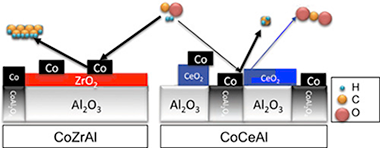
Promoting effect of CeO2, ZrO2 and Ce/Zr mixed oxides on Co/gamma-Al2O3 catalyst for Fischer-Tropsch synthesis

A series of cobalt-based catalysts have been synthesized using as support gamma-Al2O3 promoted by ceria/zirconia mixed oxides with a variable Ce/Zr molar ratio. The obtained catalysts demonstrated oxide promotion results in the protection of the major textural properties, especially for Zr-rich solids. Reducibility of cobalt species was enhanced by the presence of mixed oxides. The…

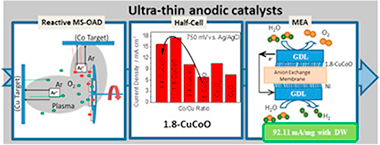
CuxCo3-xO4 ultra-thin film as efficient anodic catalysts for anion exchange membrane water electrolysers

CuxCo3-xO4 ultra-thin films, deposited by magnetron sputtering at oblique angles have been used as anodic catalysts in anion exchange membrane water electrolysers. It has been demonstrated that the used deposition procedure provides porous and amorphous samples with a strict control of the total catalyst load and Co/Cu ratio. Electrocatalytic tests showed a maximum performance for…

Technological evolution of ceramic glazes in the renaissance: In situ analysis of tiles in the Alcazar (Seville, Spain)

The Alcazar Palace (Seville, Spain) is famous for its ceramic decorations; 16th century wall tiles of different typologies have been analyzed in order to relate the manufacturing process of their colored glazes to the evolving technologies of the Renaissance. Chemical and mineralogical compositions have been determined in situ by nondestructive X-ray fluorescence and X-ray diffraction…

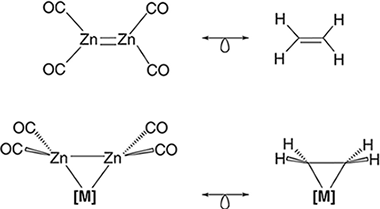
A theoretical study of the bonding capabilities of the zinc-zinc double bond

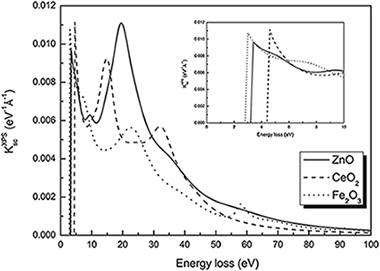
The theoretical knowledge about the zinc-zinc bond has been recently expanded after the proposal of a zinc-zinc double bond in several [Zn-2(L)(4)] compounds (Angew. Chem. Int. Ed.2017, 56, 10151-10155). Prompted by these results, we have selected the [Zn-2(CO)(4)] species, isolobally related to ethylene, and theoretically investigated the possible (2)-Zn-2-coordination to several first-row transition metal fragments.…

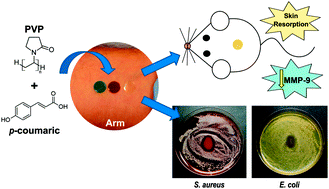
Combining dietary phenolic antioxidants with polyvinylpyrrolidone: transparent biopolymer films based on p-coumaric acid for controlled release

Polyvinylpyrrolidone (PVP) has probably been one of the most utilized pharmaceutical polymers with applications ranging from a blood plasma substitute to nanoparticle drug delivery, since its synthesis in 1939. It is a highly biocompatible, non-toxic and transparent film forming polymer. Although high solubility of PVP in aqueous environment is advantageous, it still poses several problems…

Transparent and Robust All-Cellulose Nanocomposite Packaging Materials Prepared in a Mixture of Trifluoroacetic Acid and Trifluoroacetic Anhydride

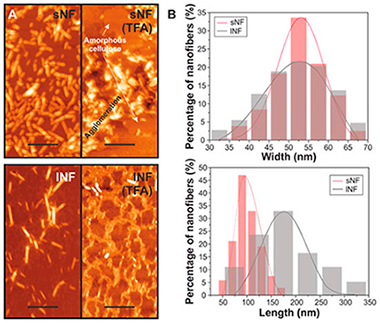
All-cellulose composites with a potential application as food packaging films were prepared by dissolving microcrystalline cellulose in a mixture of trifluoroacetic acid and trifluoroacetic anhydride, adding cellulose nanofibers, and evaporating the solvents. First, the effect of the solvents on the morphology, structure, and thermal properties of the nanofibers was evaluated by atomic force microscopy (AFM),…

Comparative studies on electrochemical energy storage of NiFe-S nanoflake and NiFe-OH towards aqueous supercapacitor

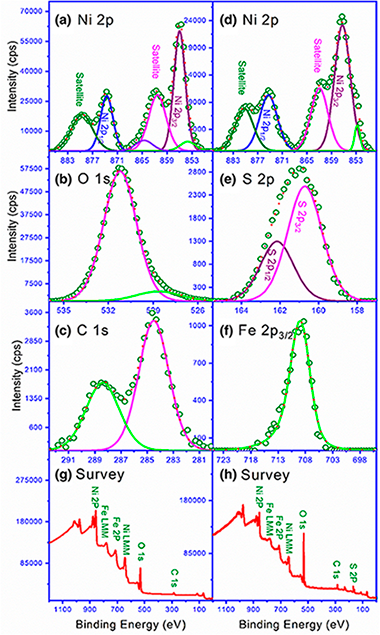
In this study, electrochemical energy storage performances of an efficient Ni-Fe sulfide and hydroxide supported on porous nickel foam are compared. X-ray diffraction (XRD), X-rayphotoelectron spectroscopy (XPS) and energy-dispersive X-ray spectrometer (EDS) results confirmed the formation of Ni-Fe-S and Ni-Fe-OH electrodes. In addition, Brunauer-Emmett Teller (BET) was used to determine the specific surface area of…

Anisotropic lattice expansion determined during flash sintering of BiFeO3 by in-situ energy-dispersive X-ray diffraction

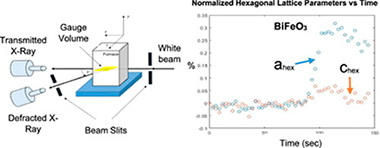
BiFeO3 has a Curie temperature (T-c) of 825 degrees C, making it difficult to sinter using conventional methods while maintaining the purity of the material, as unavoidably secondary phases appear at temperatures above T-c Flash sintering is a relatively new technique that saves time and energy compared to other sintering methods. BiFeO3 was flash sintered…