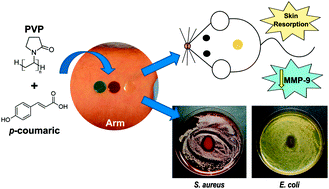
Combining dietary phenolic antioxidants with polyvinylpyrrolidone: transparent biopolymer films based on p-coumaric acid for controlled release

Polyvinylpyrrolidone (PVP) has probably been one of the most utilized pharmaceutical polymers with applications ranging from a blood plasma substitute to nanoparticle drug delivery, since its synthesis in 1939. It is a highly biocompatible, non-toxic and transparent film forming polymer. Although high solubility of PVP in aqueous environment is advantageous, it still poses several problems…

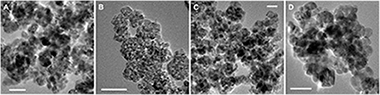
The impact of photocatalytic Ag/TiO2 and Ag/N-TiO2 nanoparticles on human keratinocytes and epithelial lung cells

The potential human health risks following the exposure to inorganic nanoparticles (NPs) is a very important issue for their application in leather finishing industry. The aim of our study was to investigate the cytotoxic effect of silver (Ag)/titanium dioxide (TiO2) NPs on human cells. Photocatalytic NPs were prepared by electrochemical deposition of Ag on the…

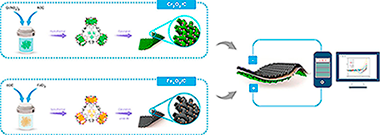
Controlled thermolysis of MIL-101(Fe, Cr) for synthesis of FexOy/porous carbon as negative electrode and Cr2O3/porous carbon as positive electrode of supercapacitor

In the present study, two kinds of metal oxide/carbon nanocomposite were prepared through calcination of MIL-101(Fe, Cr). The morphological and structural properties of the specimens were investigated using X-ray diffraction, Fourier-transform infrared spectroscopy, Brunauer, Emmett, and Teller analysis, energy dispersive Xray spectroscopy, X-ray photoelectron spectroscopy and scanning electron microscopy. The electrode materials were also electrochemically…

Sustainable polycondensation of multifunctional fatty acids from tomato pomace agro-waste catalyzed by tin (II) 2-ethylhexanoate

Bioplastics were prepared from the fatty fraction (i.e., unsaturated and polyhydroxylated fatty acids) of tomato pomace agro-wastes. Aliphatic polyesters were synthesized at different temperatures (125, 150, and 175 °C), reaction times (0.25, 0.5, 0.75, 1, 3, 5, and 7 h), and amounts of tin (II) 2-ethylhexanoate (0, 0.02, 0.05, and 0.10 mmol) used as a catalyst. The rate…

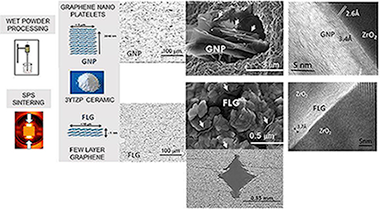
Microstructure, interfaces and properties of 3YTZP ceramic composites with 10 and 20 vol% different graphene-based nanostructures as fillers

The graphene family comprises not only single layer graphene but also graphene-based nanomaterials (GBN), with remarkably different number of layers, lateral dimension and price. In this work, two of these GBN, namely graphene nanoplatelets (GNP) with n similar to 15-30 layers and few-layer graphene (FLG) with n < 3 layers have been evaluated as fillers…

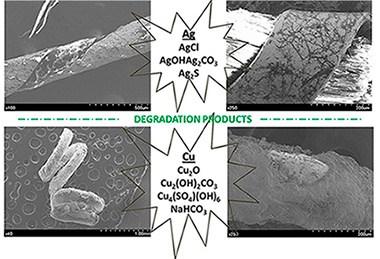
Degradation processes of historic metal threads used in some Spanish and Portuguese ornamentation pieces

The degradation processes that occurred on metal threads applied in the embroidery used for clothing and in the ornamentation of sculptures, the Sevillian Holy Week processions, and Portuguese and Spanish palace and museum are thoroughly analyzed. Some threads from the 14th and 18–19th centuries were considered. In the metal threads, sulphur- and chlorine-based compounds were…

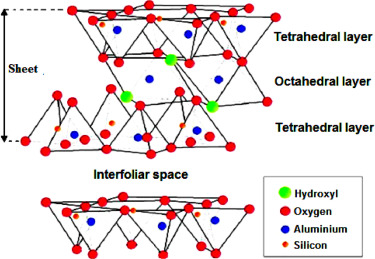
Synthesis of sol-gel pyrophyllite/TiO2 heterostructures: Effect of calcination temperature and methanol washing on photocatalytic activity

We successfully synthesized an efficient photoactive pyrophyllite/TiO2 heterostructures using a sol-gel route at ambient temperature. The samples were prepared by exfoliation of a pyrophyllite layered-type clay by TiO2. The prepared samples exhibited strong photocatalytic activity for the degradation of phenol. The heterostructure PTi750 (SBET = 16.58 m2/g) calcined at 750 °C, in which the mixed phases of anatase and rutile exist (52.2% anatase/10.7% rutile), showed the highest photocatalytic activity against commercial…

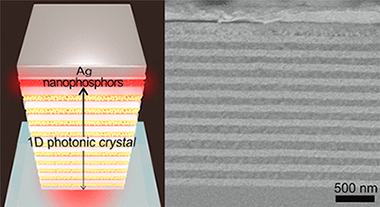
Tamm Plasmons Directionally Enhance Rare-Earth Nanophosphor Emission

Rare-earth-based phosphors are the materials on which current solid-state lighting technology is built. However, their large crystal size impedes the tuning, optimization, or manipulation of emitted light that can be achieved by their integration in nanophotonic architectures. Herein we demonstrate a hybrid plasmonic-photonic architecture capable of both channeling in a specific direction and enhancing by…