


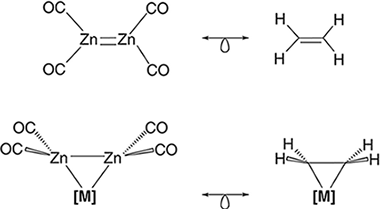
The theoretical knowledge about the zinc-zinc bond has been recently expanded after the proposal of a zinc-zinc double bond in several [Zn-2(L)(4)] compounds (Angew. Chem. Int. Ed.2017, 56, 10151-10155). Prompted by these results, we have selected the [Zn-2(CO)(4)] species, isolobally related to ethylene, and theoretically investigated the possible (2)-Zn-2-coordination to several first-row transition metal fragments. The [Zn-2(CO)(4)] coordination to the metal fragment produces an elongation of the dizinc bond and a concomitant pyramidalization of the [Zn(CO)(2)] unit. These structural parameters are indicative of -backdonation from the metal to the coordinated dizinc moiety, as occurred with ethylene ligand. A quantum theory of atoms in molecules study of the ZnZn bond shows a decrease of (BCP), delta(2)(BCP) (ZnZn) and delocalization indexes (Zn,Zn), relative to corresponding values in the parent [Zn-2(CO)(4)] molecule. The ZnZn and MZn bonds in these [((2)-Zn-2(CO)(4))M(L)(n)] complexes can be described as shared interactions with an important covalent component where the ZnZn bond is preserved, albeit weakened, upon coordination.