In situ TEM and synchrotron SAXS/WAXS study on the impact of different iron salts on iron-catalysed graphitization of cellulose

Carbon materials are essential for emerging energy applications and there is a pressing need to be able to produce carbons with controlled properties from sustainable precursors. Iron-catalysed graphitization of biomass is an attractive approach, where simple iron salts are used to convert organic matter to graphitic carbons at relatively low temperature. The choice of iron…

Microstructural control by freeze-casting of CaO architectures for improved and stable thermochemical energy storage performance

This study investigates the development of porous calcium-based monoliths via freeze-casting (FC) as a novel approach for thermochemical energy storage, particularly within the Calcium Looping (CaL) process. The freeze-casting technique enabled the fabrication of scaffolds with controlled porosity using polyvinyl alcohol (PVA) as a binder. Experimental results demonstrated that freeze-cast monoliths exhibited superior multicycle performance…

Characterization of Coffee Waste-Based Biopolymer Composite Blends for Packaging Development

In recent years, coffee waste by-products have been incorporated into polymer blends to reduce environmental pollution. In this study, coffee parchment (CP) was incorporated into biodegradable polylactic acid (PLA) and poly (butylene adipate-co-terephthalate) (PBAT) polymer blends to prepare ribbons through the extrusion process. Extracted green coffee bean oil (CO) was used as a plasticizer, and…

Elucidating the modes of incorporation of the ferulic acid amides feruloyltyramine and feruloyloctopamine into the lignin-suberin fraction of potato periderms

Ferulic acid amides are naturally present in the cell walls of potato (Solanum tuberosum) periderms. In this study, we investigated their modes of incorporation into the periderm cell wall polymers. A lignin/suberin-enriched fraction was isolated and analyzed by GPC, DFRC, and 2D-NMR. The analyses revealed that the lignin domain of this fraction was predominantly composed…

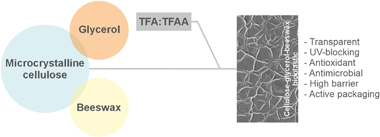
Plasticized cellulose bioplastics with beeswax for the fabrication of multifunctional, biodegradable active food packaging

Plasticized cellulose bioplastics with antioxidant and antimicrobial properties were prepared by blending cellulose and glycerol in a mixture of trifluoroacetic acid and trifluoroacetic anhydride, adding a solution of beeswax in chloroform, and subsequent drop-casting. Optical, chemical, structural, mechanical, thermal, and hydrodynamic properties were fully characterized. In addition, the biodegradability in seawater was investigated by determination…

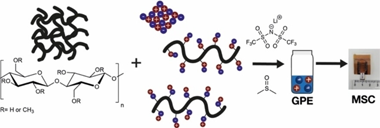
Poly(Ionic) Liquid-Enhanced Ion Dynamics in Cellulose-Derived Gel Polymer Electrolytes

Gel polymer electrolytes (GPEs) are regarded as a promising alternative to conventional electrolytes, combining the advantages of solid and liquid electrolytes. Leveraging the abundance and eco-friendliness of cellulose-based materials, GPEs were produced using methyl cellulose and incorporating various doping agents, either an ionic liquid (1-Butyl-1-methylpyrrolidinium bis(trifluoromethylsulfonyl)imide [Pyr14][TFSI]), its polymeric ionic liquid analogue (Poly(diallyldimethylammonium bis(trifluoromethylsulfonyl)imide) [PDADMA][TFSI]),…

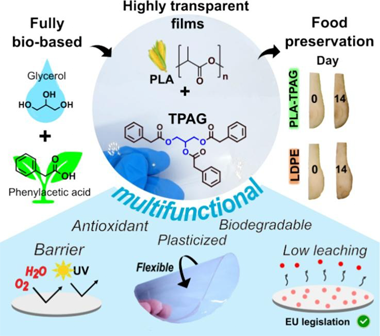
Triphenyl Acetic Glyceroate as a sustainable multifunctional additive for developing transparent, biodegradable, and flexible polylactide green alternative to polyethylene-based films for food packaging

Polylactide-based materials represent a promising bio-based alternative to traditional food packaging polymers. However, their widespread use is still limited due to significant drawbacks, such as brittleness, high gas permeability, and biodegradability only under specific conditions. This work introduces fully bio-based Triphenyl Acetic Glyceroate (TPAG), synthesized through a solvent-free and mild conditions valorization of glycerol and…

Optimización de sistemas de almacenamiento en seco usando materiales avanzados basados en nanoarcillas

El almacenamiento en seco del combustible nuclear gastado es una solución clave para la gestión segura de los residuos radiactivos a largo plazo, utilizando contenedores que preservan el combustible sin necesidad de refrigeración activa por agua. Estos contenedores incluyen una barrera neutrónica compuesta por una matriz polimérica, con alto contenido en hidrógeno para moderar a…

Enhanced extraction of bioactive compounds from tea waste for sustainable polylactide-based bioplastic applications in active food packaging

Active and sustainable food packaging materials were prepared through solvent casting, by blending tea waste (TW) extract rich in bioactive molecules with a neat polylactide (PLA) polymeric matrix. The optimization of tea waste extraction using a response surface methodology allowed achieving efficient yield and high phenolic content, which significantly enhanced the antioxidant properties of the…

Influence of the chemical activation with KOH/KNO3 on the CO2 adsorption capacity of activated carbons from pyrolysis of cellulose

Plant biomass is an attractive precursor to prepare activated carbons with high surface area for CO2 adsorption due to its low-cost and easy regeneration. Despite this interest, there are still remaining questions regarding the optimal processing conditions and the choice of activating agent. Moreover, since plant biomass shows a highly variable proportion of different biopolymers…