Synergistic Effect of He for the Fabrication of Ne and Ar Gas-Charged Silicon Thin Films as Solid Targets for Spectroscopic Studies

Sputtering of silicon in a He magnetron discharge (MS) has been reported as a bottom-up procedure to obtain He-charged silicon films (i.e., He nanobubbles encapsulated in a silicon matrix). The incorporation of heavier noble gases is demonstrated in this work with a synergistic effect, producing increased Ne and Ar incorporations when using He–Ne and He–Ar…

Optimising anode supported BaZr1-xYxO3-δ electrolytes for solid oxide fuel cells: Microstructure, phase evolution and residual stresses analysis

Yttrium-doped BaZrO3 is a promising electrolyte for intermediate-temperature protonic ceramic fuel cells. In the anode-supported configuration, a slurry containing the electrolyte is deposited on the surface of a calcined porous anode and sintered. Differences in sintering behaviour and thermal expansion coefficients for the anode and electrolyte result in elastic residual stresses that can impact the long-term…

Revalorization of Yerba Mate Residues: Biopolymers-Based Films of Dual Wettability as Potential Mulching Materials

Biodegradable mulching films are a very attractive solution to agronomical practices intended to achieve more successful crop results. And, in this context, the employment of agricultural and industrial food residues as starting material for their production is an alternative with economic and environmental advantages. This work reports the preparation of bilayer films having two different…

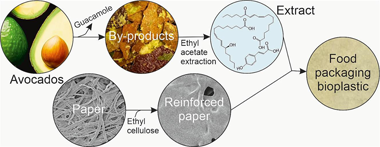
Incorporation of bioactive compounds from avocado by-products to ethyl cellulose-reinforced paper for food packaging applications

Reinforced films were fabricated by impregnating paper in ethyl cellulose solutions. After solvent evaporation, the infused ethyl cellulose acted as binder of the paper microfibres and occupied the pores and cavities, thus improving the mechanical and barrier properties. To prepare active films, avocado by-products from guacamole industrial production were extracted in ethyl acetate. Then, the…

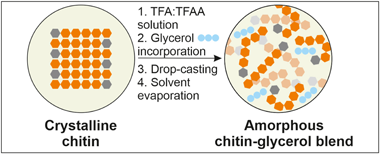
Plasticized, greaseproof chitin bioplastics with high transparency and biodegradability

A mixture of trifluoroacetic acid:trifluoroacetic anhydride (TFA:TFAA) was used to dissolve chitin from shrimp shells. Free-standing films were prepared by blending the chitin solution and glycerol at different percentages, followed by drop-casting, and the complete evaporation of the solvents. After this process, the chitin matrix showed an amorphous molecular structure, as determined by X-ray diffraction. Optical, mechanical, thermal, and antioxidant properties…

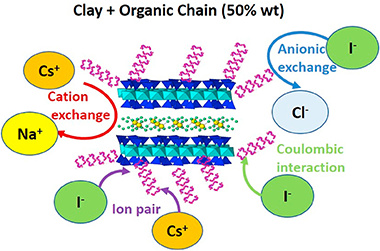
A technological approach based on engineered nanoclay composites for cesium and iodine retention

  The development of effective and environmentally friendly methods for separating hazardous radionuclides from waste poses a significant technological challenge. 137Cs and 131I are among the most important radionuclides discharged into the environment by nuclear power plants. One of the best ways to eliminate them involves adsorption on clay minerals. In this regard, studies have…

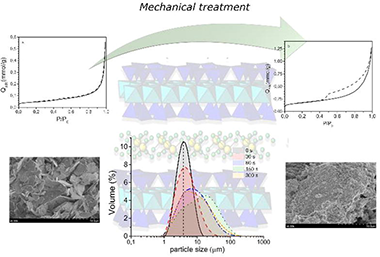
Mechanical treatments on design powder ceramic materials: Insight into the textural and structural changes

Mechanical treatment of porous ceramics, such as porous clay minerals, is a crucial step in ceramic processing. Among clay minerals, design swelling brittle micas have shown exceptional properties for further applications, although they exhibit low surface area and porosity. But, their mechanical activation could improve their textural properties and deserves to be investigated. Thus, the aim of this work…

Sustainable Integration of Zinc Oxide Nanoparticles: Enhancing Properties of Poly(ε-Caprolactone) Electrospun Nanofibers and Cast Films

This study investigated the impact of adding zinc oxide nanoparticles (ZnO-NPs) to electrospun membranes and cast films made of poly(epsilon-caprolactone) (PCL). The physicochemical, mechanical, and morphological properties of the samples were analyzed. Physicochemical parameters included water contact angle (WCA), water vapor transmission rate (WVTR), permeance, water vapor permeability (WVP), light transmission (T-600), and transparency (T). Mechanical properties, such as maximum stress (6(max)), elongation (epsilon(max)), and Young’s modulus (MPa), were also evaluated. Morphological properties were…

Biodegradability Assessment of Prickly Pear Waste-Polymer Fibers under Soil Composting

Nowadays, solving the problems associated with environmental pollution is of special interest. Therefore, in this work, the morphology and thermal and mechanical properties of extruded fibers based on polylactic acid (PLA) and poly(butylene adipate-co-terephthalate) (PBAT) added to prickly pear flour (PPF) under composting for 3 and 6 months were evaluated. The highest weight loss percentage (92 +/- 7%) was obtained after 6-month degradation of the PLA/PBAT/PPF/CO/AA blend, in which…

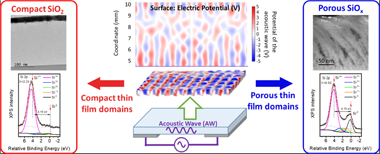
Plasmas and acoustic waves to pattern the nanostructure and chemistry of thin films

In this work, piezoelectric AWs and plasmas have been brought together during the growth of a thin film as a novel methodology of plasma-assisted thin film structuration. The ensuing effects have been investigated on a model system where SiO2 and SiOx (x<2) thin films have been deposited by magnetron sputtering at oblique angles (MS-OAD) on an electro-acoustically excited LiNbO3 piezoelectric substrate under resonant conditions. The microstructure of the resulting films was 2D patterned and depicted submillimeter size intermingled zones…