Modeling Macro-Sized, High Aspect Ratio Through-Hole Filling by Multi-Component Additive-Assisted Copper Electrodeposition

A multi-element, time-dependent model is used to examine additive-assisted copper electroplating in macro-channels. This model is an adaptation of the work of Akolkar and Landau [J. Electrochem. Soc., 156, D351 (2009)], used to describe plating in micro-vias for integrated circuits. Using their method for describing species movement in the channel, the model has been expanded…

Modeling Macro-Sized, High Aspect Ratio Through-Hole Filling by Multi-Component Additive-Assisted Copper Electrodeposition

A multi-element, time-dependent model is used to examine additive-assisted copper electroplating in macro-channels. This model is an adaptation of the work of Akolkar and Landau [J. Electrochem. Soc., 156, D351 (2009)], used to describe plating in micro-vias for integrated circuits. Using their method for describing species movement in the channel, the model has been expanded…

Thermal conductivity of wood-derived graphite and copper–graphite composites produced via electrodeposition

The thermal conductivity of wood-derived graphite and graphite/copper composites was studied both experimentally and using finite element analysis. The unique, naturally-derived, anisotropic porosity inherent to wood-derived carbon makes standard porosity-based approximations for thermal conductivity poor estimators. For this reason, a finite element technique which uses sample microstructure as model input was utilized to determine the…

In situ imaging and strain determination during fracture in a SiC/SiC ceramic matrix composite

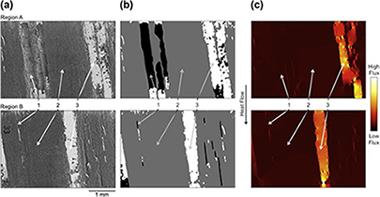
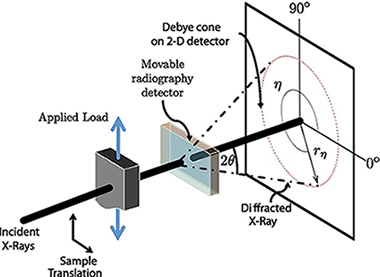
A combined imaging and microdiffraction technique using high-energy synchrotron X-rays is described and used to reveal microstructure, damage and strain evolution around notches in SiC/SiC composites. This technique allows for monitoring the material for cracks while loading and mapping the strain distribution in fibers and matrix with a resolution of tens of microns. We show…

Structure-mediated transition in the behavior of elastic and inelastic properties of beach tree bio-carbon

Microstructural characteristics and amplitude dependences of the Young modulus E and of internal friction (logarithmic decrement δ) of bio-carbon matrices prepared from beech tree wood at different carbonization temperatures T carb ranging from 600 to 1600°C have been studied. The dependences E(T carb) and δ(T carb) thus obtained revealed two linear regions of increase of…

Monolayer arrangement of fatty hydroxystearic acids on graphite: Influence of hydroxyl groups

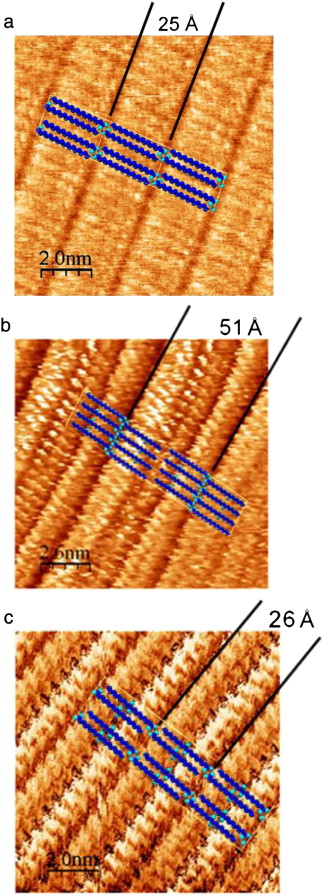
Previous studies have indicated that long-chain linear carboxylic acids form commensurate packed crystalline monolayers on graphite even at temperatures above their melting point. This study examines the effect on the monolayer formation and structure of adding one or more secondary hydroxyl, functional groups to the stearic acid skeleton (namely, 12-hydroxystearic and 9,10-dihydroxystearic acid). Moreover, a…

Evaluation of rare earth on layered silicates under subcritical conditions: Effect of the framework and interlayer space composition

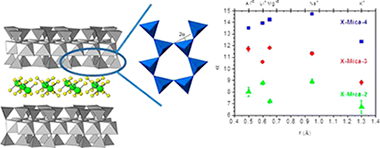
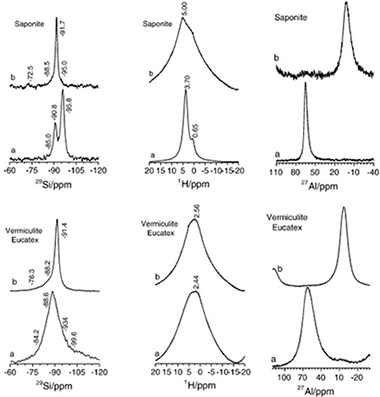
Clay-based minerals are considered to be an important component in backfill barriers due to both their ability to seal and adsorb radioactive waste and to interact chemically with it under subcritical conditions. Herein, we describe a systematic study of the properties of layered silicates that could affect their hydrothermal reactivity, namely type of layers, octahedral…

Solution Properties of the System ZrSiO4–HfSiO4: A Computational and Experimental Study

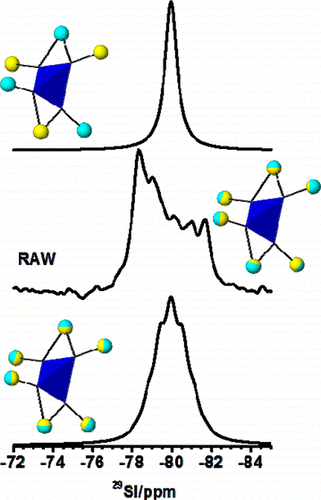
ZrSiO4 and HfSiO4 are of considerable interest because of their low thermal expansions, thermal conductivities, and the optical properties of HfSiO4. In addition, silicate phases of both are studied as model radioactive waste disposal materials. Previous first principles calculations reported near ideal mixing in the Zr1–xHfxSiO4 system, with a very weak propensity for phase separation.…