Strength and thermal shock resistance of fiber-bonded Si-Al-C-O and Si-Ti-C-O ceramics

Silicon carbide-based fiber-bonded ceramics, obtained from hot pressing of woven silicon carbide fibers, are a cost-effective alternative to ceramic-matrix composites due to their ease of fabrication, involving few processing steps, and competitive thermomechanical properties. In this work, we studied the high-temperature strength and thermal shock resistance of Si-Al-C-O and Si-Ti-C-O fiber-bonded SiC ceramics obtained from…

Iron-catalyzed graphitization for the synthesis of nanostructured graphitic carbons

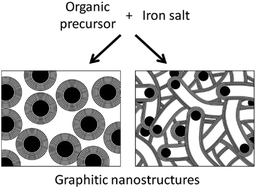
Carbons are versatile and diverse materials that have numerous applications across energy and environmental sciences. Carbons with a graphitic structure are particularly appealing due to their high chemical stability, large surface areas and high thermal and electronic conductivity. Numerous methods exist to produce nanostructured graphitic carbons but some of these can be energy-intensive and/or have…

The Response of Tomato Fruit Cuticle Membranes Against Heat and Light

Two important biophysical properties, the thermal and UV-Vis screening capacity, of isolated tomato fruit cuticle membranes (CM) have been studied by differential scanning calorimetry (DSC) and UV-Vis spectrometry, respectively. A first order melting, corresponding to waxes, and a second order glass transition (T-g) thermal events have been observed. The glass transition was less defined and displaced toward higher temperatures along the fruit ripening. In immature and mature green fruits, the CM…

Waterproof-breathable films from multi-branched fluorinated cellulose esters

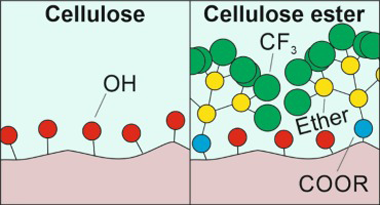
Cellulose ester films were prepared by esterification of cellulose with a multibranched fluorinated carboxylic acid, «BRFA» (BRanched Fluorinated Acid), at different anhydroglucose unit:BRFA molar ratios (i.e., 1:0, 10:1, 5:1, and 1:1). Morphological and optical analyses showed that cellulose-BRFA materials at molar ratios 10:1 and 5:1 formed flat and transparent films, while the one at 1:1…

Impact of flame confinement with inert ceramic foams on the particulate emissions of domestic heating systems

Small solid biomass combustion systems are among the main contributors to the global particulate emissions share, and cheap, efficient abatement systems are not yet available for them. The placement of inert porous material to confine the combustion region is being recently explored as a possible mitigation system for this kind of pollution. However, given the…

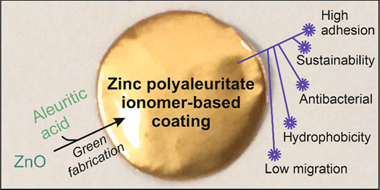
Zinc Polyaleuritate Ionomer Coatings as a Sustainable, Alternative Technology for Bisphenol A-Free Metal Packaging

Sustainable coatings for metal food packaging were prepared from ZnO nanoparticles (obtained by the thermal decomposition of zinc acetate) and a naturally occurring polyhydroxylated fatty acid named aleuritic (or 9,10,16-trihydroxy-hexadecanoic) acid. Both components reacted, originating under specific conditions zinc polyaleuritate ionomers. The polymerization of aleuritic acid into polyaleuritate by a solvent-free, melt polycondensation reaction was…