Highly Anisotropic Organometal Halide Perovskite Nanowalls Grown by Glancing-Angle Deposition

Polarizers are ubiquitous components in current optoelectronic devices as displays or photographic cameras. Yet, control over light polarization is an unsolved challenge, since the main drawback of the existing display technologies is the significant optical losses. In such a context, organometal halide perovskites (OMHP) can play a decisive role given their flexible synthesis with tunable…

Analysis of Dry Reforming as direct route for gas phase CO2 conversion. The past, the present and future of catalytic DRM technologies

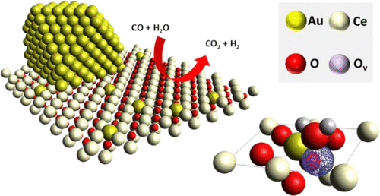
Transition to low carbon societies requires advanced catalysis and reaction engineering to pursue green routes for fuels and chemicals production as well as CO2 conversion. This comprehensive review provides a fresh perspective on the dry reforming of methane reaction (DRM) which constitutes a straightforward approach for effective CO2 conversion to added value syngas. The bottleneck…

Iron-catalyzed graphitization for the synthesis of nanostructured graphitic carbons

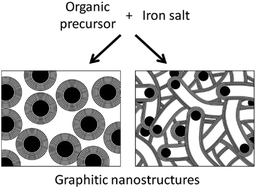
Carbons are versatile and diverse materials that have numerous applications across energy and environmental sciences. Carbons with a graphitic structure are particularly appealing due to their high chemical stability, large surface areas and high thermal and electronic conductivity. Numerous methods exist to produce nanostructured graphitic carbons but some of these can be energy-intensive and/or have…

Plasma assisted CO2 dissociation in pure and gas mixture streams with a ferroelectric packed-bed reactor in ambient conditions

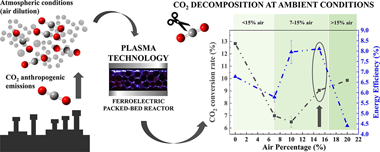
Carbon dioxide decomposition is a challenging target to combat climate change. Nonthermal plasmas are advantageous for this purpose because they operate at ambient conditions and can be easily scaled-up. In this study, we attempt the CO2 splitting into CO and O-2 in a parallel plate packed-bed plasma reactor moderated with Lead Zirconate Titanate (PZT) as…

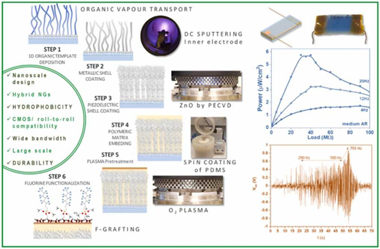
Plasma engineering of microstructured piezo-Triboelectric hybrid nanogenerators for wide bandwidth vibration energy harvesting

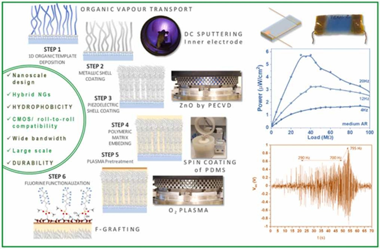
We introduce herein the advanced application of low-pressure plasma procedures for the development of piezo and triboelectric mode I hybrid nanogenerators. Thus, plasma assisted deposition and functionalization methods are presented as key enabling technologies for the nanoscale design of ZnO polycrystalline shells, the formation of conducting metallic cores in core@shell nanowires, and for the solventless…

Plasma engineering of microstructured piezo-Triboelectric hybrid nanogenerators for wide bandwidth vibration energy harvesting

We introduce herein the advanced application of low-pressure plasma procedures for the development of piezo and triboelectric mode I hybrid nanogenerators. Thus, plasma assisted deposition and functionalization methods are presented as key enabling technologies for the nanoscale design of ZnO polycrystalline shells, the formation of conducting metallic cores in core@shell nanowires, and for the solventless…

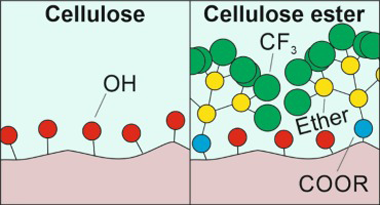
Waterproof-breathable films from multi-branched fluorinated cellulose esters

Cellulose ester films were prepared by esterification of cellulose with a multibranched fluorinated carboxylic acid, «BRFA» (BRanched Fluorinated Acid), at different anhydroglucose unit:BRFA molar ratios (i.e., 1:0, 10:1, 5:1, and 1:1). Morphological and optical analyses showed that cellulose-BRFA materials at molar ratios 10:1 and 5:1 formed flat and transparent films, while the one at 1:1…

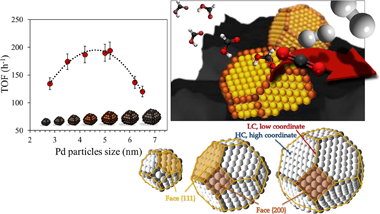
Structure-sensitivity of formic acid dehydrogenation reaction over additive-free Pd NPs supported on activated carbon

In this study the size-activity dependence of palladium based catalysts in formic acid dehydrogenation reaction was investigated and evaluated. A wide range of particle sizes was considered and the catalyst series were prepared upon variation of some synthetic parameters, precursor and solvent nature in particular. Synthesis method variations affect significantly Pd particle size and results…

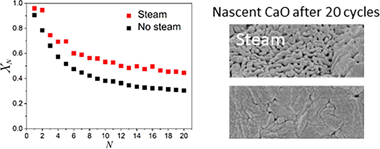
Kinetics and cyclability of limestone (CaCO3) in presence of steam during calcination in the CaL scheme for thermochemical energy storage

In the present work, we explore the use of steam in the CaCO3 calcination step of the Calcium Looping process devised for thermochemical energy storage (CaL-TCES). Steam produces a double benefit: firstly, it fastens calcination, allowing a reduction of the temperature needed to attain full calcination in short residence times, as those required in practice,…