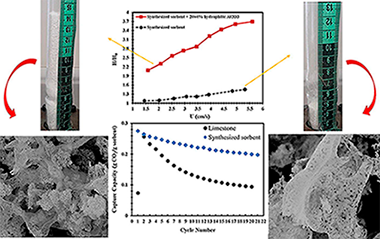
Multicycle CO2 capture activity and fluidizability of Al-based synthesized CaO sorbents

CaO-based materials have been identified as promising sorbents for highly efficient pre-combustion and post-combustion CO2 capture in fluidized beds operated at high temperatures by means of the Calcium Looping (CaL) process. However, Ca-based sorbents suffer from a decline of the capture capacity over multiple sorption/desorption cycles, mainly due to sintering, and from a markedly heterogeneous fluidization…

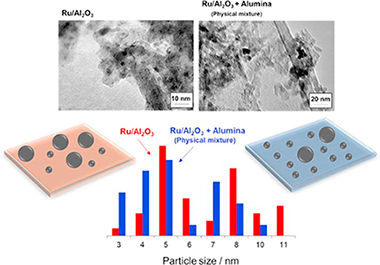
Does shaping catalysts modify active phase sites? A comprehensive in situ FTIR spectroscopic study on the performance of a model Ru/Al2O3 catalyst for the CO methanation

Routinely, it seems assumed that the catalytic layer coated on monoliths and microchannel reactors preserve the properties of the initial powder catalyst. However, this assumption should be reasonably demonstrated since the set of chemical and physical manipulations involved in the preparation of these catalytic devices hardly does not alter the surface of the starting catalyst…

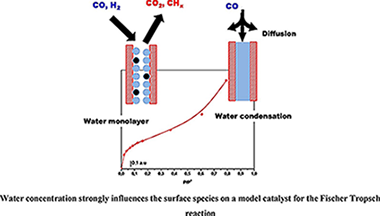
CO/H-2 adsorption on a Ru/Al2O3 model catalyst for Fischer Trospch: Effect of water concentration on the surface species

Water presence and concentration strongly influence CO conversion and CS+ selectivity in the Fischer Tropsch reaction. In this work, the influence of the water concentration was investigated using a model Ru/Al2O3 (5 wt. %) catalyst. The surface species formed after CO and H-2 adsorption in dry and wet (different water concentrations) conditions were analyzed by…

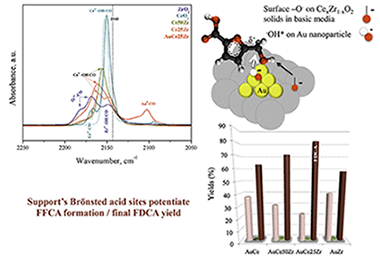
Understanding the Role of the Acid Sites in 5-Hydroxymethylfurfural Oxidation to 2,5-Furandicarboxylic Acid Reaction over Gold Catalysts: Surface Investigation on CexZr1-xO2 Compounds

A series of CexZr1-xO2 supports with different Ce/Zr molar ratios were utilized for the preparation of gold catalyst used in the selective oxidation of 5-hydroxymethyl-2-furfural to 2,5-furandicarboxylic acid. The used method of gold deposition allows the preparation of gold particles with homogeneous size and shape distribution, a formulation very useful for studies dedicated to revealing…

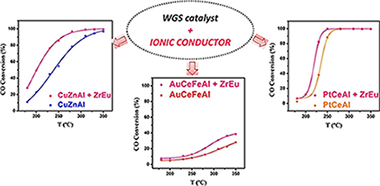
New concept for old reaction: Novel WGS catalyst design

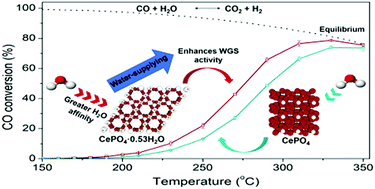
The viability of water gas shift catalytic system for mobile application passes through obligatory reactor volume reduction, achieved normally by using less charge of more efficient catalyst. Completely new concept for catalyst design is proposed: a catalytic system including classically reported WGS catalysts of different nature or active phase (Cu, Pt or Au) mechanically mixed…

Selective CO methanation with structured RuO2/Al2O3 catalysts

Active and selective structured RuO2/Al2O3 catalysts for CO methanation using a flow simulating CO2-rich reformate gases from WGS and PROX units (H-2 excess, CO2 presence and 300 ppm CO concentration) were prepared. Both, the RuO2/Al2O3 powder and the slurry prepared from it for its structuration by washcoating of the metallic micromonolithic structure, were also active…

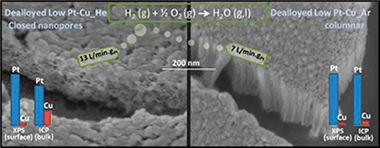
Nanoporous Pt-based catalysts prepared by chemical dealloying of magnetron-sputtered Pt-Cu thin films for the catalytic combustion of hydrogen

In this work, we prepared SiC-supported Pt-Cu thin films by magnetron sputtering for use as catalysts for the combustion of hydrogen under oxidizing conditions. We tested the catalysts as prepared and after chemical dealloying. A methodology is presented to fabricate catalytic thin films of a desired composition with tailored magnetron targets with lower Pt consumption.…

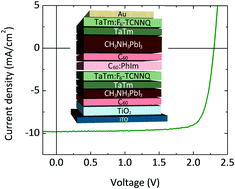
High voltage vacuum-deposited CH3NH3PbI3–CH3NH3PbI3 tandem solar cells

The recent success of perovskite solar cells is based on two solid pillars: the rapid progress of their power conversion efficiency and their flexibility in terms of optoelectrical properties and processing methods. That versatility makes these devices ideal candidates for multi-junction photovoltaics. We report an optically optimized double junction CH3NH3PbI3-CH3NH3PbI3 tandem solar cell where the…

A direct in situ observation of water-enhanced proton conductivity of Eu-doped ZrO2: Effect on WGS reaction

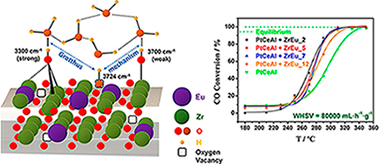
Eu-doped ZrO2 solid solutions have been synthesized in order to prepare proton conductors as water-enhancer additives for the WGS reaction. Elemental characterization has been carried out revealing homogeneous dopant distribution resulting in fluorite-type solid solutions for Eu2O3 contents up to similar to 9 mol.%. Representative samples of the Eu-doped ZrO2 series have been analysed by…