Unravelling the CO2 capture and conversion mechanism of a NiRu-Na2O switchable dual-function material in various CO2 utilisation reactions

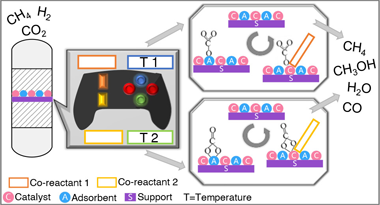
Time-resolved operando DRIFTS-MS was performed to elucidate the CO2 capture and conversion mechanisms of a NiRuNa/CeAl DFM in CO2 methanation, reverse water-gas shift, and dry reforming of methane. CO2 was captured mainly in the form of carbonyls and bidentate carbonates, and a spillover mechanism occurred to obtain the desired products.

The Need for Flexible Chemical Synthesis and How Dual-Function Materials Can Pave the Way

Since climate change keeps escalating, it is imperativethat theincreasing CO2 emissions be combated. Over recent years,research efforts have been aiming for the design and optimizationof materials for CO2 capture and conversion to enable acircular economy. The uncertainties in the energy sector and the variationsin supply and demand place an additional burden on the commercializationand implementation…

Scalable synthesis of 2D Ti2CTx MXene and molybdenum disulfide composites with excellent microwave absorbing performance

The signal crosstalk and electromagnetic interference (EMI) problems direly need to be resolved in the rapid development of modern microwave communication technology for a better working frequency and transmission power of electronic systems. Where the new absorbing materials such as molybdenum disulfide (MoS2)/titania (TiO2)/Ti2CTx and MoS2/Ti2CTx composites could meet the requirement of «thin, strong, light…

Non-sticky interactions

Quantum mechanical fluctuations of the electromagnetic field in a vacuum between two close together objects result in an attractive force. Now, it has been experimentally shown that by exploiting a similar repulsive interaction, attraction between objects can be modulated simply by tuning temperature.

A Holistic Solution to Icing by Acoustic Waves: De-Icing, Active Anti-Icing, Sensing with Piezoelectric Crystals, and Synergy with Thin Film Passive Anti-Icing Solutions

Icing has become a hot topic both in academia and in the industry given its implications in transport, wind turbines, photovoltaics, and telecommunications. Recently proposed de-icing solutions involving the propagation of acoustic waves (AWs) at suitable substrates may open the path for a sustainable alternative to standard de-icing or anti-icing procedures. Herein, the fundamental interactions…

Highly Nonstoichiometric YAG Ceramics with Modified Luminescence Properties

Y3Al5O12 (YAG) is a widely used phosphor host. Its optical properties are controlled by chemical substitution at its YO8 or AlO6/AlO4 sublattices, with emission wavelengths defined by rare-earth and transition-metal dopants that have been explored extensively. Nonstoichiometric compositions Y3+xAl5-xO12 (x not equal 0) may offer a route to new emission wavelengths by distributing dopants over…

Unraveling the Mo/HZSM-5 reduction pre-treatment effect on methane dehydroaromatization reaction

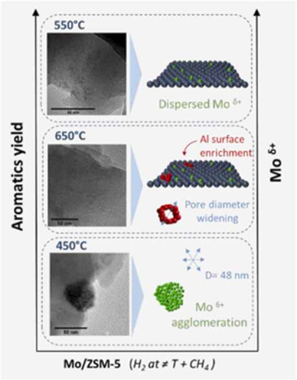
Reduction pre-treatment at different temperatures were performed over Mo/HZSM-5 system before methane dehydroaromatiztion reaction. We have shown the crucial effect of reduction temperature on the final catalytic performance. Outstanding improvement in the aromatics conversion has been attained. Thus, H-2 formation form methane cracking reaction seems to be hindered for pre-treated catalysts. As a consequence, the…

Low-pressure calcination to enhance the calcium looping process for thermochemical energy storage

The Calcium-Looping (CaL) process, based on the multicyclic calcination-carbonation of CaCO3/CaO, is considered a promising Thermochemical Energy Storage (TCES) technology to be integrated into Concentrating Solar Power (CSP) plants. This work proposes a novel CaL integration that operates at low-pressure calcination under pure CO2 and a moderated temperature. Low-pressure calcination (0.01 bar) provides a suitable solution…

Shepherding reaction intermediates to optimize H-2 yield using composite-doped TiO2-based photocatalysts

Optimization of Pt-promoted TiO2-based is key to promote the photocatalytic production of hydrogen using sacrificial alcohol molecules. Combination of doping and surface decoration of the mentioned base photoactive material is here exploited to maximize hydrogen yield. Using the quantum efficiency parameter, it is shown that the resulting composite system can boost activity up to 7.3…