Room-temperature cavity exciton-polariton condensation in perovskite quantum dots

The exploitation of the strong light-matter coupling regime and exciton-polariton condensates has emerged as a compelling approach to introduce strong interactions and nonlinearities into numerous photonic applications. The use of colloidal semiconductor quantum dots with strong three-dimensional confinement as the active material in optical microcavities would be highly advantageous due to their versatile structural and…

Interfacial Chemistry Limits the Stability of Deep Blue Perovskite LEDs Revealed by Operando Characterization

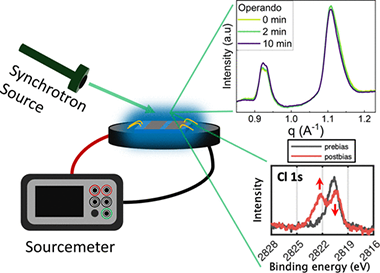
To commercialize lead halide perovskites as light-emitting diodes (LEDs), the operational device lifetime needs to be drastically improved. For this to be achieved, an understanding of degradation behavior under bias is crucial. Herein, we perform operando measurements of the structural, chemical, and electronic changes using synchrotron-based grazing-incidence wide-angle X-ray scattering and hard X-ray photoelectron spectroscopy…

Plasticized cellulose bioplastics with beeswax for the fabrication of multifunctional, biodegradable active food packaging

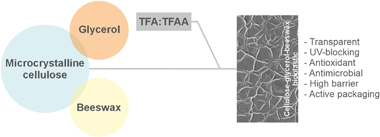
Plasticized cellulose bioplastics with antioxidant and antimicrobial properties were prepared by blending cellulose and glycerol in a mixture of trifluoroacetic acid and trifluoroacetic anhydride, adding a solution of beeswax in chloroform, and subsequent drop-casting. Optical, chemical, structural, mechanical, thermal, and hydrodynamic properties were fully characterized. In addition, the biodegradability in seawater was investigated by determination…

Compositional Gradient of Mixed Halide 2D Perovskite Interface Boosts Outdoor Stability of Highly Efficient Perovskite Solar Cells

Interface engineering using self-assembled 2D perovskite interfaces is a consolidated route to efficient and durable perovskite solar cells. Whether the 2D perovskite forms a homogeneous conformal layer or is heterogeneously distributed on the surface, interface defects are passivated, leading to a general improvement in the device’s open circuit voltage (VOC) and stability. Here, an innovative…

Triphenyl Acetic Glyceroate as a sustainable multifunctional additive for developing transparent, biodegradable, and flexible polylactide green alternative to polyethylene-based films for food packaging

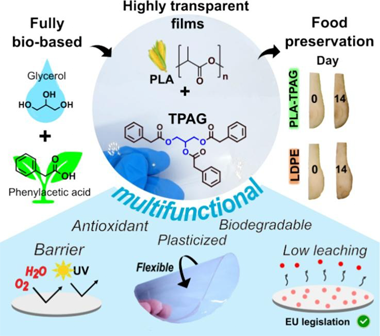
Polylactide-based materials represent a promising bio-based alternative to traditional food packaging polymers. However, their widespread use is still limited due to significant drawbacks, such as brittleness, high gas permeability, and biodegradability only under specific conditions. This work introduces fully bio-based Triphenyl Acetic Glyceroate (TPAG), synthesized through a solvent-free and mild conditions valorization of glycerol and…

Design of catalysts for selective CO2 hydrogenation

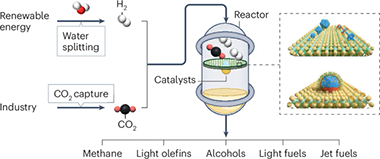
CO2 hydrogenation with green hydrogen is a practical approach for the reduction of CO2 emissions and the generation of high-value-added chemicals. Generally, product selectivity is affected by the associated reaction mechanisms, internal catalyst identity and structure, and external reaction conditions. Here we examine typical CO2 hydrogenation reaction pathways, which can provide insight useful for the atomic-level design of…

Exploring the impact of nanoshaped ceria in the methanol decomposition reaction pathway for clean energy production

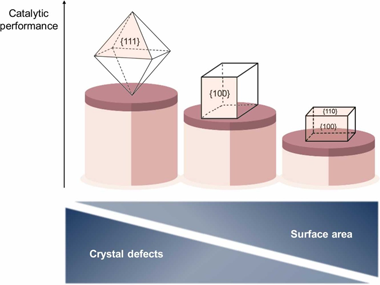
The effect of facet exposure in ceria nanostructures on the catalytic properties of Pd/CeO2 during methanol decomposition was investigated. The results showed the structure sensitive nature of this reaction, with the catalytic activity depending on the facet exposed in the ceria nanostructures. Operando DRIFTS-MS and DFT calculations demonstrated that methanol decomposition proceeds mainly via two…

Improving the photocatalytic degradation of EDTMP: Effect of doped NPs (Na, Y, and K) into the lattice of modified Au/TiO2 nano-catalysts

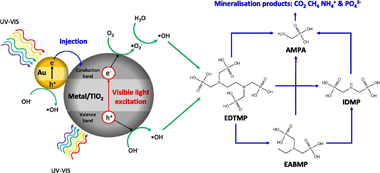
This study presents the photocatalytic degradation of the aminophosphonate ethylenediaminetetra(methylenephosphonic acid) (EDTMP) with a range of different doped nanoparticles (NP). The photocatalysts were based on TiO2 benchmark P25 and gold (Au) doped either with sodium (Na), potassium (K) or yttrium (Y). The synthesized photocatalysts were characterized via TEM, XRF, XRD, UV-DRS (band gap estimation) and…

Photoinduced Spin Centers in Photocatalytic Metal-Organic Framework UiO-66

Metal-Organic frameworks (MOFs) are promising candidates for advanced photocatalytically active materials. These porous crystalline compounds have large active surface areas and structural tunability and are thus highly competitive with oxides, the well-established material class for photocatalysis. However, due to their complex organic and coordination chemistry composition, photophysical mechanisms involved in the photocatalytic processes in MOFs…

The impact of interfacial quality and nanoscale performance disorder on the stability of alloyed perovskite solar cells

Microscopy provides a proxy for assessing the operation of perovskite solar cells, yet most works in the literature have focused on bare perovskite thin films, missing charge transport and recombination losses present in full devices. Here we demonstrate a multimodal operando microscopy toolkit to measure and spatially correlate nanoscale charge transport losses, recombination losses and…