Alkane metathesis over immobilized pincer-ligated iridium complexes: Effect of support nature

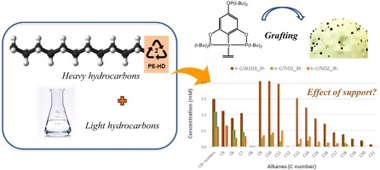
In this work, catalytic alkane metathesis has been evaluated as a suitable approach to upcycle hydrocarbons (polyolefins) at moderate temperatures. To this end, a pincer-ligated iridium complex (dehydrogenation catalyst) has been combined with a rhenium-based (metathesis) catalyst, being the effect of immobilizing the Ir complex over different supports deeply investigated. FTIR spectroscopy has been used to confirm the complex grafting and to elucidate the anchoring site…

Plasticized, greaseproof chitin bioplastics with high transparency and biodegradability

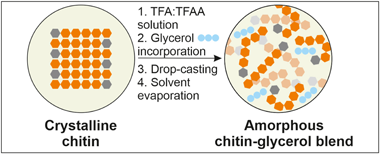
A mixture of trifluoroacetic acid:trifluoroacetic anhydride (TFA:TFAA) was used to dissolve chitin from shrimp shells. Free-standing films were prepared by blending the chitin solution and glycerol at different percentages, followed by drop-casting, and the complete evaporation of the solvents. After this process, the chitin matrix showed an amorphous molecular structure, as determined by X-ray diffraction. Optical, mechanical, thermal, and antioxidant properties…

Enroute to the Carbon-Neutrality Goals via the Targeted Development of Ammonia as a Potential Nitrogen-Based Energy Carrier

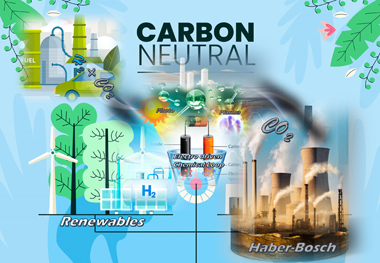
The reliance of a future carbon-free horizon is strongly aligned with the long-term energy storage avenues which are completely derived from renewable energy resources. Ammonia with its high energy content and density can perform as a decent candidate for buffering the short-term storage options. However, the current NH3 production majorly feeding the current huge desire for…

Negative emissions power plant based on flexible calcium-looping process integrated with renewables and methane production

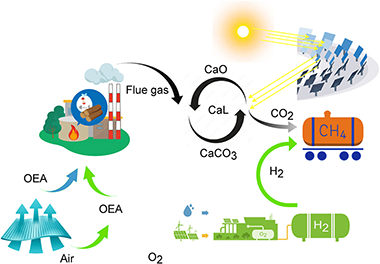
This paper provides a review of negative carbon capture technologies. Based on these technologies, here it is proposed an innovative negative emissions power plant combining the generation and storage of energy from biomass, photovoltaic, and concentrated solar power, capturing and recovering CO2 by producing H2 or CH4 as green energy carriers. The main features of the system are i) large-scale energy…

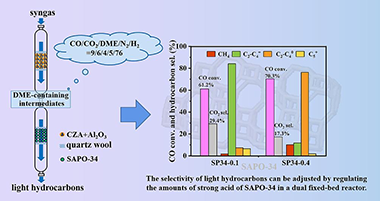
Catalytic conversion of syngas to light hydrocarbons via simulated intermediates CO/CO2/DME/N2/H2 over the regulated acidity of SAPO-34

  Direct conversion of syngas to light hydrocarbons has been intensively studied in recent years; however, the high selectivity of light hydrocarbons is still a challenging task to achieve a high CO conversion. Here, a bifunctional catalyst consisting of a methanol synthesis catalyst (CZA) and a methanol to dimethyl ether (DME) catalyst (Al2O3) was employed…

Process design and utilisation strategy for CO2 capture in flue gases. Technical assessment and preliminary economic approach for steel mills

The steel industry is the most relevant sector in emerging economies due to its application in numerous fields. However, steel manufacturing involves large energy investment and produces significant greenhouse gas emissions. The current world economic and environmental scenario therefore necessitates that improvements in the footprint of the steel industry be made without affecting its viability.…

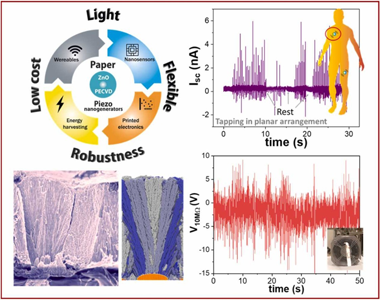
Paper-based ZnO self-powered sensors and nanogenerators by plasma technology

Nanogenerators and self-powered nanosensors have shown the potential to power low-consumption electronics and human-machine interfaces, but their practical implementation requires reliable, environmentally friendly and scalable processes for manufacturing and processing. Furthermore, the emerging flexible and wearable electronics technology demands direct fabrication onto innovative substrates such as paper and plastics typically incompatible with high process temperatures.…

Hydrogen production by catalytic aqueous-phase reforming of waste biomass: a review

The rising adverse effects of climate change call for a rapid shift to low-carbon energy and reducing our dependence on fossil fuels. For that, biorefineries appear as promising alternatives to produce energy, chemicals, and fuels using biomass and waste as raw materials. Here, we review catalytic aqueous-phase reforming to convert biomass and organic waste carbohydrates into renewable hydrogen, with focus on reforming basics; catalyst design; reforming of model compounds, wastewater and biomass; economics and life cycle assessment. We found…

Inkjet-Printed and Nanopatterned Photonic Phosphor Motifs with Strongly Polarized and Directional Light-Emission

Herein a versatile and scalable method to prepare periodically corrugated nanophosphor surface patterns displaying strongly polarized and directional visible light emission is demonstrated. A combination of inkjet printing and soft lithography techniques is employed to obtain arbitrarily shaped light emitting motifs. Such predesigned luminescent drawings, in which the polarization and angular properties of the emitted…

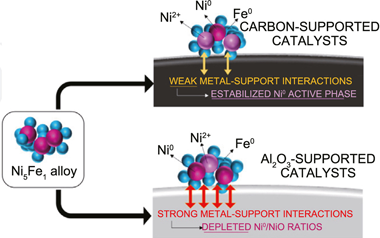
Are Ni/ and Ni5Fe1/biochar catalysts suitable for synthetic natural gas production? A comparison with g-Al2O3 supported catalysts

Among challenges implicit in the transition to the post-fossil fuel energetic model, the finite amount of resources available for the technological implementation of CO2 revalorizing processes arises as a central issue. The development of fully renewable catalytic systems with easier metal recovery strategies would promote the viability and sustainability of synthetic natural gas production circular…