Harvesting energy from friction: the revolutionary decade of triboelectric nanogenerators

Triboelectric nanogenerators (TENGs) have rapidly developed into a transformative energy harvesting technology, enabling self-powered, sustainable electronic systems. This review offers the first comprehensive, multidisciplinary perspective that connects the physics of triboelectric charge transfer with material innovation, device engineering, and real-world applications. We systematically categorize and measure the triboelectric series across a wide range of materials,…

Au-Polaritons Regulated Molecular Dipoles on Empowering the Giant Pyroelectric Response of Highly Oriented Dipoles of PVDF Thin Films

Ferroelectric polymers reinforced with noble metals enable advanced sensors, photodetectors, flexible electronics, and energy harvesters. This study investigates the effects of integrating hexagonal nanogold (n-Au) into poly(vinylidene fluoride) (PVDF), a prominent ferroelectric polymer, to advance the structure-property relationship in hybrid materials for next-generation sensor and energy conversion technologies. The fabricated Au-PVDF thin films (<= 100…

Unveiling of Unpaired Surface Spins Regulated Magnetism in 2D α-Te Nanosheets: an Implication on Magnetoelectric Driven Hydrogen Evolution

Quasi-2D tellurium (Te) unlocks surface spins (of valence 5p4 electrons) of tunable ferromagnetic order and response to strain-engineered electronic properties of widespread applications. In spin-orbit coupling, the inversion symmetry is broken in a 1S0 -> 3S1 spin-transition of the ground electronic state, a synergetic pathway to charge spin-order under applied driving forces. The surface magnetism,…

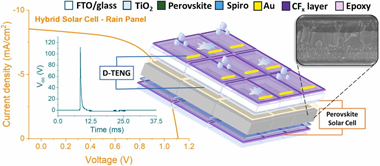
Water-resistant hybrid perovskite solar cell – drop triboelectric energy harvester

Hybrid energy-harvesting systems that combine perovskite solar cells (PSCs) with drop-driven triboelectric nanogenerators (D-TENGs) offer a compelling solution for continuous power generation under diverse weather conditions. Yet, the inherent vulnerability of halide perovskites to moisture and environmental stressors remains a critical barrier to their widespread deployment. To overcome this bottleneck, we introduce plasma-deposited fluorinated polymers…

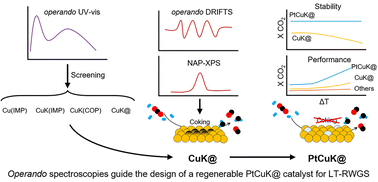
Spectroscopy-guided optimization of copper-based catalysts for low-temperature CO2 recycling to CO

The reverse water–gas shift (RWGS) reaction provides a sustainable route for CO2 valorization by producing CO, a key intermediate for various industrial applications. Its endothermic nature and the competition with Sabatier reaction impose a practical challenge on the design of low and medium temperature RWGS catalysts thus hampering its integration with downstream units. In this study,…

Exciton-Polaritons in Nanoscale Metal-Organic Frameworks: A Platform for the Reversible Modulation of Strong Light-Matter Coupling via the Chemical Environment

We demonstrate robust exciton-polariton formation in planar metallic optical cavities incorporating porphyrin-based Metal-Organic Framework (MOF) nanoparticles. Our fabrication strategy employs highly monodisperse fluorinated MOF nanoparticle monolayers, sequentially coated with transparent silicon dioxide nanoparticles, enabling precise control over film thickness while preserving MOF pore accessibility. This architecture ensures well-defined excitonic transitions and facilitates alignment of the…

Carbonation tests in a kW-scale entrained flow reactor for thermochemical energy storage using the calcium looping-based system

Deploying reliable and sustainable large-scale energy storage is a significant challenge for the widespread adoption of renewable energy sources. Thermal energy storage solutions can provide scalable solutions for renewable power and industrial processes. The calcium looping-based energy storage system stands out for its high energy density, low cost, non-toxicity, and wide availability of limestone as…

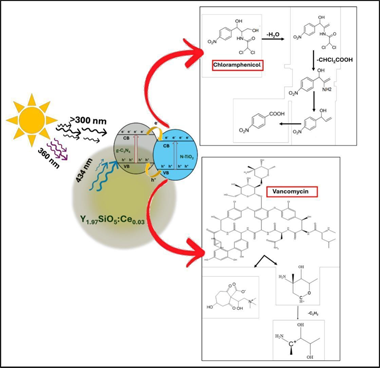
Enhanced photocatalytic degradation of organic pollutants in water by g-C3N4/N-TiO2/Y1.97SiO5:Ce0.03 heterostructure

A novel ternary heterostructure based on g-C3N4/N-TiO2/Y1.97SiO5:Ce-0.03 was synthesized via thermal treatment and evaluated for the photocatalytic degradation of two antibiotic pollutants, chloramphenicol (CAP) and vancomycin (VAN), in aqueous solution. The composite was designed to function as a photoactive platform, in which Ce3+-doped Y2SiO5 acts as an internal light converter, emitting at similar to 430…

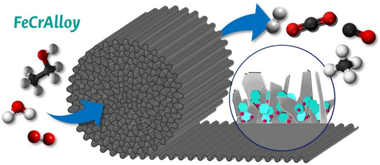
Catalytic performance of NiCo-CePr oxide on FeCrAlloy micromonoliths in hydrogen production by oxidative steam reforming of ethanol

The conformation of a NiCo catalyst promoted by CePr on FeCrAlloy thermally pretreated micromonoliths was investigated via washcoating using a colloidal suspension of the catalytic precursor (hydrotalcite, HT) without the use of additives. A high affinity was established between the nature of the reconstructed HT and the layer of the formed alumina microstructures obtained after…

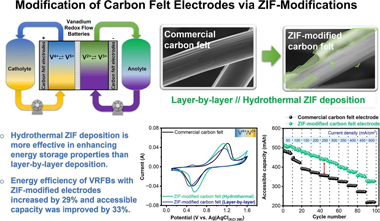
Improving energy storage properties of carbon felt electrodes for vanadium redox flow batteries via ZIF modifications

In this study, we successfully enhanced the electrochemical energy storage properties of commercial carbon felts by modifying their surface with metal-organic frameworks (MOFs) of the zeolitic imidazolate framework (ZIF) type, incorporating Fe, Co, Ni, Cu, and Zn as metal centres. These modifications were achieved through two distinct processes: layer-by-layer deposition and a hydrothermal synthesis method.…