Ultrathin Plasma Polymer Passivation of Perovskite Solar Cells for Improved Stability and Reproducibility

Despite the youthfulness of hybrid halide perovskite solar cells, their efficiencies are currently comparable to commercial silicon and have surpassed quantum-dots solar cells. Yet, the scalability of these devices is a challenge due to their low reproducibility and stability under environmental conditions. However, the techniques reported to date to tackle such issues recurrently involve the use of solvent methods that would further complicate their transfer to industry. Herein a reliable…

Photocatalytic oxidation of pollutants in gas-phase via Ag3PO4-based semiconductor photocatalysts: Recent progress, new trends, and future perspectives

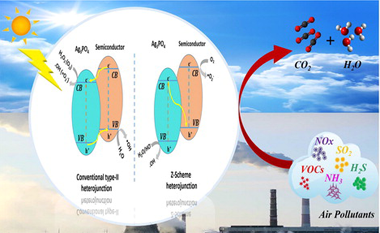
Air pollution has become a significant challenge for both developing and developed nations. due to its close association with numerous fatal diseases such as cancer, respiratory, heart attack, and brain stroke. Over recent years, heterogeneous semiconductor photocatalysis has emerged as an effective approach to air remediation due to the ease of scale-up, ready application in…

Greaseproof, hydrophobic, and biodegradable food packaging bioplastics from C6-fluorinated cellulose esters

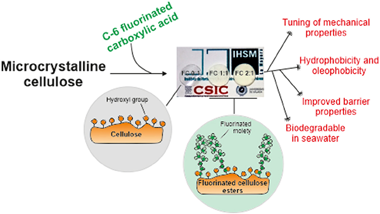
Tridecafluorononanoic acid (TFNA), a C6-fluorinated carboxylic acid, was esterified with cellulose at different molar ratios (0:1, 1:1, 2:1, and 3:1) in a trifluoroacetic acid (TFA):trifluoroacetic anhydride (TFAA):CHCl3 (2:1:1, v:v:v) solvent mixture. Free-standing films were obtained for all formulations and are presented as alternatives to composites and blends of paper with fluorinated molecules. Mechanical properties were…

Electrocatalytic CO2 conversion to C-2 products: Catalysts design, market perspectives and techno-economic aspects

The energy crisis caused by the incessant growth in global energy demand joint to its associated greenhouse emissions motivates the urgent need to control and mitigate atmospheric CO2 levels. Leveraging CO2 as carbon pool to produce value-added products represents a cornerstone of the circular economy. Among the CO2 utilization strategies, electrochemical reduction of CO2 conversion…

Evidence of new Ni-O-K catalytic sites with superior stability for methane dry reforming

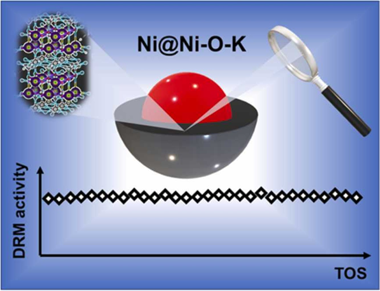
Liquid fuels produced via Fischer-Tropsch synthesis from biomass-derived syngas constitute an attractive and sustainable energy vector for the transportation sector. This study focuses on the role of potassium as a promoter in Ni-based catalysts for reducing coke deposition during catalytic dry reforming. The study provides a new structural link between catalytic performance and physicochemical properties.…

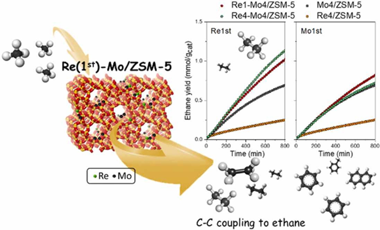
Characterization of Re-Mo/ZSM-5 catalysts: How Re improves the performance of Mo in the methane dehydroaromatization reaction

In this study, the promoting effect of rhenium addition as a co-dopant on Mo/ZSM-5 catalysts system has been analysed. Hence, bimetallic (Re-Mo/ZSM-5) catalysts have been synthesized using a sequential impregnation methodology. The catalytic performance for direct aromatization of methane reaction has been determined and correlated with their physical and chemical state combining multiple characterization techniques.…

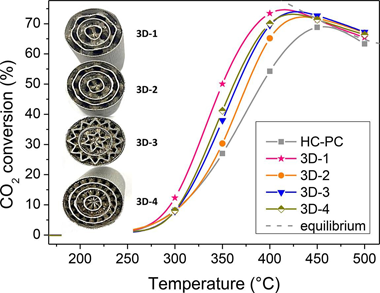
3D-printed structured catalysts for CO2 methanation reaction: Advancing of gyroid-based geometries

This work investigates the CO2 methanation rate of structured catalysts by tuning the geometr y of 3D-printed metal Fluid Guiding Elements (FGEs) structures based on periodically variable pseudo-gyroid geometries. The enhanced performance showed by the structured catalytic systems is mostly associated with the capability of the FGEs substrate geometries for efficient heat usages. Thus, variations…

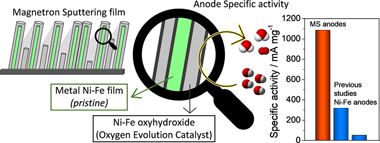
Ionomer-Free Nickel-Iron bimetallic electrodes for efficient anion exchange membrane water electrolysis

A bottleneck for the deployment of the Anion Exchange Membrane Water Electrolysis (AEMWE) is the manufacturing of efficient and long lasting anodes and cathodes for the cells. Highly performant bimetallic Ni/Fe catalyst films with various atomic ratios have been prepared by magnetron sputtering in an oblique angle configuration (MS-OAD) and used as anodes for AEMWE.…