An innovative combination of non-invasive UV–Visible-FORS, XRD and XRF techniques to study Roman wall paintings from Seville, Spain

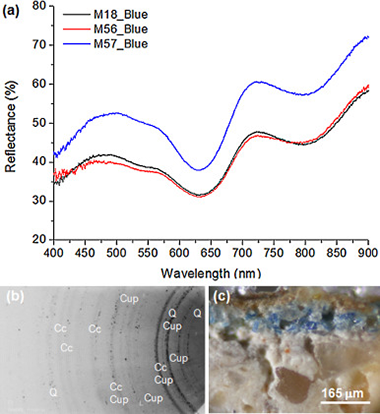
This study attempts to establish the advantages and limitations of the combined use of portable UV–Vis-FORS and XRF-XRD portable equipment for the non-invasive characterisation of pigments from Roman wall paintings from Seville, Spain, dated to the first and second century AD. XRD revealed the presence of calcite, dolomite and aragonite, indicating the colour white. Egyptian…

Optical sensing by integration of analyte-sensitive fluorophore to particles

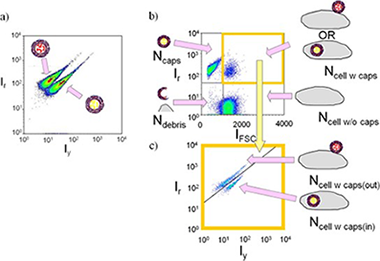
Analyte-sensitive fluorophores are a common tool in analytical chemistry. In case they are conjugated to the surface of colloidal nanoparticles new or improved applications are possible. An overview of the potential of such fluorophore-particle conjugates is given by means of several examples. First, using pH-sensitive fluorophores attached to particles are a helpful tool for investigating…

Recycling of construction and demolition waste generated by building infrastructure for the production of glassy materials

The use of waste materials generated by construction and demolition industry to yield valuable glassy materials, i.e. enamel for glazed ceramic tiles and cellular glasses is presented in this study. Both types of materials are produced by one-step treatment at moderate temperatures after simple waste chemical composition adjust. The enamels are manufactured directly from the…

Surface functionalizing of a lipid nanosystem to promote brain targeting: step-by-step design and physico-chemical characterization

The use of lipid nanosystems as drug delivery to the central nervous system may be advantageous over the current strategies. The aim of this study was to develop and characterize functionalized liposomes for treatment of brain diseases. The covalent method of coupling IgG to liposomes via the derivatized lipid 1,2-dioleoyl-sn-glycero-3-phosphoethanolamine-N-[4-(p-maleimidophenyl)butyramide](MPB-PE) was investigated. Optimized coupling conditions…

Characterization and Validation of a-Si Magnetron-Sputtered Thin Films as Solid He Targets with High Stability for Nuclear Reactions

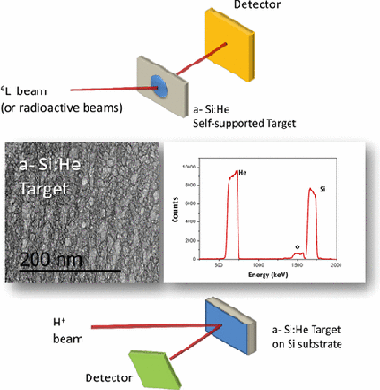
In this work, we present our magnetron sputtering based methodology to produce amorphous silicon coatings with closed porosity, as a strategy to fabricate solid helium targets, in the form of supported or self-supported thin films, for nuclear reactions. We show how by changing the He working pressure it is possible to obtain highly porous homogeneous…

Multifunctional Eu-doped NaGd(MoO4)(2) nanoparticles functionalized with poly(L-lysine) for optical and MRI imaging

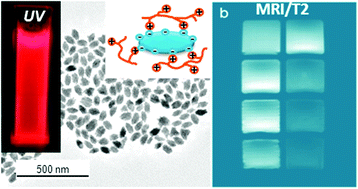
A method for the synthesis of non-aggregated and highly uniform Eu3+ doped NaGd(MoO4)(2) nanoparticles is reported for the first time. The obtained particles present tetragonal structure, ellipsoidal shape and their size can be varied by adjusting the experimental synthesis parameters. These nanoparticles, which were coated with citrate anions and functionalised with PLL, have also been…

Tailor-made preparation of Co-C, Co-B, and Co catalytic thin films using magnetron sputtering: insights into structure-composition and activation effects for catalyzed NaBH4 hydrolysis

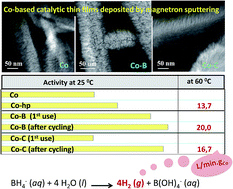
The magnetron sputtering (MS) methodology is a powerful tool for tailor-made fabrication of Co-based thin film catalysts with controlled microstructures and compositions for sodium borohydride (SBH) hydrolysis. In particular, Co-C catalysts were tested in this reaction and compared to Co-B and Co catalyst coatings. The microstructural and chemical analyses by X-ray diffraction (XRD), scanning and…

Combined TGA-MS kinetic analysis of multistep processes. Thermal decomposition and ceramification of polysilazane and polysiloxane preceramic polymers

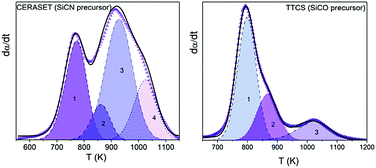
The polymer-to-ceramic transformation kinetics of two widely employed ceramic precursors, 1,3,5,7-tetramethyl-1,3,5,7-tetravinylcyclotetrasiloxane (TTCS) and polyureamethylvinylsilazane (CERASET), have been investigated using coupled thermogravimetry and mass spectrometry (TG-MS), Raman, XRD and FTIR. The thermally induced decomposition of the pre-ceramic polymer is the critical step in the synthesis of polymer derived ceramics (PDCs) and accurate kinetic modeling is key…

Surface functionalization of a lipid nanosystem to promote brain targeting: step-by-step design and physico-chemical characterization

The use of lipid nanosystems as drug delivery to the central nervous system may be advantageous over the current strategies. The aim of this study was to develop and characterize functionalized liposomes for treatment of brain diseases. The covalent method of coupling IgG to liposomes via the derivatized lipid 1,2-dioleoyl-sn-glycero-3-phosphoethanolamine-N-[4-(p-maleimidophenyl)butyramide](MPB-PE) was investigated. Optimized coupling conditions…