Pre-prosthetic use of poly(lactic-co-glycolic acid) membranes treated with oxygen plasma and TiO2 nanocomposite particles for guided bone regeneration processes

Objectives: Guided bone regeneration (GBR) processes are frequently necessary to achieve appropriate substrates before the restoration of edentulous areas. This study aimed to evaluate the bone regeneration reliability of a new poly-lactic-co-glycolic acid (PLGA) membrane after treatment with oxygen plasma (PO2) and titanium dioxide (TiO2) composite nanoparticles.  Methods: Circumferential bone defects (diameter: 10 mm; depth:…

Light management: porous 1-dimensional nanocolumnar structures as effective photonic crystals for perovskite solar cells

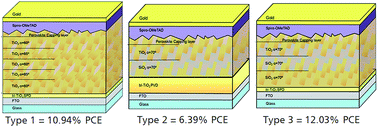
Hybrid organic-inorganic perovskite solar cells are a topic of increasing interest, as in a short time span they are able to lead in the third generation photovoltaics. Organohalide perovskites possess exceptional optoelectronic and physical properties, thus making their implementation possible in many diverse configurations of photovoltaic devices. In this work, we present three different configurations…

Effect of lime on stabilization of phyllite clays

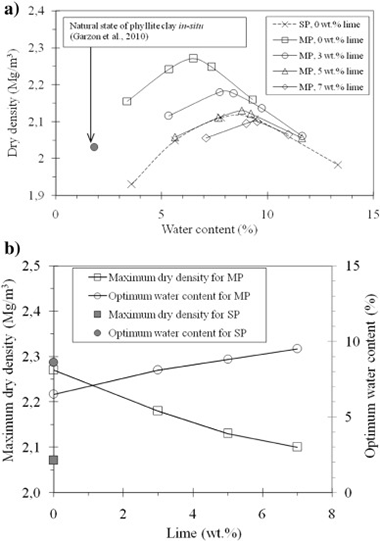
This paper represents a new advance in the study of engineering properties and material applications of phyllite clays. Considering their potential use as construction materials for structures subjected to low stress levels, this laboratory research investigated the stabilization and improvement in engineering properties of a Spanish phyllite clay achieved by the addition of 3, 5…

Nickel-copper bilayer nanoporous electrode prepared by physical vapor deposition at oblique angles for the non-enzymatic determination of glucose

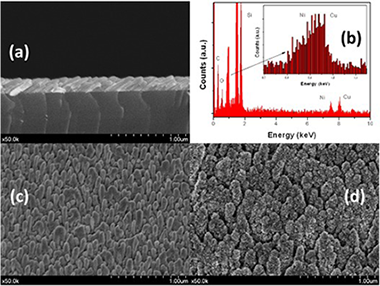
This work presents a novel bilayer Ni/Cu porous nanostructured film electrode prepared by physical vapor deposition (PVD) in an oblique angle configuration. Scanning electron microscopy (SEM) data revealed that the film, with an approximate thickness of 200 nm, is formed by tilted nanocolumns of around 50 nm of diameter and an inclination of 30° with respect to…

The Structure and Chemical Composition of Wall Paintings From Islamic and Christian Times in the Seville Alcazar

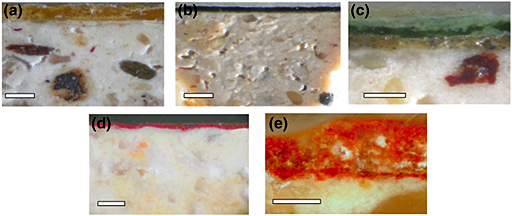
Wall paintings from the Islamic epoch (10th to 12th centuries) and the Christian monarchy (14th to 16th centuries) have been recovered in discarded materials and on walls after reconstruction works in the Seville Alcazar. These paintings have spent centuries underground or under a plaster coat. Portable X-ray fluorescence (XRF) and combined XRF/X-ray diffraction (XRD) were…

Effect of temperature variations on equilibrium distances in levitating parallel dielectric plates interacting through Casimir forces

We study at thermal equilibrium the effect of temperature deviations around room temperature on the equilibrium distance (d(eq)) at which thin films made of Teflon, silica, or polystyrene immersed in glycerol levitate over a silicon substrate due to the balance of Casimir, gravity, and buoyancy forces. We find that the equilibrium nature (stable or unstable)…

Growth Assisted by Glancing Angle Deposition: A New Technique to Fabricate Highly Porous Anisotropic Thin Films

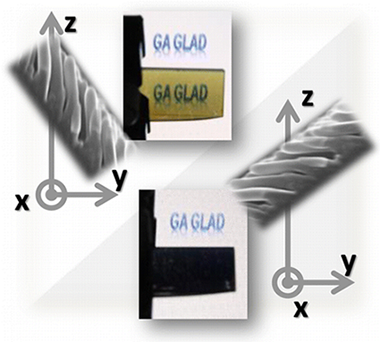
We report a new methodology based on glancing angle deposition (GLAD) of an organic molecule in combination with perpendicular growth of a second inorganic material. The resulting thin films retain a very well-defined tilted columnar microstructure characteristic of GLAD with the inorganic material embedded inside the columns. We refer to this new methodology as growth…

Nanogold mesoporous iron promoted ceria catalysts for total and preferential CO oxidation reactions

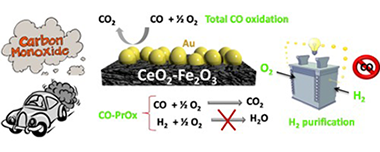
Herein, a series of highly efficient gold based catalysts supported on mesoporous CeO2-Fe2O3 mixed oxides for CO elimination reactions have been developed. The materials have been fully characterized by means of XRD, Raman and UV-vis spectroscopies among other techniques. We identify the Ce-Fe synergism as a fundamental factor controlling the catalytic performance. Our data clearly…

Strength and microplasticity of biocarbons prepared by carbonization in the presence of a catalyst

The microdeformation has been investigated under uniaxial compression of beech-derived biocarbons partially graphitized during carbonization in the presence of a Ni- or Fe-containing catalyst. The strength and ultimate fracture strain have been determined at different temperatures of carbonization of the samples in the absence or in the presence of a catalyst. It has been shown…