Perspectives on oblique angle deposition of thin films: From fundamentals to devices

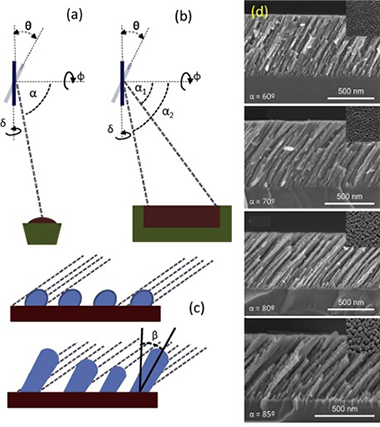
The oblique angle configuration has emerged as an invaluable tool for the deposition of nanostructured thin films. This review develops an up to date description of its principles, including the atomistic mechanisms governing film growth and nanostructuration possibilities, as well as a comprehensive description of the applications benefiting from its incorporation in actual devices. In…

Electrocatalytic System for the Simultaneous Hydrogen Production and Storage from Methanol

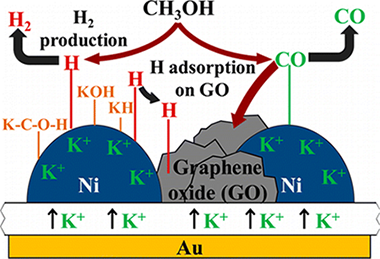
This paper reports a groundbreaking approach for simultaneous hydrogen production and storage that entails catalysis, electrochemistry, surface science, and materials synthesis. A novel electrocatalytic system is developed based on nickel nanocolumnar films of controlled microstructure prepared on K-βAl2O3 solid electrolyte supports by oblique angle physical vapor deposition. The outstanding characteristics of this system are a hydrogen…

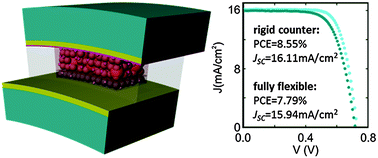
Integration of Photonic Crystals into Flexible Dye Solar Cells: A Route toward Bendable and Adaptable Optoelectronic Devices Displaying Structural Color and Enhanced Efficiency

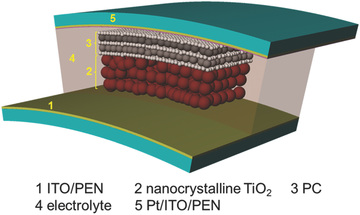
Herein is presented what is believed to be the first example of integration of photonic structures in a flexible optoelectronic device. The resulting devices may be designed to display any color in the visible range and, simultaneously, present enhanced power conversion efficiency as a consequence of the increased light harvesting caused by the colored back…

Nanoindentation and scratch resistance of multilayered TiO2-SiO2 coatings with different nanocolumnar structures deposited by PV-OAD

This paper presents a study of the mechanical properties and an evaluation of damage mechanisms of nanocolumnar TiO2-SiO2 multilayer coatings prepared by physical vapour oblique angle deposition at different configurations (slanted, zigzag or chiral) and two zenithal evaporation angles (70 degrees or 85 degrees). The characterization at micro-and nanometric length scales of the mechanical properties…

Maximized performance of dye solar cells on plastic: a combined theoretical and experimental optimization approach

We demonstrate that a combined optimization approach based on the sequential alternation of theoretical analysis and experimental realization gives rise to plastic supported dye solar cells for which both light harvesting efficiency and electron collection are maximized. Rationalized configurations with optimized light trapping and charge extraction are realized to achieve photoanodes on plastic prepared at…

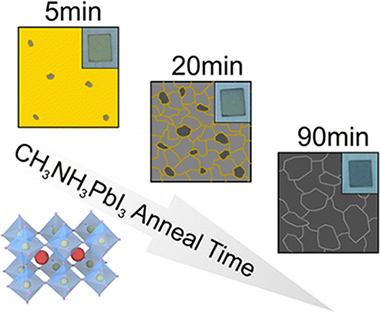
Photophysical Analysis of the Formation of Organic–Inorganic Trihalide Perovskite Films: Identification and Characterization of Crystal Nucleation and Growth

In this work we demonstrate that the different processes occurring during hybrid organic–inorganic lead iodide perovskite film formation can be identified and analyzed by a combined in situ analysis of their photophysical and structural properties. Our observations indicate that this approach permits unambiguously identifying the crystal nucleation and growth regimes that lead to the final…