Upcycling textile derived microplastics waste collected from washer and dryers to carbonaceous products using hydrothermal carbonization

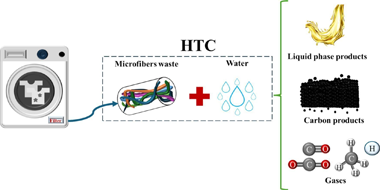
Microplastics are an emerging pollutant of concern. Many microplastics in the waters arise from washing synthetic textiles in residential and commercial washing machines. The present research evaluated the upcycling of this waste to carbon materials by hydrothermal carbonization. Real microfiber waste was collected using clothes washer and dryer microfilters. Via temperature and residence time screening…

Exploring the Synergistic Interaction between Nickel- and Ruthenium-Based Catalysts for Carbon Dioxide Methanation Reaction

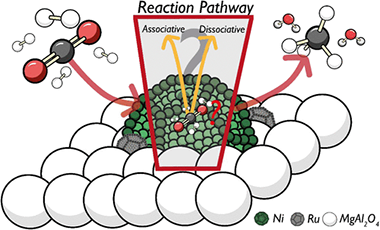
The utilization of nickel-ruthenium as bimetallic catalysts is widely recognized for its efficacy in enhancing the catalytic performance in the carbon dioxide methanation reaction. The present study focuses on the synergistic interplay between both active sites and their respective roles in the reaction mechanism through operando DRIFT-MS analysis. Findings reveal that the bimetallic catalyst is…

Treatment of Dairy Industry Wastewater and Crop Irrigation Water Using AgBr-Coupled Photocatalysts

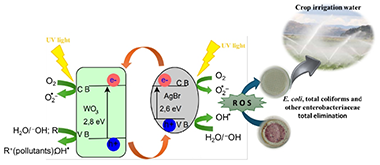
This work describes the application of three different AgBr heterojunctions with TiO2, SnO2 and WO3 in the treatment of two water sources: wastewater from a dairy industry facility (WDI) and water from a polluted river (WPR). All heterojunctions were widely characterised, and it was observed that the physicochemical properties of all the coupled materials were similar; however,…

Piezoelectric and Dielectric Response of BaTiO3/PVDF-TrFE Composites with High β-Phase Content

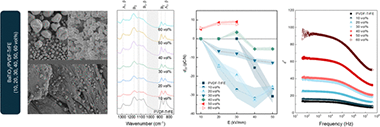
The search for flexible piezoelectric materials to build adaptable sensors, electronics, and nanogenerators has become a key area of interest. The addition of piezoceramic particles to piezoelectric polymers, such as the copolymer poly(vinylidene fluoride-trifluoroethylene) (PVDF-TrFE), is one of the strategies used to enhance the piezoelectric response. In this work, the effect of BaTiO3 content on…

Room-temperature cavity exciton-polariton condensation in perovskite quantum dots

The exploitation of the strong light-matter coupling regime and exciton-polariton condensates has emerged as a compelling approach to introduce strong interactions and nonlinearities into numerous photonic applications. The use of colloidal semiconductor quantum dots with strong three-dimensional confinement as the active material in optical microcavities would be highly advantageous due to their versatile structural and…

In situ growing of ZIF-8 crystals into TiO2 micro columnar films

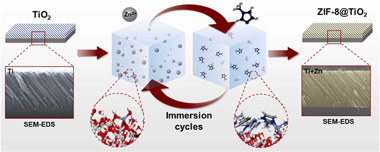
This study proposes a fast and simple method for the in situ growth of metal-organic frameworks (MOFs) on metal oxide substrates as an alternative to the traditional approaches of using gold substrates and self-assembled monolayers (SAMs). As a case study, zeolitic imidazolate framework 8 (ZIF-8) crystals were grown in micro columnar TiO2 films through simple…

Production of Barium Sulfide from Low-Grade Barite Ores

The manufacture of barium sulfide or barium salts (BaS, BaCl2, Ba (OH)(2), among others) requires high-purity barite ores (>90%). In this study, a new method to produce barium sulfide from low-grade barite ores (60% purity) is proposed. The method involves gravitational concentration of barite ore on a shaking table followed by mechanical activation of the…

Characterization of Coffee Waste-Based Biopolymer Composite Blends for Packaging Development

In recent years, coffee waste by-products have been incorporated into polymer blends to reduce environmental pollution. In this study, coffee parchment (CP) was incorporated into biodegradable polylactic acid (PLA) and poly (butylene adipate-co-terephthalate) (PBAT) polymer blends to prepare ribbons through the extrusion process. Extracted green coffee bean oil (CO) was used as a plasticizer, and…

Interfacial Chemistry Limits the Stability of Deep Blue Perovskite LEDs Revealed by Operando Characterization

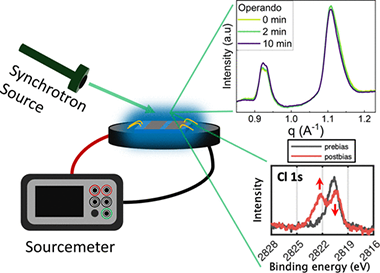
To commercialize lead halide perovskites as light-emitting diodes (LEDs), the operational device lifetime needs to be drastically improved. For this to be achieved, an understanding of degradation behavior under bias is crucial. Herein, we perform operando measurements of the structural, chemical, and electronic changes using synchrotron-based grazing-incidence wide-angle X-ray scattering and hard X-ray photoelectron spectroscopy…

A hypervalent metal MOF catalyst as an avenue to go beyond heterogeneous Fenton-like processes for organic contaminant removal in water

Metal-organic frameworks (MOFs) have recently been proposed as a plausible solution to the pressing issue of water scarcity and as a means of remediating contaminated water bodies. In light-assisted water treatment, they have so far only been exploited via the hydroxyl radical route, through Fenton-like processes. A new avenue is introduced here by the biomimetic…