Mechanical performance of sub-stoichiometric titanium carbide ceramics synthesized by a hybrid SHS and SPS methodology

Sub-stoichiometric titanium carbide ceramics were synthesized via a hybrid route combining self-propagating high-temperature synthesis (SHS) and spark plasma sintering (SPS). TiC1-x powders were produced through a single, rapid SHS step by the direct reaction of titanium and graphite, followed by attrition milling to achieve an average particle size of 3-5 mu m. Particular attention was…

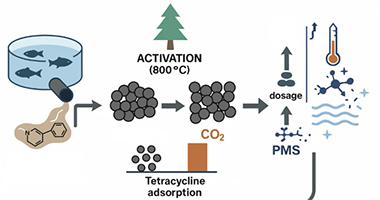
Upcycling pine-bark into powerful adsorbents: tetracycline removal from aquaculture effluents combining biochar and advanced oxidation processes

The presence of antibiotics in aquaculture wastewater poses environmental and public-health risks by disrupting aquatic ecosystems and promoting the spread of antibiotic-resistant bacteria. This study evaluates pine-bark biochars activated under different atmospheres for the removal of tetracycline from real aquaculture wastewater and examines their combined use with peroxymonosulfate as an oxidant. The biochars were produced…

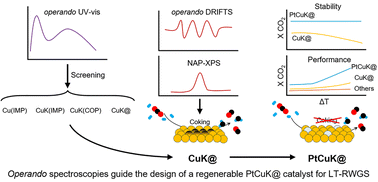
Spectroscopy-guided optimization of copper-based catalysts for low-temperature CO2 recycling to CO

The reverse water–gas shift (RWGS) reaction provides a sustainable route for CO2 valorization by producing CO, a key intermediate for various industrial applications. Its endothermic nature and the competition with Sabatier reaction impose a practical challenge on the design of low and medium temperature RWGS catalysts thus hampering its integration with downstream units. In this study,…

Clinical and Radiographic Outcomes of Vital Pulp Therapy Using Resin-Modified Versus Conventional Calcium Silicate-Based Materials: A Systematic Review and Meta-Analysis

Vital pulp therapy (VPT) is increasingly recognised as a biologically driven alternative to root canal treatment in teeth with deep caries and a vital pulp diagnosis. Resin-modified calcium silicate-based materials (RM-CSMs) were introduced to combine the bioactivity of traditional cements with improved handling and immediate light-curing, but their biological performance remains debated. Objectives: This systematic…

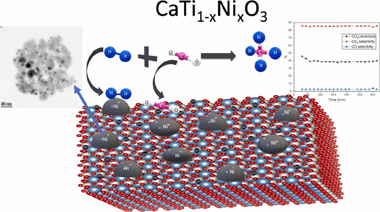
In situ generation of Ni particles from CaTi1-xNixO3 perovskites used in CO2 methanation

Ni nanoparticles were successfully generated from a CaTi1-xNixO3 perovskite structure and the effect of Ni substitution level, in the physicochemical characteristics and hence in its catalytic activity and stability in CO2 methanation reaction was evaluated. Particles were generated by a reduction process, where Ni particles were exsolved to perovskite surface. The samples were characterized by…

Exciton-Polaritons in Nanoscale Metal-Organic Frameworks: A Platform for the Reversible Modulation of Strong Light-Matter Coupling via the Chemical Environment

We demonstrate robust exciton-polariton formation in planar metallic optical cavities incorporating porphyrin-based Metal-Organic Framework (MOF) nanoparticles. Our fabrication strategy employs highly monodisperse fluorinated MOF nanoparticle monolayers, sequentially coated with transparent silicon dioxide nanoparticles, enabling precise control over film thickness while preserving MOF pore accessibility. This architecture ensures well-defined excitonic transitions and facilitates alignment of the…

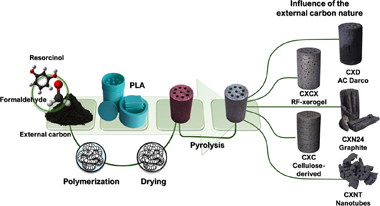
Influence of external carbon sources on the morpho-structural and mechanical properties of 3D-structured carbon monoliths

High purity carbon structured devices have been prepared by resorcinol-formaldehyde polycondensation in aqueous medium and alkaline conditions with starch as a binder and various external carbon sources. Polylactic acid (PLA) templates have been used to perform the structures which, after controlled and fixed pyrolysis conditions, generate 3D carbon devices with tuneable geometry and properties, as…

Persistent Luminescence Analysis in the Frequency Domain

Frequency-domain techniques offer a powerful means to disentangle overlapping physical processes with distinct characteristic timescales-yet remain underexplored in the context of complex photoluminescent materials. Here, frequency-domain analysis is applied to persistent luminescence (PersL) materials, which exhibit long-lasting emission following excitation due to charge trapping and detrapping processes spanning wide temporal ranges. Using SrAl2O4:Eu2(+),Dy3(+) (SAO:Eu,Dy) as…