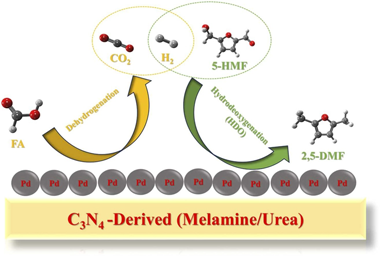
Formic acid dehydrogenation and use as H-donor in 5-hydroxymethylfur-fural hydrodeoxygenation over Pd/C3N4 catalysts

This work studies the behavior of a series of Pd/C3N4 catalyst in the reaction of formic acid dehydrogenation and the use of the latter as H-donor for 2,5-hydroxymethyl furfural hydrodeoxygenation. Firstly, a series of supports have been synthesized from melamine and urea as a function of precursors ratio and temperature of their condensation. The different…

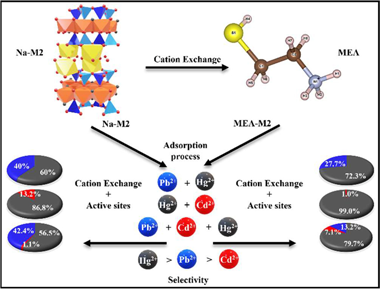
Multicomponent heavy metals adsorption on functionalized swelling micas: Mechanistic insights and structural evolution

Heavy metal contamination is a critical environmental issue, often involving complex multicomponent systems. Swelling brittle micas, a family of designer sorbents, have demonstrated exceptional heavy metal removal capabilities, yet their behabior in competitive adsorption systems remains largely unexplored. This study systematically investigates the simultaneous uptake of Pb2*, Cd2*, and Hg2* on both as-synthesized brittle mica…

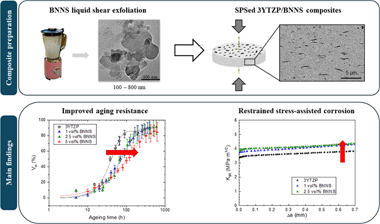
Boron nitride nanosheets as an effective strategy against the slow crack growth and hydrothermal ageing in zirconia composites

This paper explores the effectiveness of boron nitride nanosheets in preventing the premature failure of yttriastabilized tetragonal zirconia ceramics, particularly in humid environments. A simple, low-cost and scalable technique-shear exfoliation in a kitchen blender-was used to prepare BNNS, and pure zirconia and composites with 1, 2.5 and 5 vol. % BNNS were spark plasma sintered.…

Cellulose and xylan nanofiber mats via electrospinning: Lignin-enhanced properties in wood-inspired biocomposites

Nanofiber mats were fabricated by combining cellulose, xylan, and organosolv lignin. The biopolymers, and a small amount (15 wt. %) of polyethylene oxide, were dissolved in a mixture of trifluoroacetic acid and trifluoroacetic anhydride, then blended in various ratios (keeping cellulose as the main component and changing the proportions of lignin and hemicellulose) and processed…

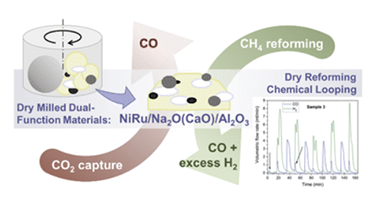
Integrated carbon capture and dry reforming of methane of mechanochemically synthesised dual-function materials

Herein we report a green mechanochemical synthesis with low energy input of dual-function materials for integrated CO2 capture and dry reforming of methane. The materials produced syngas during the CH4 step (up to 0.6 mmol g−1 CO and 7.7 mmol g−1 H2) and CO during the CO2 step (up to 3.1 mmol g−1) via the reverse Boudouard reaction due to the carbon…

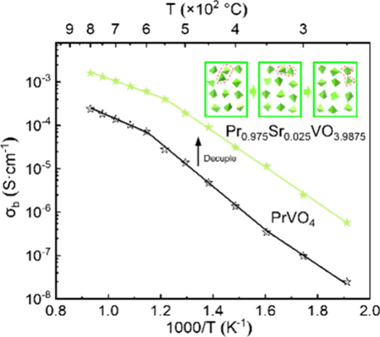
Enhanced Oxygen Ion Conductivity and Ionic Conduction Mechanistic Visualization in Tetragonal Zircon-Type Pr1-x Sr x VO4-0.5x

Oxide-ion conductors based on tetrahedral anion-related oxides have attracted considerable attention due to their high oxygen-ion conductivity and potential applications in clean energy devices, such as solid-state fuel cells. In this study, we report the improvement of oxide-ion conductivity by Sr2+ doping in isolated tetrahedral zircon-type PrVO4. It is found that Pr0.975Sr0.025VO4-delta features the highest…

Laser-Induced Graphene: A Promising Conductive Platform for Cell Culture

Cardiovascular mortality remains a major health challenge. Cardiomyocyte (CM)-based tissue engineering (TE) offers promising alternatives for developing therapies via in vitro models. However, the immature phenotype of CM in engineered tissues hampers progress. Recent studies introduce conductive materials like graphene to enhance CM maturation, but conventional graphene synthesis suffers from complexity, toxicity, and low yield.…

Boosting Hydrogen Release: Optimized C3N4-Supported Palladium Catalysts for Formic Acid Dehydrogenation

Carbon nitride, C3N4, was synthesized through thermal polycondensation of melamine with varying temperature and time conditions. This approach represents a cost-effective, straightforward, and environmentally friendly synthetic method with lower energy consumption to obtain hierarchically structured carbon nitride. The resulting materials were subjected to comprehensive characterization to analyze their crystalline structure, textural properties, composition, and light…

High piezoelectric performance in lead-free BCHT fine-grained ceramics synthesized by mechanochemistry

Lead-free piezoelectric ceramics (Ba1-xCax) (Ti1-yHfy)O-3 with stoichiometries close to the morphotropic phase boundary (MPB) were synthesized by high-energy ball milling. The influence of Hf and Ca contents and the sintering method (conventional and hot-press) on the piezoelectric, dielectric, and ferroelectric response was investigated. It was confirmed that the different phases stabilized at room temperature and…

Descriptors for Predicting Single- and Multi-Phase Formation in High-Entropy Oxides: A Unified Framework Approach

High-entropy oxides, HEOs, represent a relatively new class of ceramic materials characterized by the incorporation of multiple cations, typically four or more, into a single-phase crystal structure. This extensive compositional flexibility allows for the introduction of specific chemical elements into a crystal lattice that would normally be unable to accommodate them, making it difficult to…