Zn-MIL53(Fe) as an electro-Fenton catalyst: Application in organic pollutant degradation and pathogen inactivation

In this study, the potential of a bimetallic Metal-Organic Framework Zn-MIL53(Fe) for electro-Fenton catalysis was evaluated. After the material characterisation, its catalytic activity was validated in Fenton reaction to degrade a model organic pollutant: Rhodamine B. After that, the evaluation of Zn-MIL53(Fe) as electro-Fenton catalyst was performed and improved outcomes were reached by electro-Fenton regarding…

Mechanisms of De-icing by Surface Rayleigh and Plate Lamb Acoustic Waves

Acoustic waves (AW) have recently emerged as an energy-efficient ice-removal procedure compatible with functional and industrial-relevant substrates. However, critical aspects at fundamental and experimental levels have yet to be disclosed to optimize their operational conditions. Identifying the processes and mechanisms by which different types of AWs induce de-icing are some of these issues. Herein, using…

Advances in Hybrid Icing and Frosting Protection Strategies for Optics, Lens, and Photonics in Cold Environments Using Thin-Film Acoustic Waves

Fogging, icing, or frosting on optical lenses, optics/photonics, windshields, vehicle/airplane windows, and solar panel surfaces have often shown serious safety concerns with hazardous conditions and impaired sight. Various active techniques, such as resistive heating, and passive techniques, such as icephobic treatments, are widely employed for their prevention and elimination. However, these methods are not always…

Microstructural control by freeze-casting of CaO architectures for improved and stable thermochemical energy storage performance

This study investigates the development of porous calcium-based monoliths via freeze-casting (FC) as a novel approach for thermochemical energy storage, particularly within the Calcium Looping (CaL) process. The freeze-casting technique enabled the fabrication of scaffolds with controlled porosity using polyvinyl alcohol (PVA) as a binder. Experimental results demonstrated that freeze-cast monoliths exhibited superior multicycle performance…

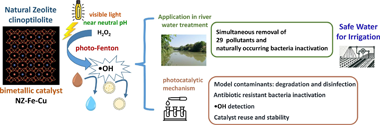
From the lab to the river: Bimetallic clinoptilolite photocatalyst for antibiotic-resistant bacteria and emerging contaminants removal

The presence of contaminants of emerging concern and antibiotic-resistant bacteria in aquatic environments is a major global challenge. Heterogeneous photo-Fenton-type treatments have proven effective; however, affordable and sustainable catalysts are needed to address real-world water treatment challenges. For the first time, we report the efficacy of a heterogeneous bimetallic Fe-Cu clinoptilolite catalyst, which can remove…

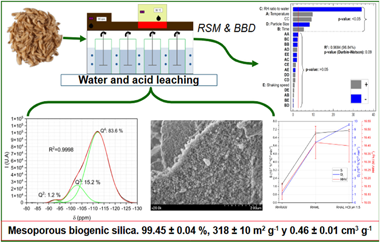
Comprehensive understanding of the experimental factors determining the leaching of rice husk, and their effect on the thermochemical properties and characteristics of bio-silica

Leaching is a pretreatment that removes ionic species responsible for undesired reactions during biomass thermochemical transformation. Despite numerous reported leaching conditions, the impact of specific factors on ionic species removal remains insufficiently understood for widespread application. This study investigates the relationship between experimental factors and their optimal levels in aqueous medium, focusing on the effects…

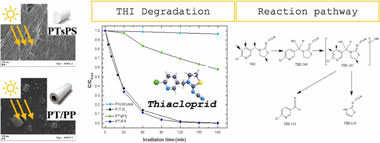
Solar light-driven degradation of thiacloprid by polymer composites based on P-doped TiO2 as photoactive phase: Theoretical and experimental assessment of the reaction mechanism and degradation pathway

In this paper, visible light-activated phosphorus-doped TiO2 (P-TiO2) was used as a photoactive phase to prepare polymer composites for the degradation of the pesticide thiacloprid under direct sunlight irradiation. In particular, a monolithic composite aerogel, consisting of P-TiO2 embedded in syndiotactic polystyrene (PTsPS), and a composite polymer film, consisting of P-TiO2 immobilized on the surface…

An efficient strategy for simultaneous gold deposition and obtention of hierarchical Au/TS-1 applied to liquid-phase propylene epoxidation

A novel and straightforward one-step method has been developed for the controlled deposition of gold nanoparticles (AuNPs) with uniform diameters onto the titanosilicate (TS-1) zeolitic surface via a direct anionic exchange (DAE) approach. This innovative process simultaneously introduces auxiliary mesoporosity into the zeolite framework, overcoming critical limitations associated with traditional microporous catalysts, including diffusion constraints…