A theoretical reassessment of the onset of plastic deformation in single crystals: beyond the Estrin-Kubin framework1

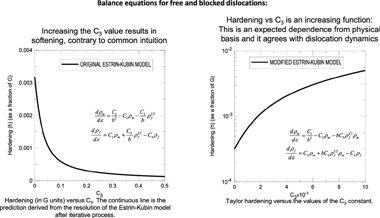
Dislocations are the fundamental carriers of plastic deformation in single crystals. Their multiplication, interaction, mutual blocking, and annihilation collectively govern the material’s plastic response across all strain regimes. Classical modeling approaches, such as the Kocks-Mecking and Estrin-Kubin formulations, aim to capture these mechanisms through balance equations for free and blocked dislocations. This manuscript develops a…

Catalyzed hydrothermal carbonization of sewage sludge: structural modification of hydrochar and its derived selective pyrolytic product distribution

  The pressing demand for sustainable alternatives to fossil fuels coupled with environmental risks associated with inappropriate sewage sludge (SS) disposal calls for innovative valorization strategies that transform waste into value-added products. This study introduces a novel approach by directly incorporating zeolite catalysts (HZSM-5 and USY) into the hydrothermal carbonization (HTC) of SS, followed by…

AgBr and Ag3PO4 Coupled with TiO2 as Active Powder Photocatalysts and Glass Coatings

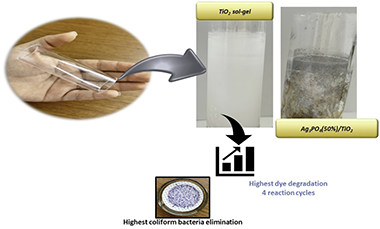
  In this work, different materials based on TiO2 coupled with either AgBr or Ag3PO4 were synthesized. The Ag3PO4(50%)/TiO2 powder photocatalyst prepared by deposition-precipitation method showed higher antimicrobial activity than the bare TiO2 and also than the same coupled powder obtained by sol-gel method. This material achieved 100% E. coli, coliforms, and other enterobacteria elimination.…

Enhanced photocatalytic degradation of organic pollutants in water by g-C3N4/N-TiO2/Y1.97SiO5:Ce0.03 heterostructure

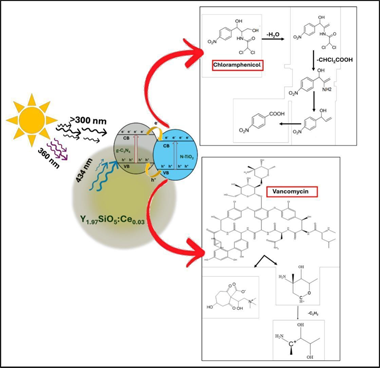
A novel ternary heterostructure based on g-C3N4/N-TiO2/Y1.97SiO5:Ce-0.03 was synthesized via thermal treatment and evaluated for the photocatalytic degradation of two antibiotic pollutants, chloramphenicol (CAP) and vancomycin (VAN), in aqueous solution. The composite was designed to function as a photoactive platform, in which Ce3+-doped Y2SiO5 acts as an internal light converter, emitting at similar to 430…

Enhancing the Photocatalytic Performance of WO3/AgBr Composites Through the Incorporation of Olive Waste-Derived Biochar Obtained Under Controlled Pyrolysis Conditions

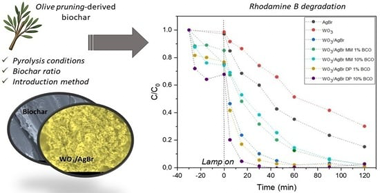
The integration of biochars into photocatalytic systems to increase their efficiency in the degradation of different pollutants in water has gained attention in recent years. However, systematic studies on optimizing biochar properties for photocatalysis remain limited. This work explores the incorporation of biochar from olive pruning (BCO), produced via CO2 pyrolysis at 800 °C, into WO3/AgBr…

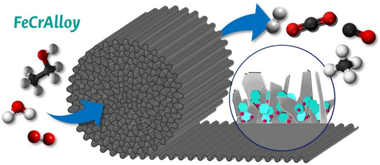
Catalytic performance of NiCo-CePr oxide on FeCrAlloy micromonoliths in hydrogen production by oxidative steam reforming of ethanol

The conformation of a NiCo catalyst promoted by CePr on FeCrAlloy thermally pretreated micromonoliths was investigated via washcoating using a colloidal suspension of the catalytic precursor (hydrotalcite, HT) without the use of additives. A high affinity was established between the nature of the reconstructed HT and the layer of the formed alumina microstructures obtained after…

Green exfoliation of 2D nanomaterials using cyrene as a solvent

Liquid-phase exfoliation (LPE) is a versatile and scalable method for producing high-quality two-dimensional materials (2DMs). However, commonly used solvents such as dimethylformamide (DMF) or N-methyl-2-pyrrolidone (NMP) are highly toxic, limiting their potential for large-scale industrial applications. In this study, we address this challenge using Cyrene (dihydrolevoglucosenone), a nontoxic and biodegradable solvent, for the exfoliation of several…

Ammonia to Hydrogen Conversion in a Ferroelectric Packed-Bed Plasma Reactor: The Effect of a High-Permittivity Effective Medium Material

  Herein we report about the ammonia to hydrogen conversion induced at ambient conditions in a ferroelectric barrier discharge plasma. Decomposition yields of 40% have been found at 2.5 kV of applied voltage in a packed-bed reactor moderated with ferroelectric PZT pellets, bared and coated with layers of agglomerated Al2O3 and Ru/Al2O3 powders. The electrical…

Sodium lanthanide tungstate-based nanoparticles as bimodal probes for T1-T2 magnetic resonance imaging and X-ray computed tomography

  Magnetic resonance imaging (MRI) is one of the most commonly used imaging techniques for diagnosis in clinics. Often, magnetically-active substances, called contrast agents (CAs), have to be used, which increase contrast by shortening the longitudinal (T1) (resulting in signal enhancement in T1-weighted images) and/or transverse (T2) (resulting in signal decay in T2-weighted images) relaxation…