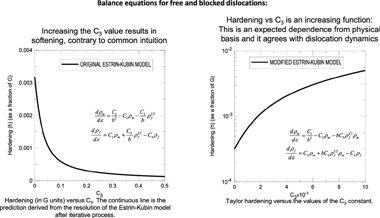
Dislocations are the fundamental carriers of plastic deformation in single crystals. Their multiplication, interaction, mutual blocking, and annihilation collectively govern the material’s plastic response across all strain regimes. Classical modeling approaches, such as the Kocks-Mecking and Estrin-Kubin formulations, aim to capture these mechanisms through balance equations for free and blocked dislocations. This manuscript develops a mathematical framework enabling an analytical solution to the Estrin-Kubin equations in both the low- and high-strain limits. The analysis reveals that the model’s validity is confined to a narrow range of parameter values. More critically, the dislocation capture term-intended to account for work hardening-fails to reproduce the observed hardening behavior at early strain stages. The theoretical predictions diverge significantly from experimental observations. In response, an alternative model is proposed, which addresses the limitations of the Estrin-Kubin formulation. Notably, the new model preserves inversion symmetry, a fundamental physical property absents in the original equations.