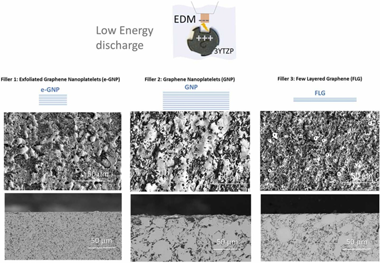
Highly efficient electrical discharge machining of yttria-stabilized zirconia ceramics with graphene nanostructures as fillers

Electrical-discharge machining (EDM) of advanced ceramics allows the miniaturization of parts with complex shapes. Since electrical conductivity is required, non-conductive ceramics need a conductive second phase. This work assesses the feasibility of industrial EDM in advanced yttria-stabilized tetragonal zirconia (3YTZP) composites with 20 vol% graphene nanostructures with different morphology using different EDM energies. The structural integrity of the graphene nanostructures,…

Enhanced red-UC luminescence through Ce3+ co-doping in NaBiF4:Yb3+/Ho3+(Er3+)/Ce3+ phosphors prepared by ultrafast coprecipitation approach

Series of Yb3+/Ho3+(Er3+)/Ce3+ co-doped NaBiF4 phosphors were synthesized through an ultrafast co-precipitation reaction technique at room temperature. The effect of the Ce3+ ions on the crystal structure and upconversion (UC) luminescence properties of the studied samples were investigated in detail. FTIR and XPS demonstrated the pre-formation of NaBiF4 and the introduction of Yb3+, Ho3+, Er3+ and Ce3+ all as dopants in…

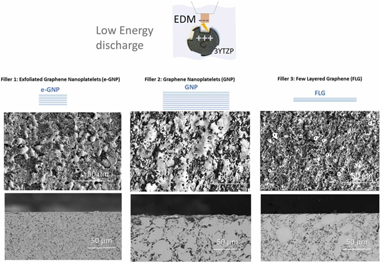
Highly efficient electrical discharge machining of yttria-stabilized zirconia ceramics with graphene nanostructures as fillers

Electrical-discharge machining (EDM) of advanced ceramics allows the miniaturization of parts with complex shapes. Since electrical conductivity is required, non-conductive ceramics need a conductive second phase. This work assesses the feasibility of industrial EDM in advanced yttria-stabilized tetragonal zirconia (3YTZP) composites with 20 vol% graphene nanostructures with different morphology using different EDM energies. The structural integrity of the graphene nanostructures,…

Design and Characterization of ITO-Covered Resonant Nanopillars for Dual Optical and Electrochemical Sensing

In this work we present a dual optical and electrochemical sensor based on SiO2/Si3N4 resonant nanopillars covered with an indium tin oxide (ITO) thin film. A 25-30 nm thick ITO layer deposited by magnetron sputtering acts as an electrode when incorporated onto the nanostructured array, without compromising the optical sensing capability of the nanopillars. Bulk…

Oxygen production routes assessment for oxy-fuel combustion

Oxyfuel combustion is a promising alternative to decarbonize the power sector. However, the main barrier to commercial deployment of the technology is the high energy consumption associated with oxygen production (-200-300 kWh per ton of O-2), which penalizes the thermal-to-electric efficiency of 8.5-12% compared to traditional air combustion plants. Typically, oxygen is obtained from a cryogenic air separation process. However, other technologies have been…

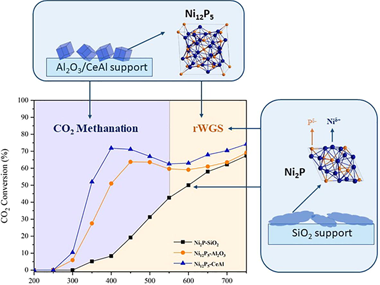
Ni-Phosphide catalysts as versatile systems for gas-phase CO2 conversion: Impact of the support and evidences of structure-sensitivity

We report for the first time the support dependent activity and selectivity of Ni-rich nickel phosphide catalysts for CO2 hydrogenation. New catalysts for CO2 hydrogenation are needed to commercialise the reverse water-gas shift reaction (RWGS) which can feed captured carbon as feedstock for traditionally fossil fuel-based processes, as well as to develop flexible power-to-gas schemes…

Sustainable routes for acetic acid production: Traditional processes vs a low-carbon, biogas-based strategy

The conversion of biogas, mainly formed of CO2 and CH4, into high-value platform chemicals is increasing attention in a context of low-carbon societies. In this new paradigm, acetic acid (AA) is deemed as an interesting product for the chemical industry. Herein we present a fresh overview of the current manufacturing approaches, compared to potential low-carbon…

Pre-Roman and Republican amphorae (III-I centuries b.C.) from production contexts of the Guadalquivir Basin: technical and compositional characterization

The present work consists of an archaeometric investigation concerning ceramic samples, mostly unpublished, of the III-I centuries b.C. They were found in connection with kilns of the city of Sevilla (Archbishop’s Palace) and the countryside (Arrabal zone, Carmona). They are identified with evolved variations of Iron Age amphorae of Punic and Turdetanian tradition, or already…