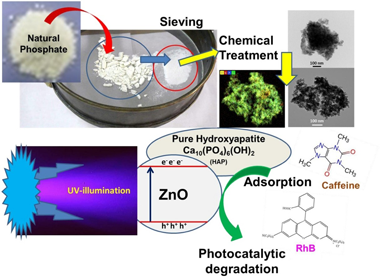
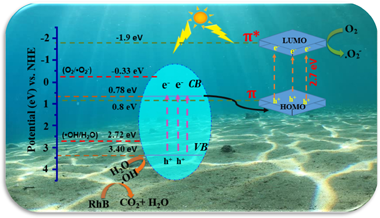
Fast photodegradation of rhodamine B and caffeine using ZnO-hydroxyapatite composites under UV-light illumination

Zinc oxide-hydroxyapatite composites were prepared using wet impregnation method. Firstly, a natural phosphate ore rich in silica and calcium phosphate was sieved to separate silica phase from phosphate phase. Then, through a chemical precipitation method, a pure hydroxyapatite (HAP) was obtained, which was used as a support for ZnO immobilization and applied for the photodegradation…

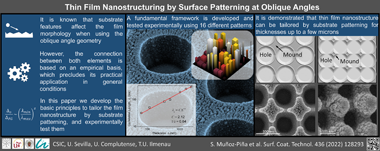
Thin film nanostructuring at oblique angles by substrate patterning

It is demonstrated that, besides classical nanocolumnar arrays, the oblique angle geometry induces the growth of singular structures in the nanoscale when using wisely designed patterned substrates. Well-ordered array of crosses, cylindrical nanorods or hole structures arranged in square or hexagonal regular geometries are reported as examples, among others. The fundamental framework connecting substrate topography…

Ageing-resistant zirconia/graphene-based nanostructures composites for use as biomaterials

This work explores the incorporation of graphene-based two-dimensional nanostructures as moisture barriers to delay hydrothermal ageing of yttria-stabilized zirconia and strengthen its use in biomedical applications. Two sets of highly dense zirconia composites incorporating multilayered graphene with very different lateral dimensions, few layer graphene and exfoliated graphene nanoplatelets, were prepared. The effect of the addition of graphene nanostructures on…

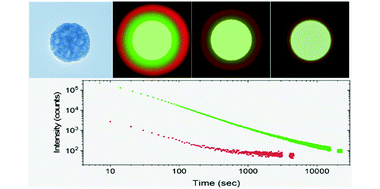
Transparent Phosphor Thin Films Based on Rare-Earth-Doped Garnets: Building Blocks for Versatile Persistent Luminescence Materials

Afterglow properties of persistent phosphors are attracting a great deal of attention in the fields of bioimaging, sensing, labeling, safety, or security. Complex garnet oxides, especially those doped with Ce3+ and Cr3+, are particularly relevant to this end since their persistent luminescence can be tuned through matrix composition and activated by visible light, in contrast to…

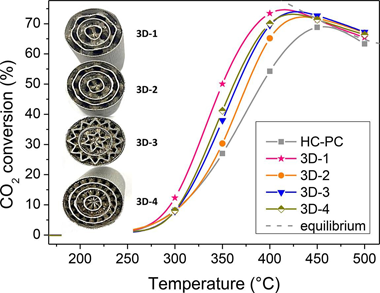
3D-printed structured catalysts for CO2 methanation reaction: Advancing of gyroid-based geometries

This work investigates the CO2 methanation rate of structured catalysts by tuning the geometr y of 3D-printed metal Fluid Guiding Elements (FGEs) structures based on periodically variable pseudo-gyroid geometries. The enhanced performance showed by the structured catalytic systems is mostly associated with the capability of the FGEs substrate geometries for efficient heat usages. Thus, variations…

QUEELS: Software to calculate the energy loss processes in TEELS, REELS, XPS and AES including effects of the core hole

We present the user-friendly and freely available software package QUEELS (QUantitative analysis of Electron Energy Losses at Surfaces) that allows to calculate effective inelastic scattering cross sections within the dielectric response description, for swift electrons travelling nearby surfaces in several environments. We briefly describe the underlying theoretical models and illustrate its use to evaluate the…

Highly uniform Y3Al2Ga3O12-based nanophosphors for persistent luminescence bioimaging in the visible and NIR regions

In the last few years, persistent phosphors with a garnet crystal structure have attracted a great deal of interest for a plethora of applications ranging from bioimaging to anti-counterfeiting technologies. However, the development of synthesis methods to fabricate uniform garnet-based micro and nanoparticles, that are needed for such applications, is not mature at all. This…

Z-scheme WO3/PANI heterojunctions with enhanced photocatalytic activity under visible light: A depth experimental and DFT studies

A WO3@PANI heterojunction photocatalyst with a various mass ratio of polyaniline to WO3 was obtained via the in situ oxidative deposition polymerization of aniline monomer in the presence of WO3 powder. The characterization of WO3@PANI composites was carried via X-ray diffraction (XRD), scanning electron microscopy (SEM-EDS), transmission electron microscopy (TEM), Fourier transform infrared spectroscopy (FT-IR), ultraviolet–visible diffuse…

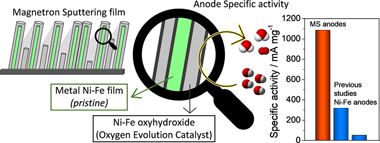
Ionomer-Free Nickel-Iron bimetallic electrodes for efficient anion exchange membrane water electrolysis

A bottleneck for the deployment of the Anion Exchange Membrane Water Electrolysis (AEMWE) is the manufacturing of efficient and long lasting anodes and cathodes for the cells. Highly performant bimetallic Ni/Fe catalyst films with various atomic ratios have been prepared by magnetron sputtering in an oblique angle configuration (MS-OAD) and used as anodes for AEMWE.…