


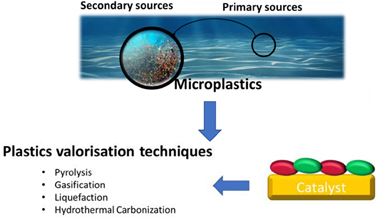
Materials challenges and opportunities to address growing micro/ nanoplastics pollution: a review of thermochemical upcycling

Micro/nanoplastics have sparked attention in recent years due to their widespread presence in the environment. Currently, several waste valorization approaches are under development in order to upcycle micro/nanoplastics. Thermal conversion technologies such as pyrolysis, gasification, liquefaction, or hydrothermal carbonization can yield high-value solid products, oil, and gases from plastics waste. The common thermal conversion technologies…

Development of Power-to-X Catalytic Processes for CO2 Valorisation: From the Molecular Level to the Reactor Architecture

Nowadays, global climate change is likely the most compelling problem mankind is facing. In this scenario, decarbonisation of the chemical industry is one of the global challenges that the scientific community needs to address in the immediate future. Catalysis and catalytic processes are called to play a decisive role in the transition to a more…

CO2 methanation on Ni/YMn1-xAlxO3 perovskite catalysts

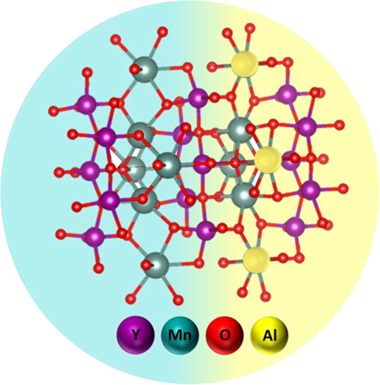
Seeking for advanced catalytic systems for the CO2 methanation reaction, the use of Ni supported catalysts over redox materials is often proposed. Profiting the superior redox properties described for layered perovskite systems, this work has investigated a series Ni supported YMn1-xAlxO3 (x = 0, 0.2, 0.5, 0.8, 1) perovskite catalysts. The obtained results evidenced the…

Assessment of pilot-plant scale solar photocatalytic hydrogen generation with multiple approaches: Valorization, water decontamination and disinfection

The main goal of the present study was to explore pilot-scale combination of H-2 generation with simultaneous water disinfection or decontamination. Performance of a TiO2-CuO mixture for solar-to-hydrogen (STH) con-version was studied, focusing on treatment optimization (catalyst dose, proportion of semiconductors in the mixture and concentration of the sacrificial agent). Experiments were performed in a…

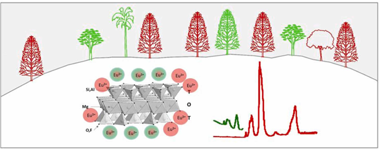
Exploring the local environment of the engineered nanoclay Mica-4 under hydrothermal conditions using Eu(3+)as a luminescent probe

High charge mica Na4Al4Si4Mg6O20F4 , Mica-4, is a promising candidate as a filling material to immobilize high-level radioactive waste in deep geological repositories due to its extraordinary adsorption capacity. In contrast to traditional clay materials, the structural composition of this mica, with a high content of alu-minum in the tetrahedral sheet, enhances its chemical reactivity,…

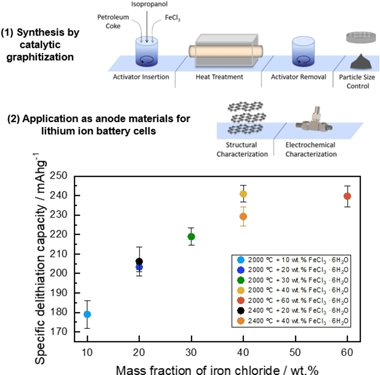
Insights into the Impact of Activators on the ‘Catalytic’ Graphitization to Design Anode Materials for Lithium Ion Batteries

In this work, we systematically investigate the ‘catalytic’ graphitization of a biomass precursor (coffee ground) using 10-60 wt.% of the activator iron (III) chloride hexahydrate in a temperature range of 1000 degrees C-2400 degrees C. Special focus is put on the correlation of synthesis conditions, e.g., heat treatment temperature and mass fraction of iron chloride,…

Biopolymer-Based Films Reinforced with FexOy-Nanoparticles

Nowadays, natural polymer-based films are considered potentially environmentally friendly alternatives to conventional plastic films, due to many advantageous properties, including their easy processability, high flexibility, non-toxicity, low cost, high availability, and environmental safety. However, they are limited in their application by a number of shortcomings, including their high water solubility and vapor permeability as well…

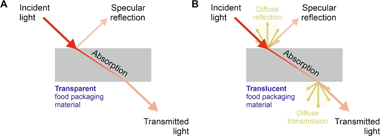
Transparency of polymeric food packaging materials

Transparency is a very important technical parameter to evaluate and validate certain food packaging materials. In the recent scientific literature, several methods (i.e. transmittance, opacity, haze, and absorbance) have been used and such variety hinders a direct comparison of results from different authors. In this Review, we describe and discuss the most widely employed methods…