(NH4)4[NiMo6O24H6].5H2O / g-C3N4 materials for selective photo-oxidation of Csingle bondO and Cdouble bondC bonds

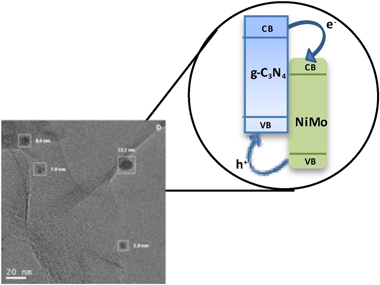
Novel composite photo-catalysts having (NH4)(4)[NiMo6O24H6]center dot 5H(2)O Polyoxometalate (POM) species deposited over g-C3N4 are synthesized. Materials were characterized through a multitechnique approach showing the stability of the carbon nitride component both through the synthesis process and under reaction. Contrarily, the POM component evolves under reaction conditions to maximize the interaction with the support. Such a…

Influence of Water on the Oxidation of NO on Pd/TiO2 Photocatalysts

Two series of new photocatalysts were synthesized based on modification with Pd of the commercial P25 photocatalyst (EVONIK®). Two techniques were employed to incorporate Pd nanoparticles on the P25 surface: photodeposition (series Pd-P) and impregnation (series Pd-I). Both series were characterized in depth using a variety of instrumental techniques: BET, DRS, XRD, XPS, TEM, FTIR…

Control of experimental conditions in reaction flash-sintering of complex stoichiometry ceramics

The inherent potential of reaction flash-sintering for the preparation of complex oxides is evidenced by the one-step synthesis and densification of a ceramic of complex stoichiometry. The system Bi0.93La0.07FeO3, a multi-ferroic ceramic with promising technological applications, has been chosen. This system presents three different metals in its composition and it is extremely challenging to prepare…

Ru-Ni/MgAl2O4 structured catalyst for CO2 methanation

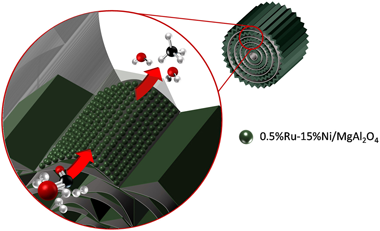
Novel catalytic systems should be tested for the valorization of CO2 through the Sabatier reaction, since this process is gaining great importance within strategic sectors of the chemical industry. Therefore, this work explores the feasibility of structuring a catalyst (0.5%Ru-15%Ni/MgAl2O4) for CO2 methanation using metal micromonoliths. The coating of the catalyst over the surface of…

Wetting and spreading of liquid lithium onto nanocolumnar tungsten coatings tailored through the topography of stainless steel substrates

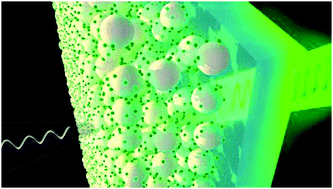
The use of liquid metal as an alternative to cover the plasma-exposed areas of fusion reactors has called for the development of substrates where refilling and metal spreading occur readily and at reasonably low temperatures. In the search for common materials for this purpose, we show that nanostructured tungsten coatings deposited on stainless steel (SS)…

Characterization, thermal and ceramic properties of phyllite clays from southeast Spain

The present research studied a set of phyllite clays from several deposits in southeast Spain. These phyllite clays have traditionally been used as sealing material to impermeabilize roofs, embankments, ponds, construction and waste landfill, with recent applications in the preparation of new mortars. However, studies on thermal behaviour and ceramic properties of phyllite clays have been scarce. The present research showed a summary of previous characterization studies on representative phyllite clays from these deposits with additional results. Mineralogical, by X-ray diffraction, and chemical,…

Thin film electroluminescent device based on magnetron sputtered Tb doped ZnGa2O4 layers

Photoluminescent (PL) layers and electroluminescent (EL) systems prepared by different methods have been systematically studied for the fabrication of flat panel displays, monitoring screens, and lighting systems. In this work we report about a new procedure of preparing Tb doped ZnGa2O4 green luminescent thin films at low temperature that consists of the simultaneous reactive magnetron…

Efficient third harmonic generation from FAPbBr(3) perovskite nanocrystals

The development of versatile nanostructured materials with enhanced nonlinear optical properties is relevant for integrated and energy efficient photonics. In this work, we report third harmonic generation from organic lead halide perovskite nanocrystals, and more specifically from formamidinium lead bromide nanocrystals, ncFAPbBr(3), dispersed in an optically transparent silica film. Efficient third order conversion is attained…

High-temperature solar-selective coatings based on Cr(Al)N. Part 2: Design, spectral properties and thermal stability of multilayer stacks

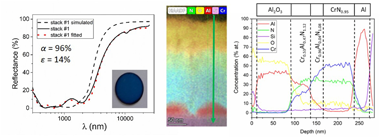
Two multilayer solar selective absorber coatings [Al/CrN0.95/Cr0.96Al0.04N1.08/Cr0.53Al0.47N1.12/Al2O3 (stack #1) and Cr0.96Al0.04N0.89/Cr0.62Al0.38N1.00/Cr0.53Al0.47N1.12/Al2O3 (stack #2)] were deposited on 316L steel by combining direct current (DC) and high power impulse magnetron sputtering (HiPIMS) technologies with the aim of increasing the working limit temperature. The composition and thickness of the constituent layers were optimized using CODE software to achieve…