Study of the phenol photocatalytic degradation over TiO2 modified by sulfation, fluorination, and platinum nanoparticles photodeposition

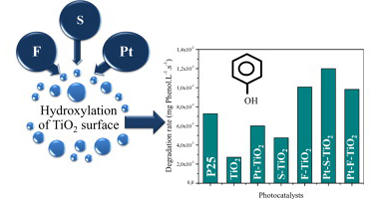
In this work, titanium dioxide has been modified by sulfation, fluorination and simultaneous Pt nanoparticles deposition; the influence of these treatments on the photocatalytic activity of this oxide has been studied. A complete characterization study was carried out and it was observed that sulfation, fluorination and metallization were important factors influencing the TiO2 properties. The photocatalytic…

High-temperature deformation of fully-dense fine-grained boron carbide ceramics: Experimental facts and modeling

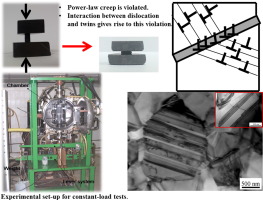
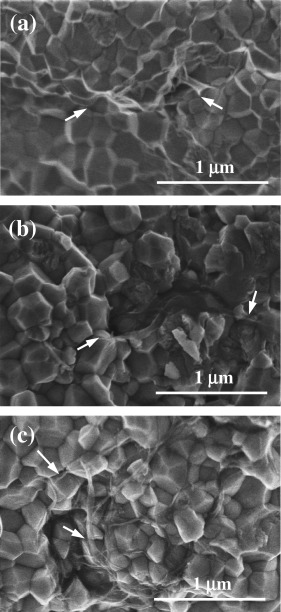
Boron carbide ceramics are the hardest material in Nature after diamond and the cubic phase of boron nitride. Due to this fact, their room-temperature fracture properties are the object of intense research. Paradoxically, high-temperature deformation is essentially unknown, because very high temperatures and stresses are necessarily required and high-quality specimens have not been available until…

Impact of hydrothermal treatment of FEBEX and MX80 bentonites in water, HNO3 and Lu(NO3)(3) media: Implications for radioactive waste control

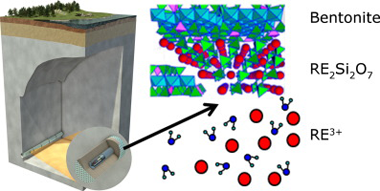
Engineered barriers of deep geological repositories (DGR) are commonly constructed with bentonite. FEBEX and MX80 bentonites have been selected by different countries as reference materials for the sealing of repositories; however, their chemical reactivity with high-level long-lived radioactive wastes (HLRW) under subcritical conditions had not been explored before. The hydrothermal stability in neutral and acid…

Cu–TiO2 systems for the photocatalytic H2 production: Influence of structural and surface support features

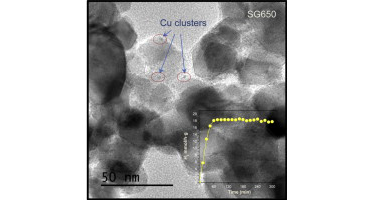
The influence of different TiO2 supports on the Cu active species has been studied. It was found that the photocatalytic H2 evolution is highly affected by the structural and electronic features of surface Cu species. Thus, metal dispersion and oxidation state appears strongly conditioned by the structural and surface properties of the TiO2 support. We have examined three…

Efficient synthesis of ammonia from N-2 and H-2 alone in a ferroelectric packed-bed DBD reactor

A detailed study of ammonia synthesis from hydrogen and nitrogen in a planar dielectric barrier discharge (DBD) reactor was carried out. Electrical parameters were systematically varied, including applied voltage and frequency, electrode gap, and type of ferroelectric material (BaTiO3 versus PZT). For selected operating conditions, power consumption and plasma electron density were estimated from Lissajous…

Design and realization of transparent solar modules based on luminescent solar concentrators integrating nanostructured photonic crystals

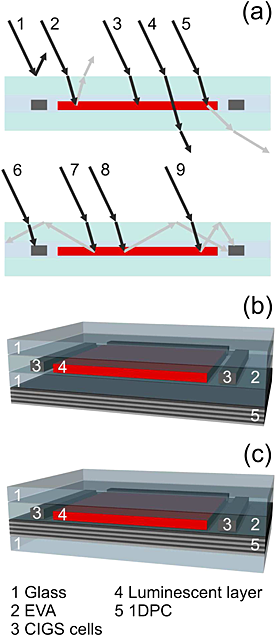
Herein, we present a prototype of a photovoltaic module that combines a luminescent solar concentrator integrating one-dimensional photonic crystals and in-plane CuInGaSe2 (CIGS) solar cells. Highly uniform and wide-area nanostructured multilayers with photonic crystal properties were deposited by a cost-efficient and scalable liquid processing amenable to large-scale fabrication. Their role is to both maximize light…

Atomic scale characterization of SiO2/4H-SiC interfaces in MOSFETs devices

The breakthrough of 4H-SiC MOSFETs is stemmed mainly due to the mobility degradation in their channel in spite of the good physical intrinsic material properties. Here, two different n-channel 4H-SiC MOSFETs are characterized in order to analyze the elemental composition at the SiC/SiO2 interface and its relationship to their electrical properties. Elemental distribution analyses performed by EELS…